Natural Language UnderstandingSymbolic Representing of Language

Natural Language
Understanding
Symbolic Representing
of Language
Understanding
Symbolic Representing
of Language
Mingming Sun
BIMSA
Outline

Outline
Symbolic Structures of Language
History of Symbolic Language Representation
Case Studies:
Noam Chomsky’s Generative Grammar
Dependency Grammar
Open Information Annotation
Coreference
Semantic Relationship Between Sentences
Obtain the Symbolic Representation
1.1 Symbolic Representation of Language 1.1.1 Symbolic Structures of Language
1.1 Symbolic Representation of Language 1.1.1 Symbolic Structures of Language
Symbolic Structures of Language
Symbolic Structures of Language
Corpus
Document
Paragraph
Sentence
Chunk
Word
Morpheme
Character
Character, Morpheme, Word
Character, Morpheme, Word
Category | English | Chinese |
Character | A letter (e.g., 'a', 'b', 'c') has no meaning by itself. | A character (e.g., '水', '火', '学') often has meaning by itself. |
Morpheme | The smallest meaningful unit (e.g., 'un-', 'run', '-ing'). | A character or a combination of characters that carries meaning (e.g., '学' in '学习', '化' in '现代化'). |
Word | A combination of morphemes that forms a complete meaning (e.g., 'running', 'unhappy'). | Usually a compound word combining multiple morphemes (e.g., '电脑' from '电' + '脑'). |
Word, Chunk, Sentence
Word, Chunk, Sentence
Category | Definition | English Examples | Chinese Examples |
Word | A combination of morphemes forming a meaningful unit. | 'computer', 'running' | '电脑' , '跑步' |
Chunk | A group of words forming a meaningful phrase but not a full sentence. | 'the big house', 'eating lunch' | '漂亮的房子', '吃午饭' |
Sentence | A complete grammatical structure expressing a full thought. | 'I am reading a book.' | '南京市长江大桥' |
Sentence, Paragraph, Document, Corpus
Sentence, Paragraph, Document, Corpus
Category | Definition | Note |
Sentence | A complete grammatical structure expressing a full thought. | |
Paragraph | A collection of related sentences forming a coherent unit. | Sentences in it are related and not independent. |
Document | A structured collection of paragraphs forming a complete text. | Paragraphs in it are related and not independent. |
Corpus | A large collection of documents used for linguistic or computational analysis. | The documents are generally considered independent. |
Studies on the Symbolic Representation
Studies on the Symbolic Representation
Where the elements and structure come from.
How lower-level elements form and constitute the upper structure.
What is the relationship between elements in the same layer.
1.1 Symbolic Representation of Language 1.1.2 History of Symbolic Language Representation
1.1 Symbolic Representation of Language 1.1.2 History of Symbolic Language Representation
Early Formal Representations in Linguistics—— Ferdinand de Saussure (1857–1913): Structuralism
Early Formal Representations in Linguistics—— Ferdinand de Saussure (1857–1913): Structuralism
A sign is the basic unit of meaning in language.It consists of:
Signifier (signifiant): The sound pattern or written form (e.g., the word “tree”).
Signified (signifié): The concept or meaning associated with the signifier (the mental image of a tree).
Structural Relationships in Language
Syntagmatic relations: How words are arranged in a sequence (e.g., word order in a sentence).
Paradigmatic relations: How words can be substituted for one another in a given context (e.g., synonyms or different tenses of a verb). In “The cat sleeps,” the word “cat” can be substituted with “dog” (paradigmatic), while “sleeps” follows the subject “cat” (syntagmatic).
Formal Grammar and Symbolic Syntax——Noam Chomsky (1950s–Present): Generative Grammar
Formal Grammar and Symbolic Syntax——
Noam Chomsky (1950s–Present): Generative Grammar
Noam Chomsky (1950s–Present): Generative Grammar
Phrase Structure Rules & Context-Free Grammar (CFG)
Chomsky introduced formal grammar rules that generate valid sentences.
Example: S → NP VP;NP → Det N;VP → V NP
Generates sentences like “The cat chased the mouse.”
Deep Structure vs. Surface Structure
A sentence has an underlying deep structure (logical meaning) and a surface structure (actual words).
Example: “John is easy to please” vs. “John is eager to please” (different deep structures despite similar surface structures)
Transformational Grammar
Introduces transformations (e.g., passive voice) to explain structural variations.
Example: “The boy saw the girl” → “The girl was seen by the boy.”
Dependency Grammar and Semantic Structures—— Lucien Tesnière (1959): Dependency Grammar
Dependency Grammar and Semantic Structures
—— Lucien Tesnière (1959): Dependency Grammar
—— Lucien Tesnière (1959): Dependency Grammar
Emphasize word-to-word relationships instead of hierarchical phrase structures.
Dependency Relations
Unlike phrase structure grammar, which organizes sentences into hierarchical constituents, dependency grammar represents syntax as a network of head-dependent relationships.
In a dependency structure, each word (except the root) depends on another word (its governor/head).
The relationships between words are represented as directed edges in a tree.
Structural Simplicity
Avoids unnecessary intermediate nodes like noun phrases (NP) or verb phrases (VP)
Instead, it directly links words based on their syntactic and semantic relationships.
Abstract Meaning Representation (AMR, 2010s)
Abstract Meaning Representation (AMR, 2010s)
AMR represents the semantic structure of a sentence as a directed acyclic graph (DAG).
Nodes represent concepts (entities, events, actions).
Edges represent semantic relations.
Predicate-Argument Structure
Verbs: PropBank-style verb senses (e.g., want-01, eat-01).
Roles are labeled using numbered arguments:
ARG0 → Agent/Doer
ARG1 → Theme/Object
ARG2 → Beneficiary
It abstracts away from word order and syntactic variations, meaning different syntactic realizations of the same idea map to the same AMR structure.
(w / want-01
:ARG0 (b / boy)
:ARG1 (e / eat-01
:ARG0 b
:ARG1 (a / apple)))
Open Domain Knowledge Representations (OIA, 2022 and Lingua 2026)
Open Domain Knowledge Representations (OIA, 2022 and Lingua 2026)
An intermediate representation of cognition elements:
Entities, facts in the world and their relationships;
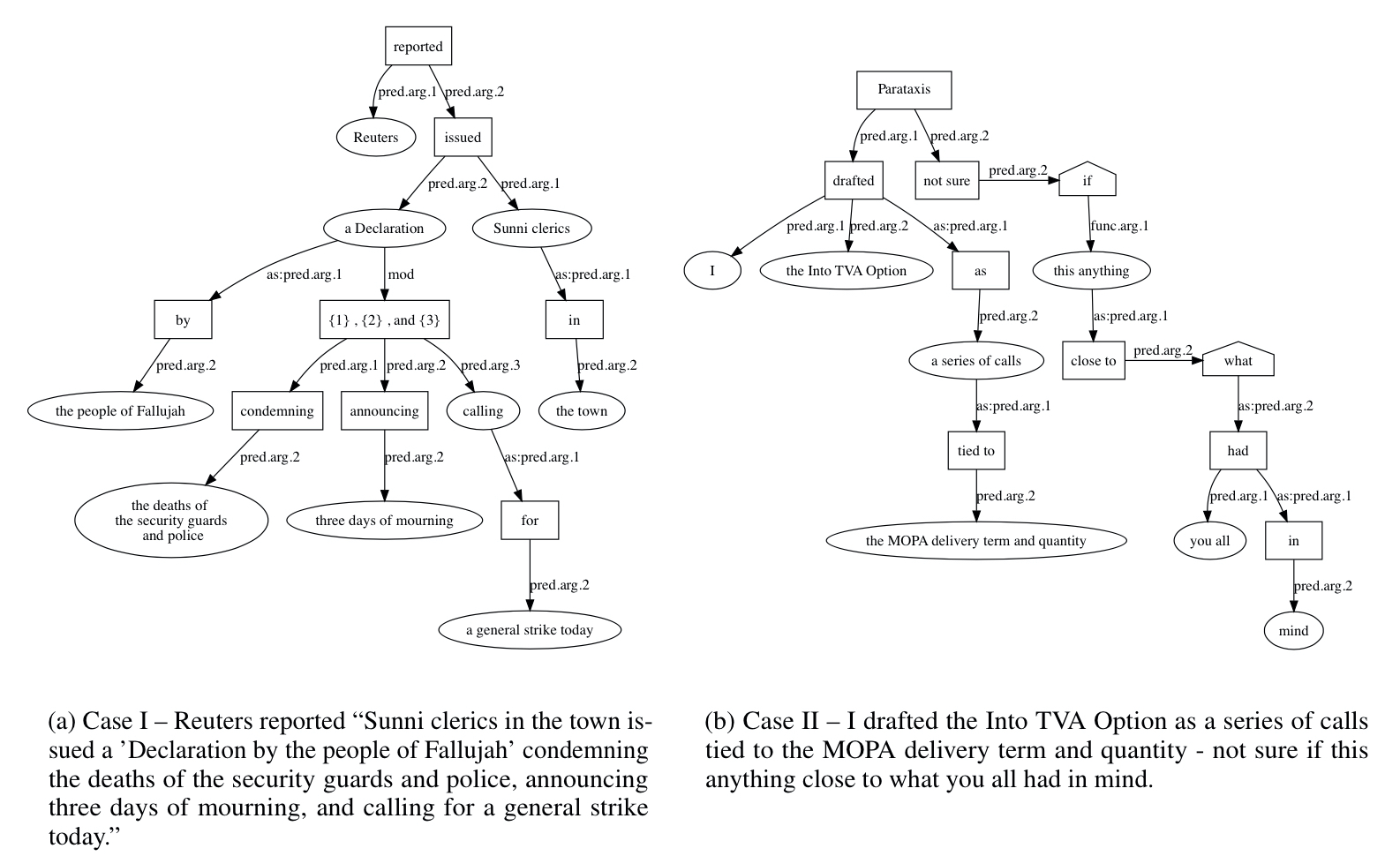
Each sentence can be represented as a Predicate/Function/Argument structure.
Use original words to express the structure, without loss of information.
The Central Problem: Surface Expression and Underlying Meaning
The Central Problem: Surface Expression and Underlying Meaning
Theory | View on Surface Expression | View on Underlying Meaning | Key Mechanism of Mapping | Example |
Structuralism (Saussure, 1916) | Words and grammar are part of a structured system of signs. | Meaning comes from differences between signs, not direct reference to reality. | Signifier (word form) ↔ Signified (concept) | The word “dog” means “dog” not because of an inherent property, but because it differs from “cat”. |
Generative Grammar (Chomsky, 1957) | Sentences have surface structure (what we see) and deep structure (abstract rules). | Deep structure captures core meaning, independent of syntax. | Transformational rules convert deep structure → surface structure. | “John saw Mary” vs. “Mary was seen by John” have different syntax but same deep meaning. |
Dependency Grammar (Tesnière, 1959) | Words are connected by dependency relations (head-modifier structure). | Meaning is derived from syntactic relations rather than linear order. | Dependency trees capture who does what to whom. | “The cat chased the mouse” → “chased” is the head, “cat” is subject, “mouse” is object. |
Abstract Meaning Representation (AMR, 2010s) | Surface syntax varies, but core meaning is a graph. | Meaning is a directed graph of concepts and relations. | Sentences are mapped into AMR graphs. | “She wants to buy a car” → (w / want-01 :arg0 (s / she) :arg1 (b / buy-01 :arg1 (c / car))) |
Open Information Annotation (OIA, 2020s) | Language can be expressed as Predicate/Function/Arguemnt structure; | Meaning is relationships among entities and facts. | Sentences are mapped into OIA Graphs; | “She buy a car” → (buy) –arg1->(She) -arg2->(a car) |
1.1 Symbolic Representation of Language 1.1.3 Case Studies
1.1 Symbolic Representation of Language 1.1.3 Case Studies
Generative Grammar and Constituency Parsing
Generative Grammar and Constituency Parsing
https://www.structural-learning.com/post/chomskys-theory
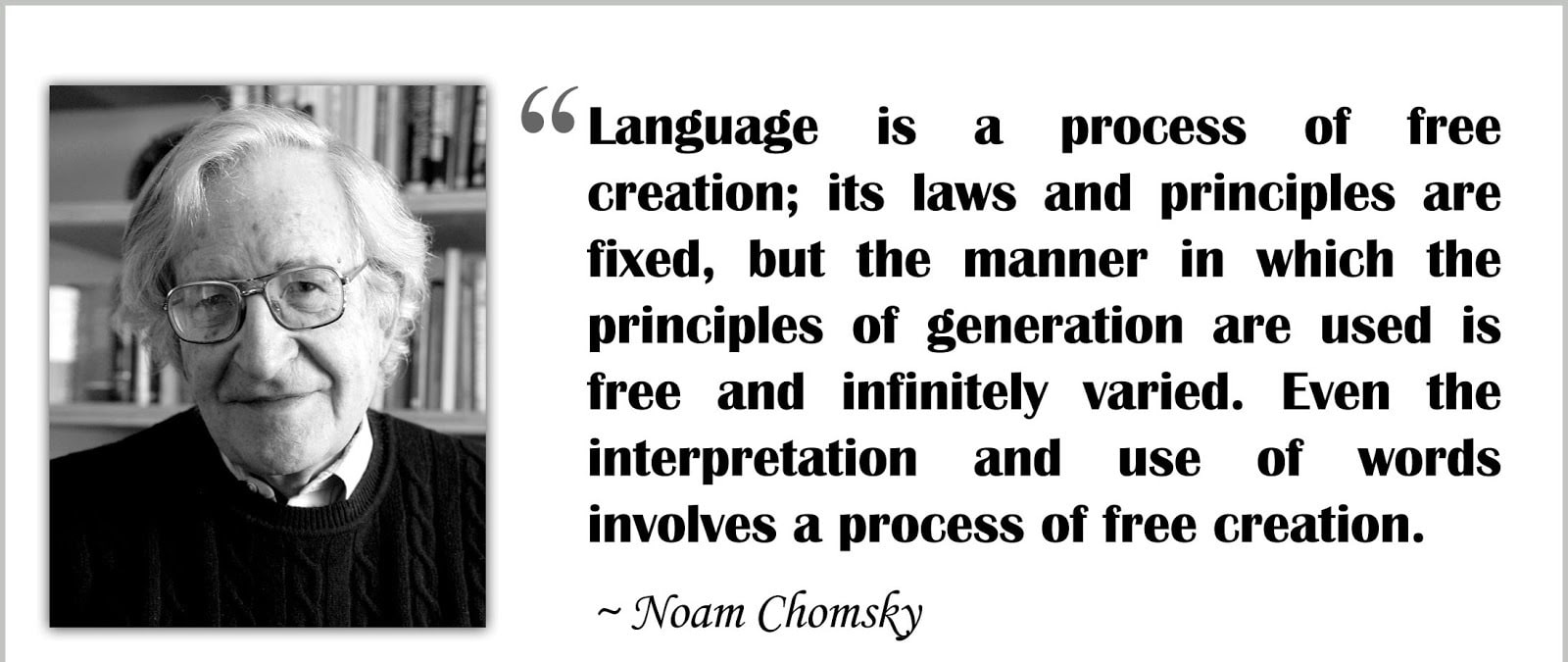
Generative Grammar
Generative Grammar
https://en.wikipedia.org/wiki/Generative_grammar
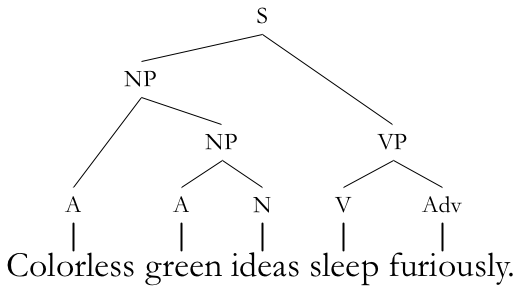
Rules for Generative Grammar
Rules for Generative Grammar
https://kevinbinz.com/2017/09/05/intro-grammar/
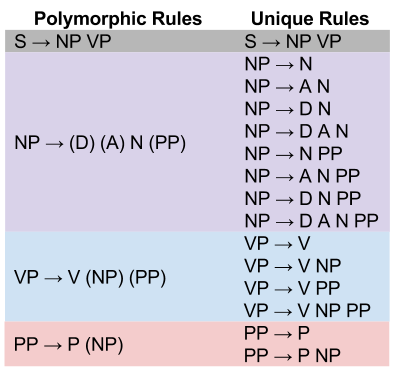
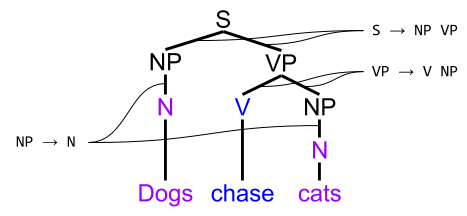
Constituency Parsing
Constituency Parsing
https://kevinbinz.com/2017/09/05/intro-grammar/
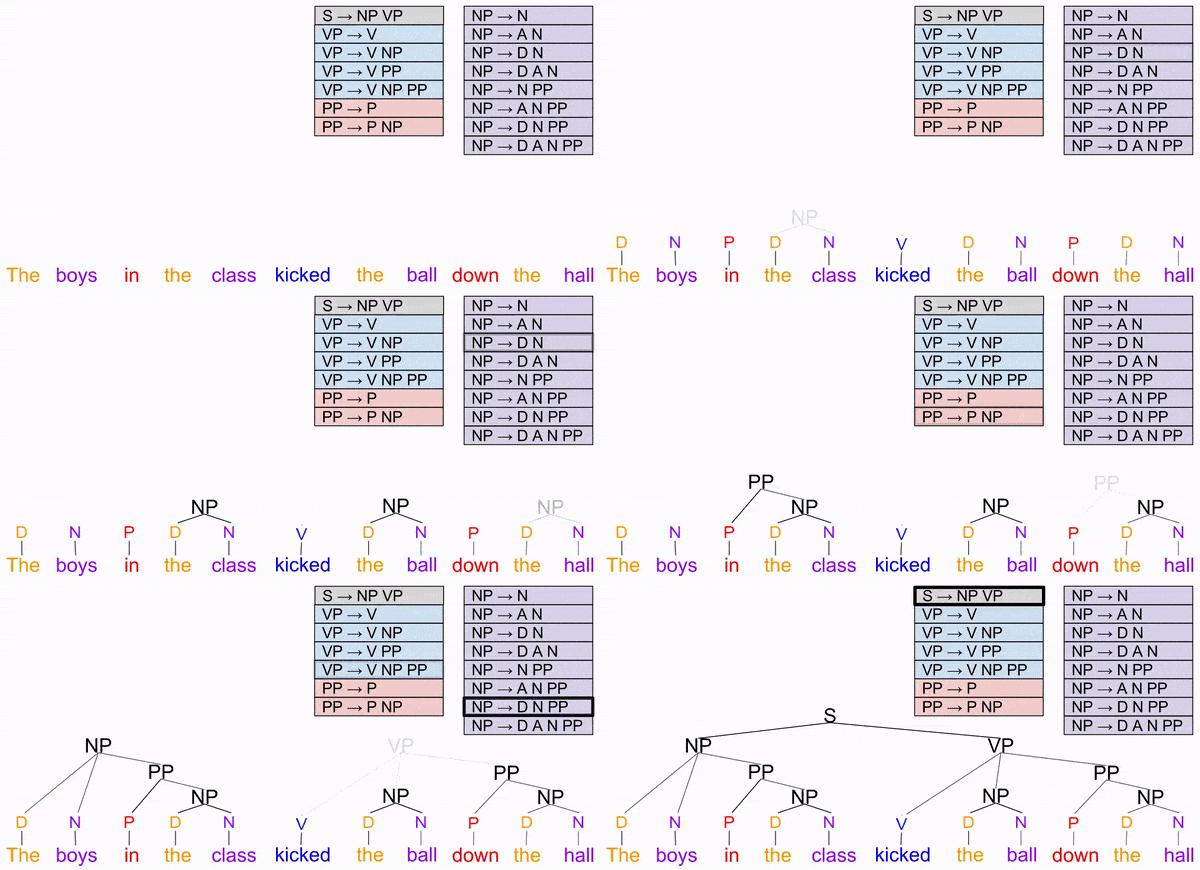
Dependency Grammar and Parsing
Dependency Grammar and Parsing
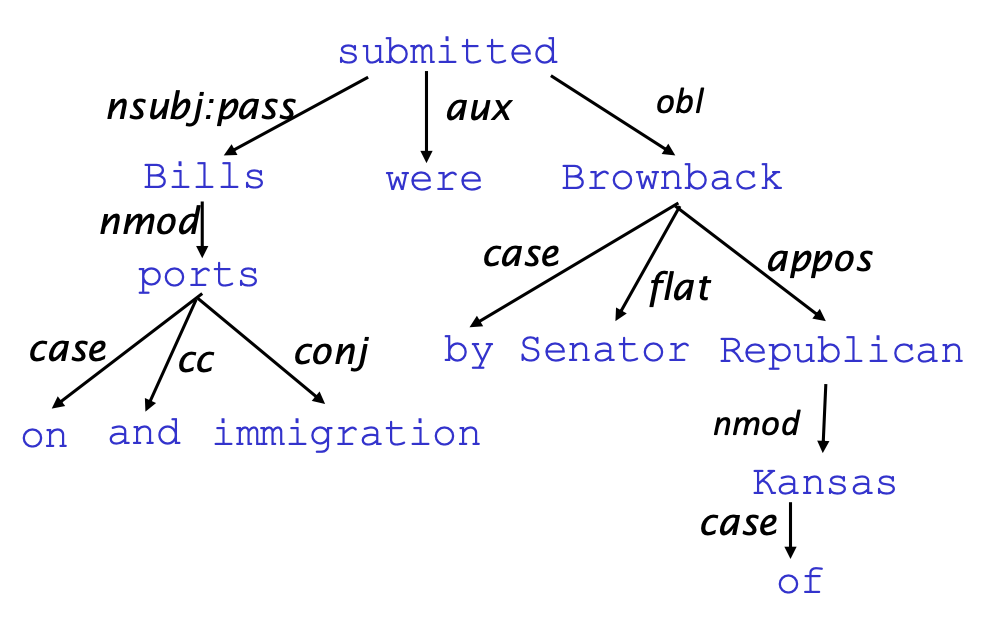
https://web.stanford.edu/class/cs224n/slides_w25/cs224n-2025-lecture04-dep-parsing.pdf
Why Dependency
Why Dependency
https://web.stanford.edu/class/cs224n/slides_w25/cs224n-2025-lecture04-dep-parsing.pdf
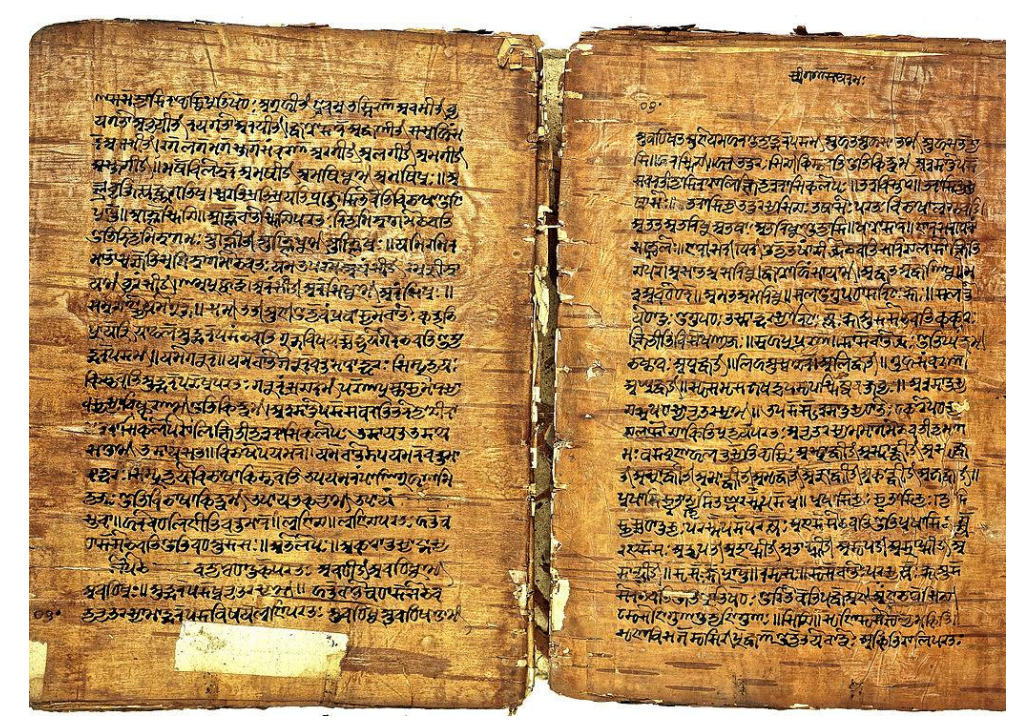
Dependency goes back a long way:
To Pāṇini’s grammar (c. 5th century BCE)
Basic approach of 1st millennium Arabic grammarians
Solving the ambiguity in language understanding and parsing into the generative gramma actually rely on dependency information.
I eat the food [on the table] [in the morning].
I saw the man with the telescope. ?
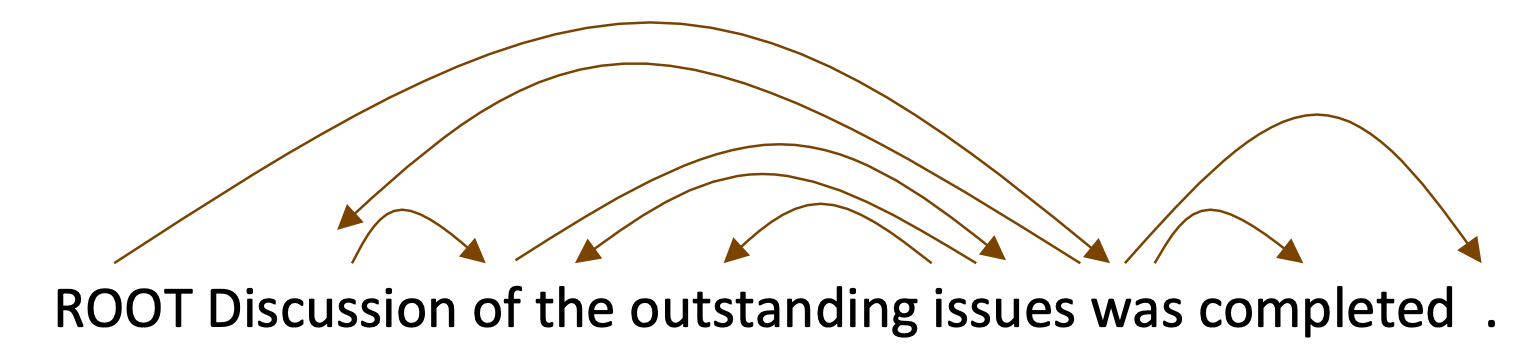
Dependency Parsing: Information Source
Dependency Parsing: Information Source
https://web.stanford.edu/class/archive/cs/cs224n/cs224n.1162/handouts/SLoSP-2014-4-dependencies.pdf
Bilexical affinities: [issues → the] is plausible
Dependency distance: mostly with nearby words
Intervening material: Dependencies rarely span intervening verbs or punctuation
Valency of heads: How many dependents on which side are usual for a head?
Relationship between Dependency and Constituency
Relationship between Dependency and Constituency
https://web.stanford.edu/class/cs224n/slides_w25/cs224n-2025-lecture04-dep-parsing.pdf
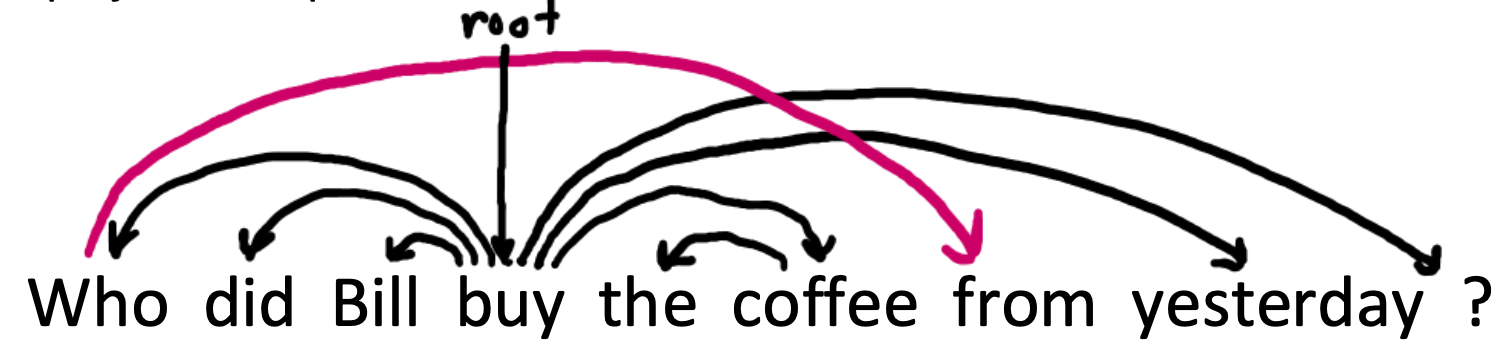
Projective parse: There are no crossing dependency arcs when the words are laid out in their linear order, with all arcs above the words
Dependencies corresponding to a Constituency Tree must be projective
Most syntactic structure is projective, but dependency theory normally does allow non-projective structures to account for displaced constituents.
Open Information Annotation
Open Information Annotation
Mingming Sun, et.al . 2020. A Predicate-Function-Argument Annotation of Natural Language for Open-Domain Information eXpression. In Proceedings of EMNLP, pages 2140–2150
Why OIA
Why OIA
Cognition happens in intermediate level:
Higher than byte, character, and words;
Lower than high-level real-world tasks;
Cognition is about entities, facts in the world and their relationships;
The basis of Cognitive Language Modeling is:
Entities, Facts and Relationships between them.
Intermediate Representation of Knowledge
Intermediate Representation of Knowledge
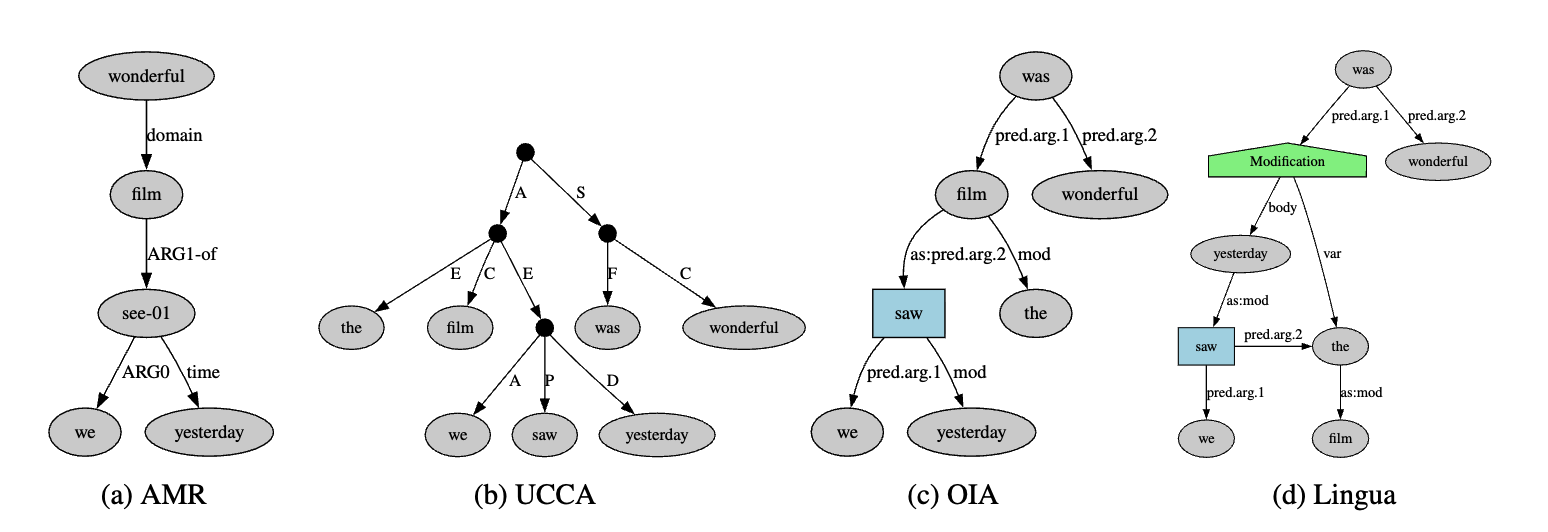
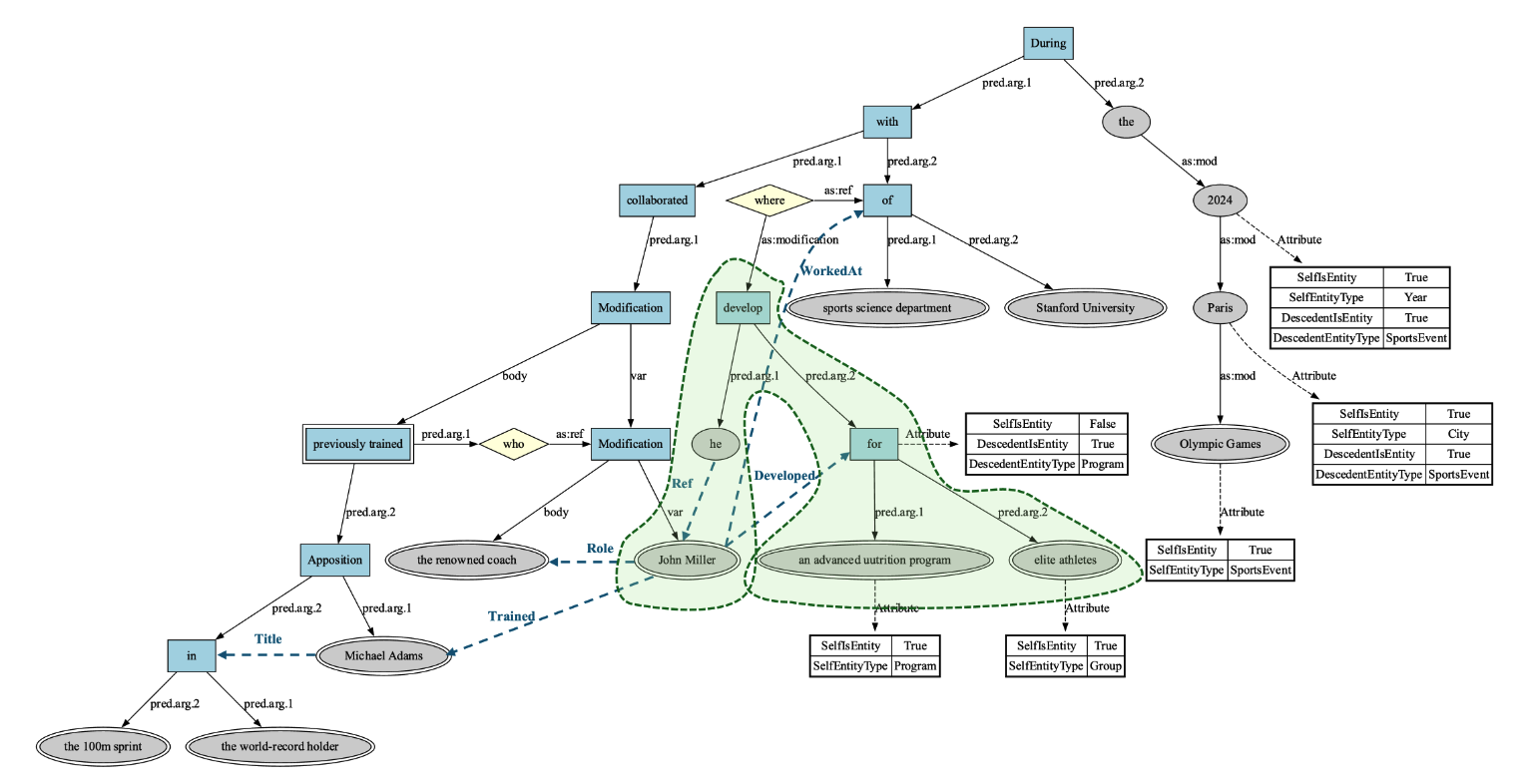
Constants: express entities (“the solar system”) and any abstract concept (“expensive”);
Functions: 𝑓(𝑎𝑟𝑔1,⋯,𝑎𝑟𝑔𝑛)⟶{𝑒} express query of entities or delegation of entities, such as “the CEO of X”, the questions and wh-clause “when Y”
Predicates: p(𝑎𝑟𝑔1,⋯,𝑎𝑟𝑔𝑛)⟶{0,1}, express relationships or logical connections among entities, predicates, and functions, such as “X buy Y”, “X says Y”, “Y, because Z”.
Lingua Graph
Lingua Graph
Lingua Graph
Lingua Graph
Lingua Graph
Lingua Graph
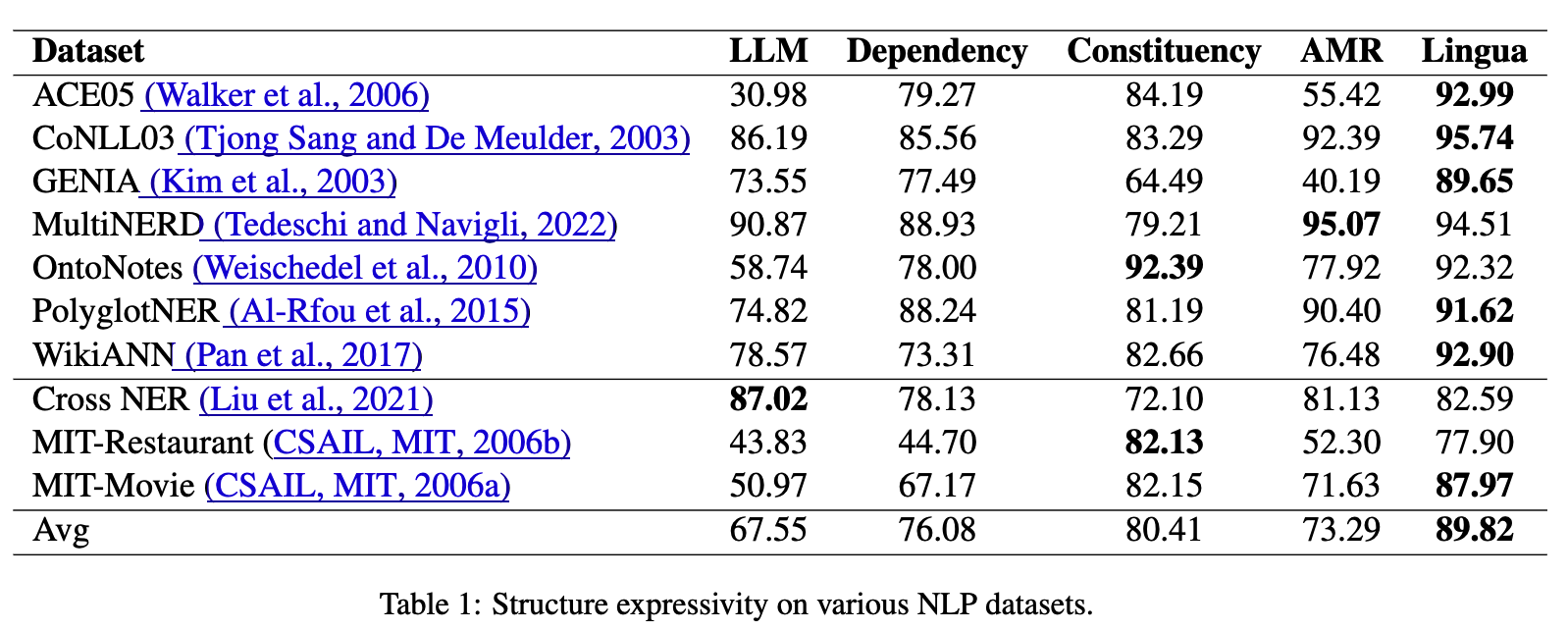
Sentence Parsing: Intermediate Level Expression
Sentence Parsing: Intermediate Level Expression
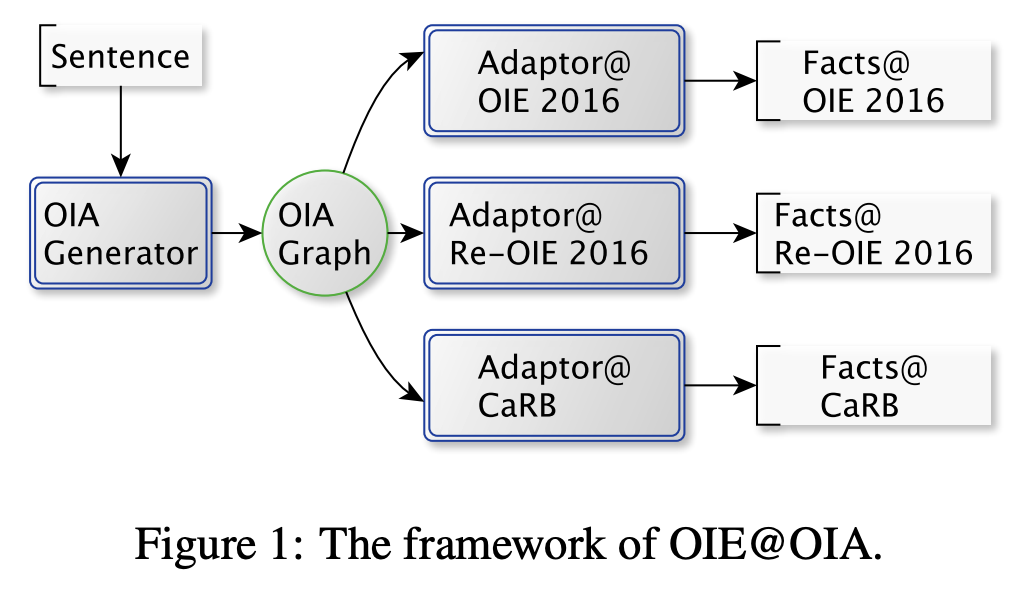
Sentence Parsing: Break through the Limitation of Sequence
Sentence Parsing: Break through the Limitation of Sequence
https://web.stanford.edu/class/archive/cs/cs224n/cs224n.1162/handouts/SLoSP-2014-4-dependencies.pdf
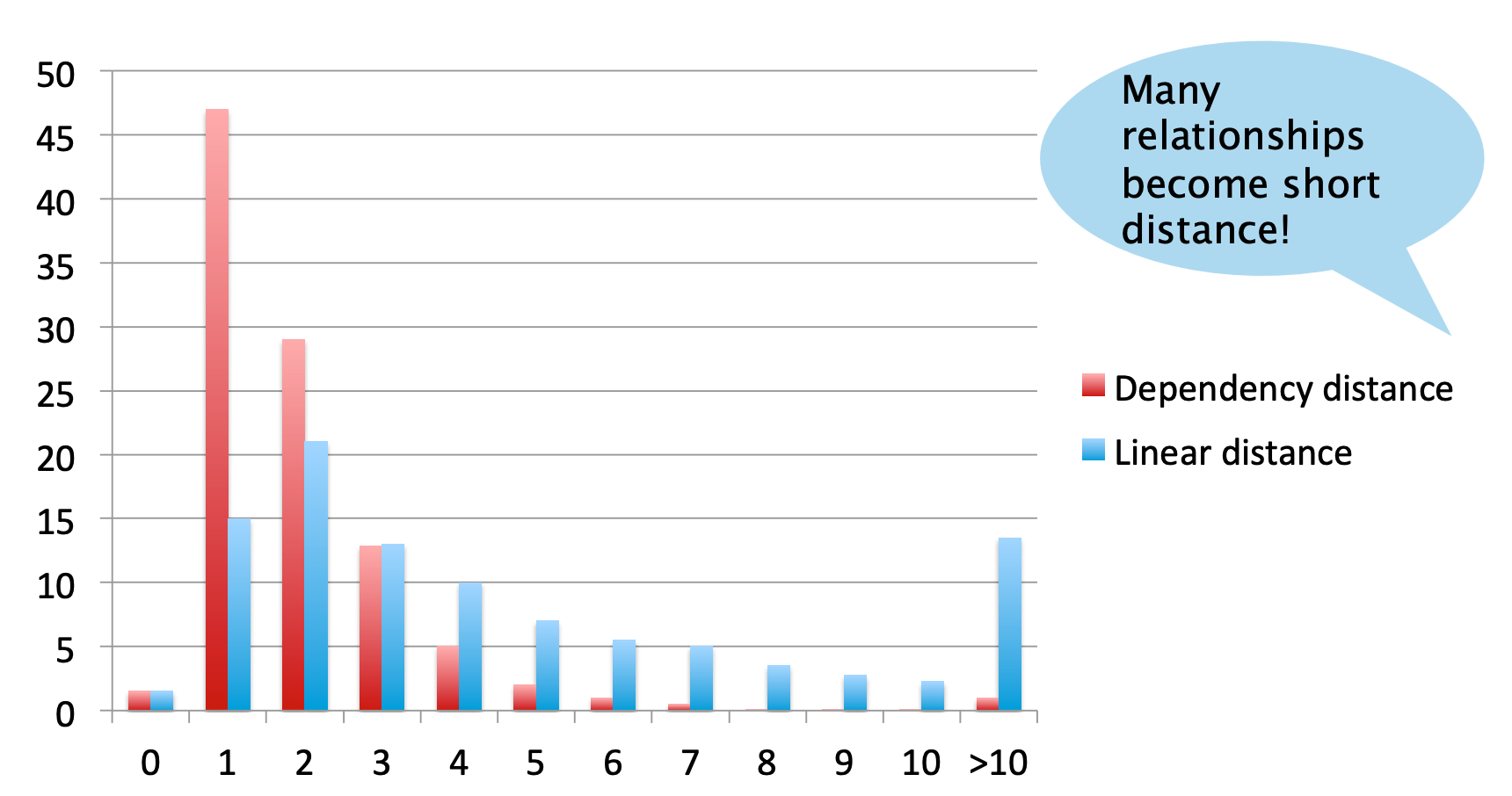
Coreference
Coreference
https://web.stanford.edu/class/archive/cs/cs224n/cs224n.1194/slides/cs224n-2019-lecture16-coref.pdf
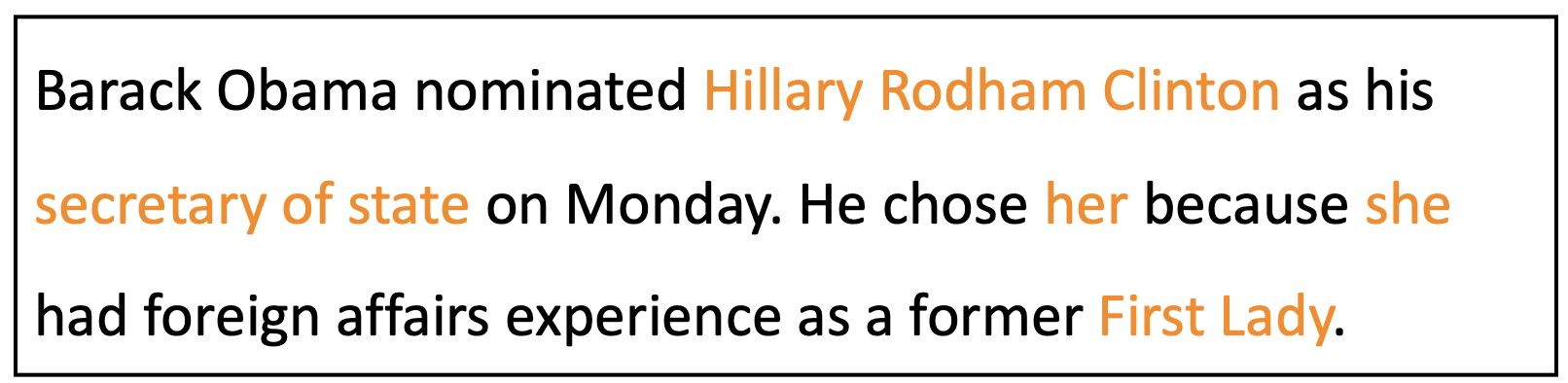
Identify all mentions that refer to the same real world entity.
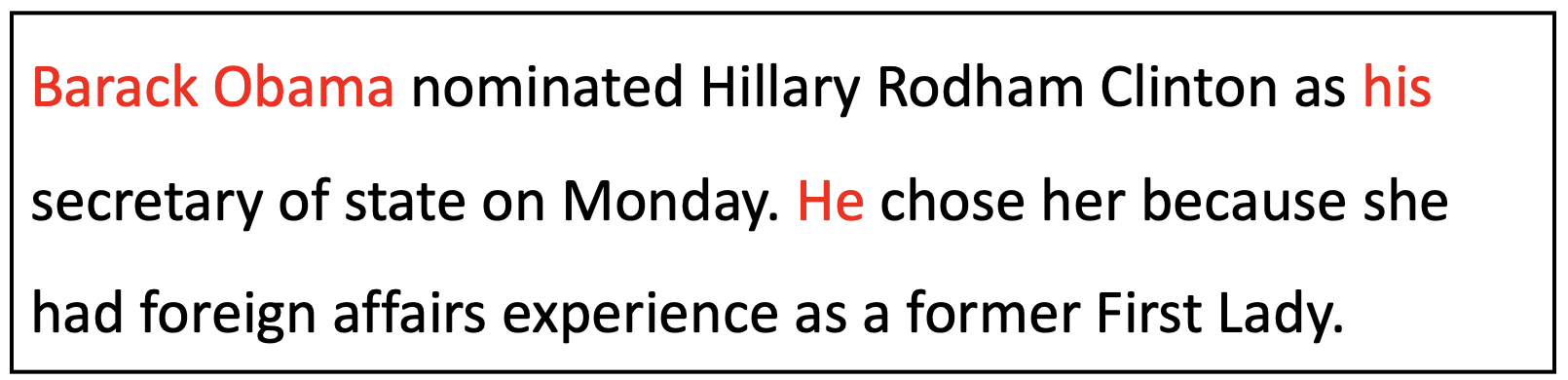


Types of Coreference
Types of Coreference
Pronominal Coreference
Pronouns referring to noun phrases
Example: “Lisa is a scientist. She works at NASA.”
Nominal Coreference
Two noun phrases referring to the same entity
Example: “The president gave a speech. The leader addressed the nation.”
Bridging Coreference
Inferring the relationship between mentions
Example: “I bought a laptop. The screen is amazing.”
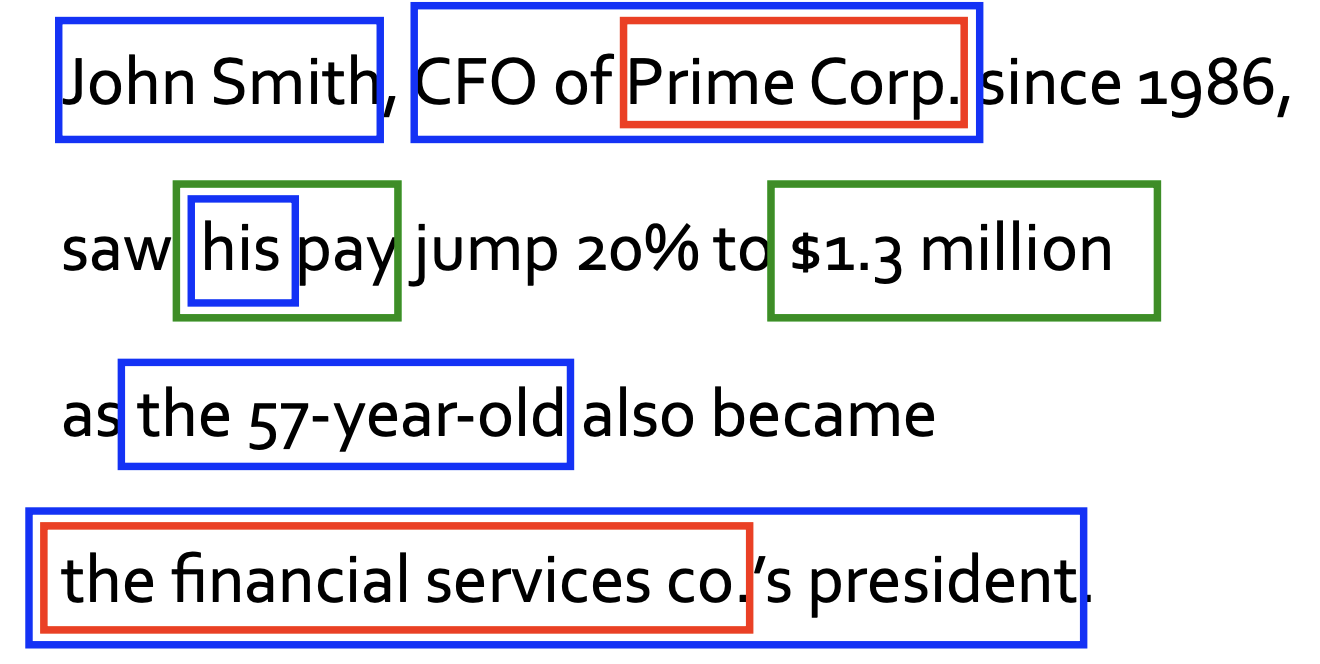
Coreference is Complex
Coreference is Complex
https://web.stanford.edu/class/archive/cs/cs224n/cs224n.1194/slides/cs224n-2019-lecture16-coref.pdf
Coreference is Ccrucial
Coreference is Ccrucial
Resolving Ambiguity in Language
“Mary told Sue that she won the award.”
Maintaining Context and Coherence
“A scientist discovered a new particle. The researcher presented her findings.”
Constructing Accurate Knowledge Graphs
“Google acquired DeepMind. The AI lab specializes in reinforcement learning.”
“Apple Inc. released a new iPhone. The Cupertino-based company expects high sales.”
Coherence Relations
Coherence Relations
https://www.sfu.ca/~mtaboada/lot/coherence_relations.html
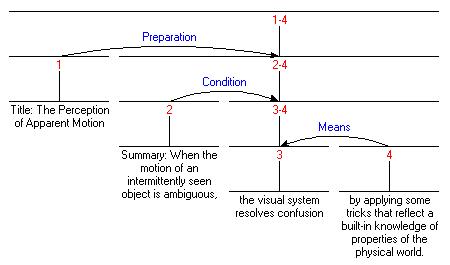
Logical and semantic connections between sentences or discourse segments that contribute to the overall coherence of a text.
These relations help make discourse understandable and structured.
Theoretical Foundations of Coherence Relations
Theoretical Foundations of Coherence Relations
Rhetorical Structure Theory (RST)
Introduced by Mann & Thompson (1988).
Views text as a hierarchical structure with different relations.
Coherence is achieved through a network of nucleus (main idea) and satellite (supporting idea).
Example RST relations:
Cause-Effect
Elaboration
Contrast
Hobbs’ Theory of Coherence (1979)
Defines coherence as an inferential process where readers fill in missing links.
Emphasizes logical reasoning and causal inferences.
Example: John fell off his bike. He broke his arm.”
Humans infer a causal connection between these events.
Kehler’s Coherence Model (2002)
Inspired by theories of event coherence.
Divides coherence into three main categories:
Resemblance: Similarities between sentences.
Cause-Effect: Causal relationships.
Contiguity:: Events occurring in a sequence.
Types of Coherence Relations
Types of Coherence Relations
Type | Description | Example |
Causal Relations (因果关系) | One sentence (cause) leads to another (effect). | “It rained heavily. The streets got flooded.” (Cause → Effect) |
- Result (结果关系) | The second sentence is a direct consequence of the first. | “She studied hard. She passed the exam.” |
- Reason/Explanation (原因关系) | The second sentence explains the first. | “He left early because he was feeling sick.” |
Temporal Relations (时间关系) | One event happens before, after, or at the same time as another. | “She woke up. Then she made coffee.” |
- Sequential (顺序关系) | One event follows another. | “He finished work. Then he went home.” |
- Simultaneous (同时关系) | Two events happen at the same time. | “She was cooking while he was reading.” |
Contrastive Relations (对比关系) | The two segments express opposite ideas. | “She likes tea. He prefers coffee.” |
- Contrast (对照关系) | Highlights a clear opposition. | “She loves winter, but I hate it.” |
- Concession (让步关系) | Acknowledges one idea but presents another contradicting it. | “It was raining, but they still went out.” |
Additive Relations (添加关系) | The second segment adds more information. | “She speaks English. She also knows French.” |
- Elaboration (详细说明关系) | The second sentence expands on the first. | “He bought a car. It’s a red Tesla.” |
- Parallel (并列关系) | The two segments describe similar ideas. | “She enjoys hiking. He likes running.” |
Attribution Relations (引述关系) | One sentence attributes an action or statement to someone. | “The professor said that the exam would be postponed.” |
- Statement (陈述关系) | Reporting an assertion. | “Experts claim that AI will change the world.” |
- Question (提问关系) | Reporting a question. | “She asked if I could help her.” |
Condition & Hypothetical Relations (条件关系) | Expresses a condition that affects an outcome. | “If you study hard, you will pass the exam.” |
- Conditional (条件关系) | Explicit “if-then” condition. | “If it rains, we will cancel the trip.” |
- Hypothetical (假设关系) | A condition that is unlikely or speculative. | “If I were rich, I would travel the world.” |
Purpose & Means Relations (目的与手段关系) | Expresses a goal and the method to achieve it. | “He left early to catch the train.” |
- Purpose (目的关系) | The second sentence explains the goal of the first. | “She trains daily to become a professional athlete.” |
- Means (手段关系) | The second sentence describes how something is achieved. | “He solved the problem by using an equation.” |
Importance of Coherence Relations
Importance of Coherence Relations
Coherence relations play a crucial role in:
Text Understanding – Helps in resolving ambiguities in meaning.
Text Generation & Summarization – Ensures well-structured, logical output.
Discourse Parsing – Used in NLP tasks for organizing large texts.
Question Answering – Helps infer implicit knowledge.
Dialogue Systems – Maintains logical conversational flow
1.1 Symbolic Representation of Language 1.1.4 Obtaining Symbolic Representations
1.1 Symbolic Representation of Language 1.1.4 Obtaining Symbolic Representations
Rule-Based and Heuristic Methods (Pre-1990s)
Rule-Based and Heuristic Methods (Pre-1990s)
Expert Hand-Crafted Grammar Rules
In English, a verb (V) typically governs a noun phrase (NP) as its subject or object.
Rule: V → NP (subject), V → NP (object)
Limitations:
✔ High precision in well-defined cases
❌ Poor scalability, hard to adapt to new languages and ambiguous cases
Statistical Parsing (1990s–2000s)
Statistical Parsing (1990s–2000s)
Probabilistic extension of Generative Gramma:
Each rule has an associated probability.
Data-Driven Statistical Parsing
Data Sets: Penn Treebank, Universal Dependencies.
Lexicalized Models: Assigned probabilities to dependencies based on word co-occurrence. The probability of a dependency relation was often calculated using:
Example: If “eats” frequently governs “apple” in a treebank, then the parser learns that “eats → apple” is a probable dependency.
Limitations:
✔ More flexible than rule-based methods
❌ Struggled with long-range dependencies and ambiguous structures
P(S → NP VP) = 0.9
P(VP → V NP) = 0.7
Classical Machine Learning (2000s–2015)
Classical Machine Learning (2000s–2015)
Transition-Based Dependency Parsing
Key Idea: Parse sentences by making a sequence of shift-reduce decisions.
Uses a classifier (SVM, perceptron, or neural network) to decide each parsing step.
Graph-Based Dependency Parsing
Key Idea: Treat parsing as a graph optimization problem.
Define a scoring function to determine the best dependency tree.
Limitations:
✔ Much Powerful than Statistical Parser;
❌ Need Feature Engineering; Long-term dependencies not well modeled.
Neural Network-Based Methods (2014–2017)
Neural Network-Based Methods (2014–2017)
Machine Learning goes to Deep Learning:
Feature Engineering → Neural Embedding Representation
Shallow Machine → BiLSTM + Shallow Machine
Limitations:
✔ Long-term dependencies well modeled.
❌ Inherent pattern of language not used.
Pretrained Model (2018–2022)
Pretrained Model (2018–2022)
Pretrained Model + Fine-tuning:
BiLSTM → Transformer
Random Initialization → Pretrained /Bert Weights
Limitations:
✔ Inherent pattern of language used.
❌ Information across tasks not used.
AGI (2022–)
AGI (2022–)
Specific Task → AGI:
Hidden Task Info → Explicit Task Instructions
Output Labels → Natural Language Generation
Training on one task → Training on every task
Limitations:
✔ Information across tasks not used.
❌ Language instructions may not be accurate. Subtle task requirement may need finetuning.
Tree-Bank Datasets
Tree-Bank Datasets
Tree Bank
Tree: Linguistic structures, particularly syntactic structures, are naturally represented as trees in formal grammar.
Bank: The dataset stores (or “banks”) a large number of syntactically annotated sentences.
Instances:
Penn Tree-Bank
Universal Dependencies
OntoNote
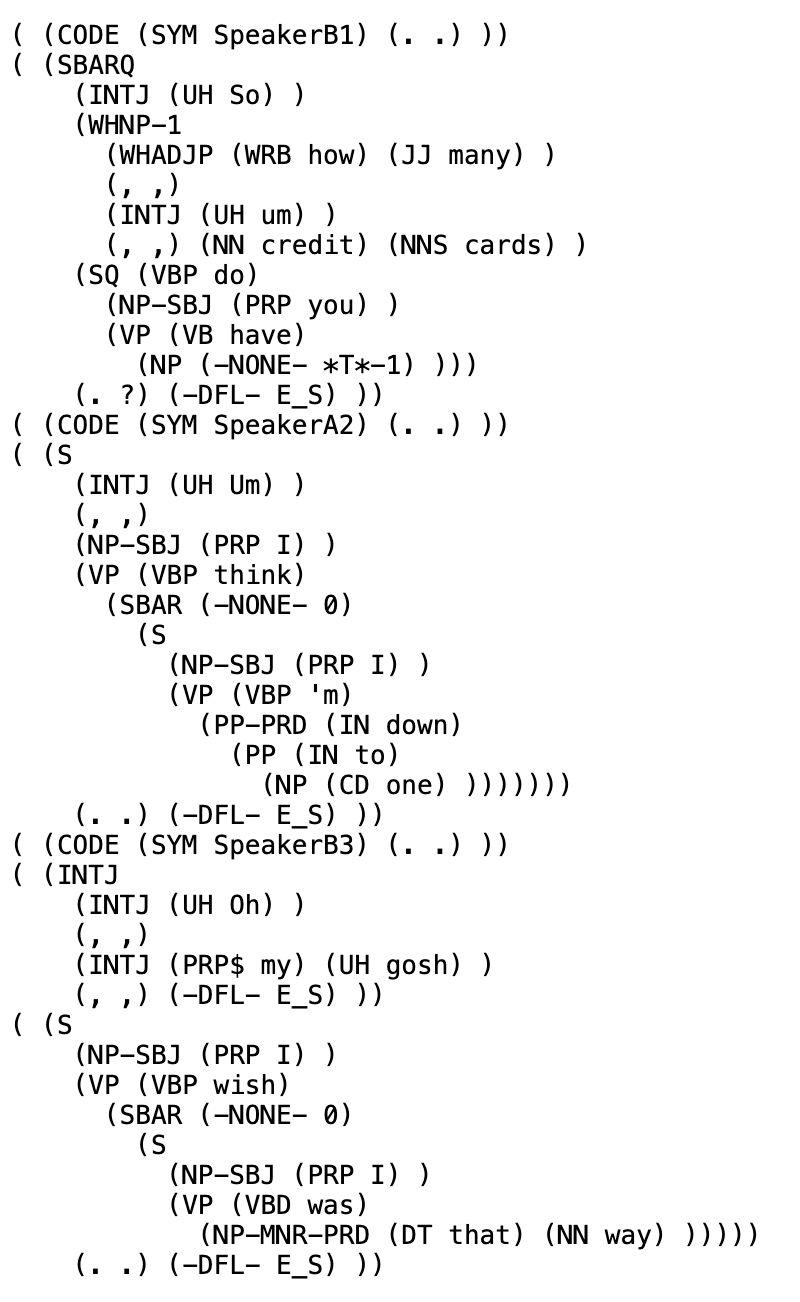
Penn Tree Bank (PTB)
Penn Tree Bank (PTB)
One of the most influential linguistic corpora;
Developed at the University of Pennsylvania ;
Language: English
Annotation Type: Constituency-based phrase structure trees, POS tags, and some dysfluency annotations.
Source Data:
Wall Street Journal (WSJ) articles (about 1 million words).
Brown Corpus (a balanced dataset of American English).
Switchboard (spoken conversations).
ATIS-3 material
Annotation Scheme:
Each word is labeled with a POS tag.
Phrases are marked with constituency labels (e.g., NP, VP, PP).
Universal Dependencies (UD)
Universal Dependencies (UD)
Cross-linguistic dependency annotation that standardizes the annotation of syntactic structure and morphology across many languages. https://universaldependencies.org/
Language: More than 100 languages;
Annotation Type: Cross-Linguistic Consistency; Universal POS Tags; Morphological Features
Annotation Scheme: CoNLL-U format
1 She she PRON _ Number=Sing|Person=3 2 nsubj _ _
2 said say VERB _ Tense=Past 0 root _ _
3 that that SCONJ _ _ 5 mark _ _
4 he he PRON _ Number=Sing|Person=3 5 nsubj _ _
5 likes like VERB _ Tense=Pres|Number=Sing 2 ccomp _ _
6 apples apple NOUN _ Number=Plur 5 obj _ _
7 . . PUNCT _ _ 2 punct _ _
OntoNote
OntoNote
Large-scale, multi-layered corpus offering syntactic, semantic, and discourse-level annotations
Created as part of the DARPA GALE program;
Language: English, Chinese, Arabic
Annotation Type: POS tags, Constituency Trees, Word Sense Disambiguation, Named Entity Recognition, Coreference Resolution, PropBank Semantic Role Labeling (SRL).
Source Data:
Newswire (Wall Street Journal, Xinhua News)
Broadcast News (CNN, MSNBC)
Broadcast Conversations (Transcribed interviews)
Web Texts (Blogs, discussion forums)
Telephone Conversations (Switchboard corpus)
Annotation Scheme: CoNLL-U format and others
Comparison
Comparison
Feature | Penn Treebank (PTB) | Universal Dependencies (UD) | OntoNotes |
POS Tagging | ✅ Yes | ✅ Yes | ✅ Yes |
Constituency Trees | ✅ Yes | ❌ No | ✅ Yes |
Dependency Parsing | ❌ No | ✅ Yes | ❌ No |
Named Entities (NER) | ❌ No | ❌ No | ✅ Yes |
Coreference | ❌ No | ❌ No | ✅ Yes |
Semantic Role Labeling | ❌ No | ❌ No | ✅ Yes |
Word Sense Disambiguation (WSD) | ❌ No | ❌ No | ✅ Yes |
Multilingual | ❌ No | ✅ Yes | ✅ Yes (Eng, Chi, Ara) |
Types of Tasks
Types of Tasks
Segmentation
Element Identification
Element Attribute Prediction
Pairwise Relationship Identification
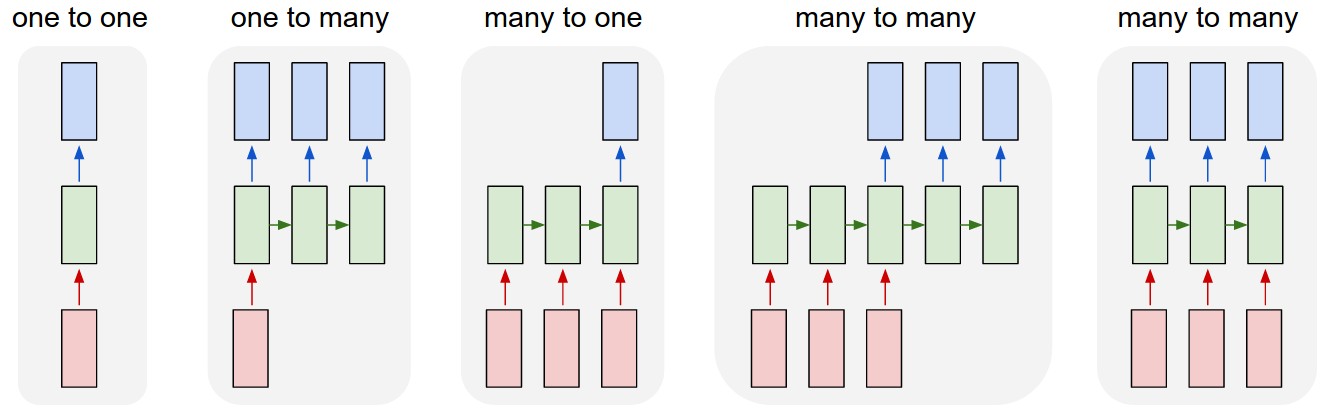
Recall: Neural Learning Paradigms
Recall: Neural Learning Paradigms
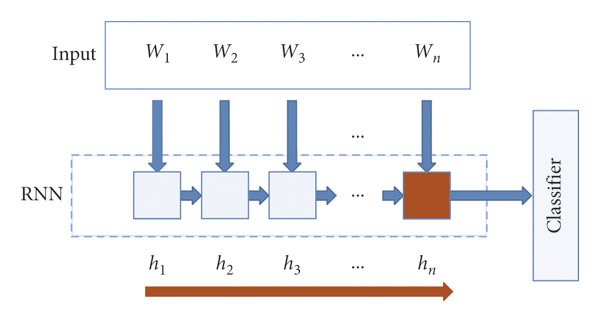
Recall: Applications: Sequence Classification
Recall: Applications: Sequence Classification
Feed the last hidden-state to the classifier;
Widely used in NLP task such as text classification;
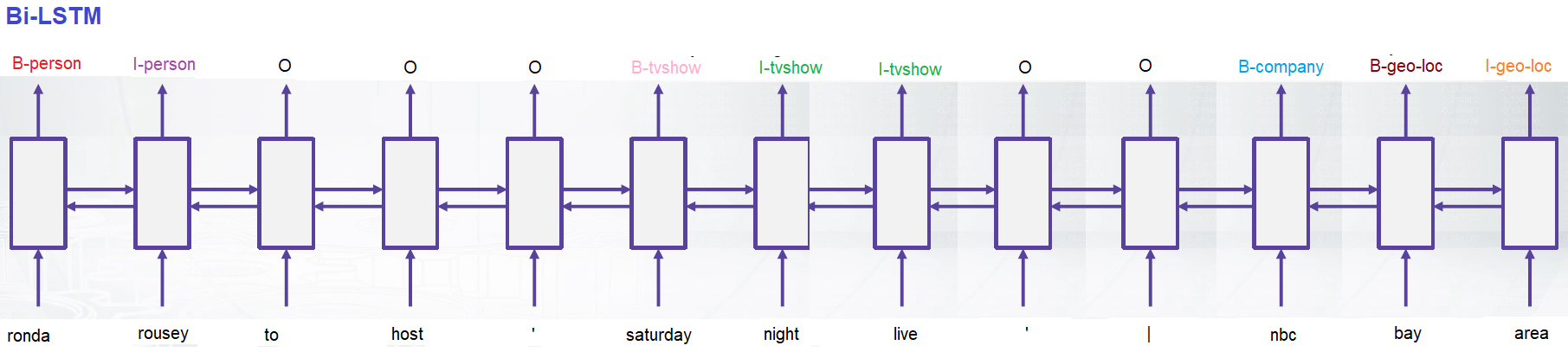
Recall: Applications: Sequence Labeling
Recall: Applications: Sequence Labeling
Predict a label for each item of input sequence.
Widely used in NLP task like NER;
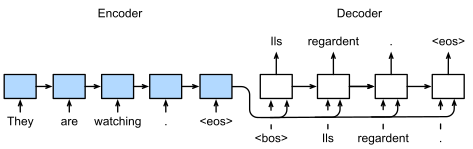
Recall: Applications: Sequence Prediction
Recall: Applications: Sequence Prediction
Modeling the problem as a sequence prediction task;
Typical application: Machine Translation, AGI LLM;
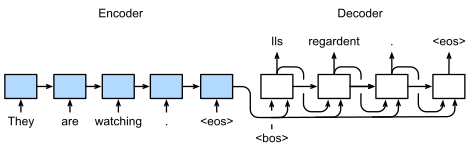
Segmentation —— Task Modeling
Segmentation —— Task Modeling
Modeling as a Sequence Labeling Task
Modeling as a Sequence Prediction Task
https://medium.com/towards-data-science/joint-khmer-word-segmentation-and-pos-tagging-cad650e78d30
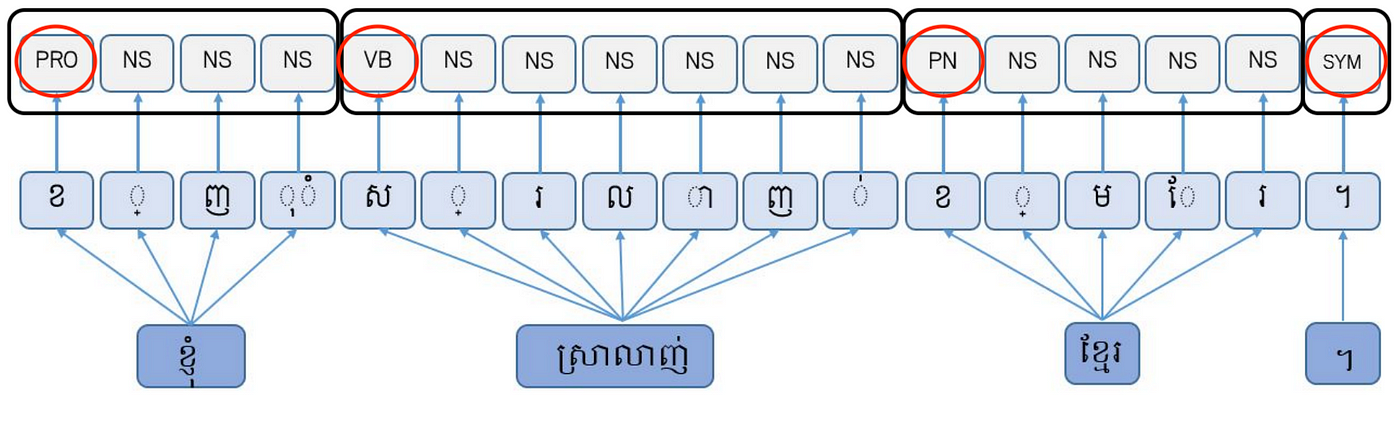
STA
STA
STA
STA
Segmentation —— Network Architecture
Segmentation —— Network Architecture
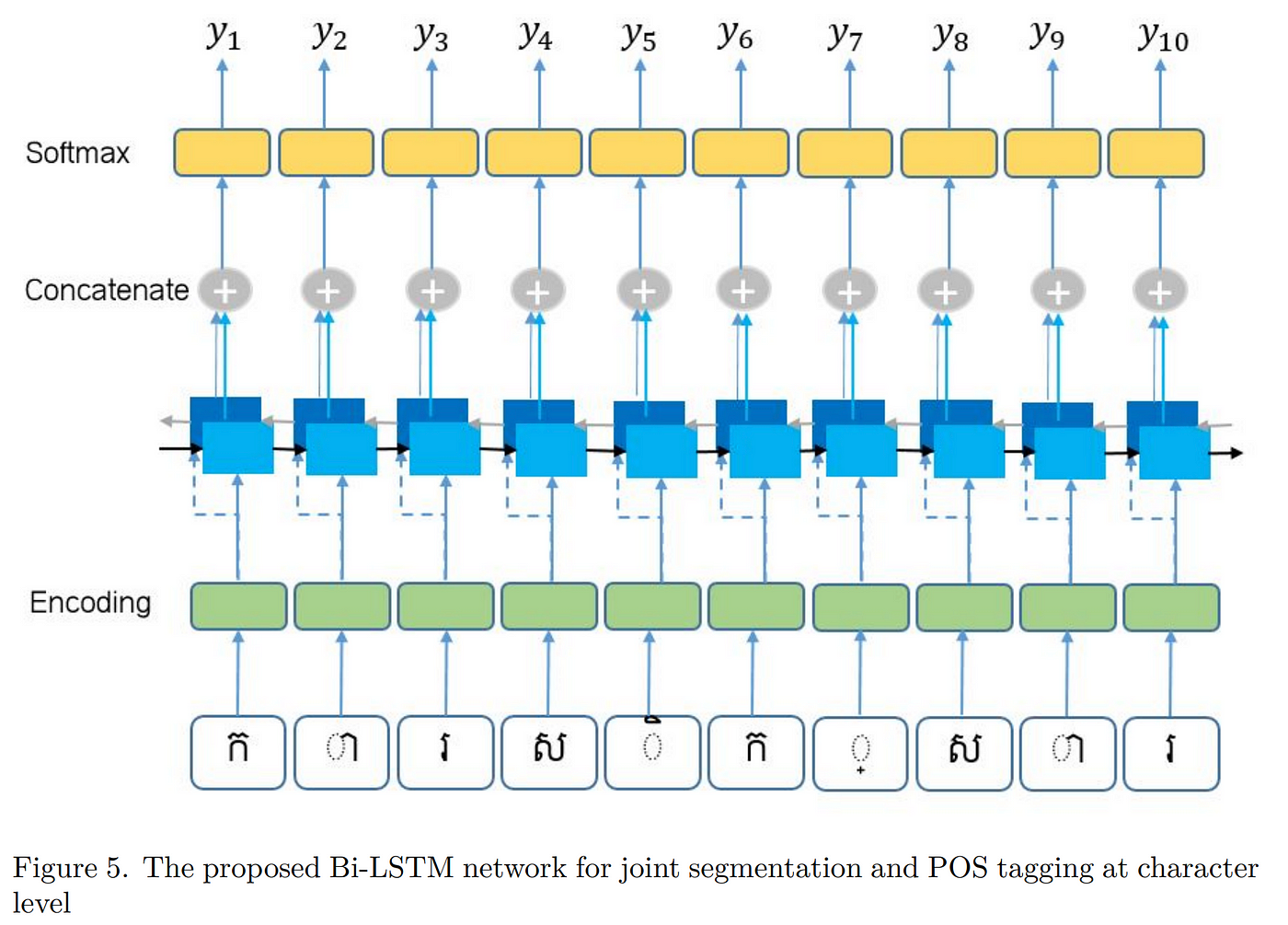
https://medium.com/towards-data-science/joint-khmer-word-segmentation-and-pos-tagging-cad650e78d30
Segmentation —— Algorithm
Segmentation —— Algorithm
Loss:
Typical Classification Loss: Cross-Entropy
Optimization:
Gradient Descent: Adam
Segmentation —— Evaluation
Segmentation —— Evaluation
Model Level Evaluation:
Binary Classification Error: Precision, Recall, F1
Task Level Evaluation:
Words Prediction Performance: Precision, Recall, F1
Boundary Prediction Performance: Precision, Recall, F1
Element Identification——Task Modeling
Element Identification——Task Modeling
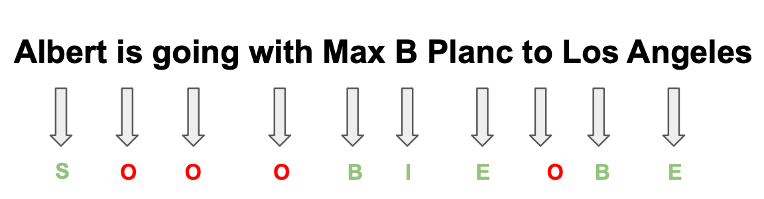
Same with Segmentation, just change the target label system.
Typical Task: Noun Phrase Identification, Entity Detection
https://medium.com/@muskaan.maurya06/name-entity-recognition-and-various-tagging-schemes-533f2ac99f52
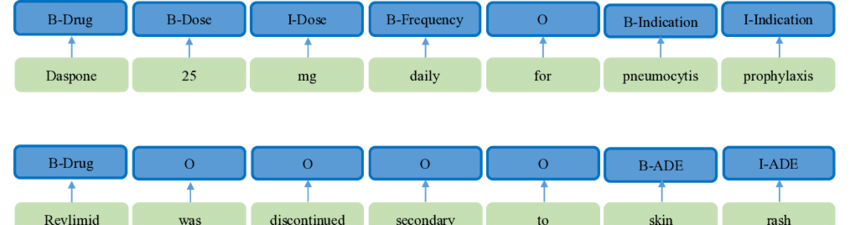
Element Attribute Prediction——Task Modeling
Element Attribute Prediction——Task Modeling
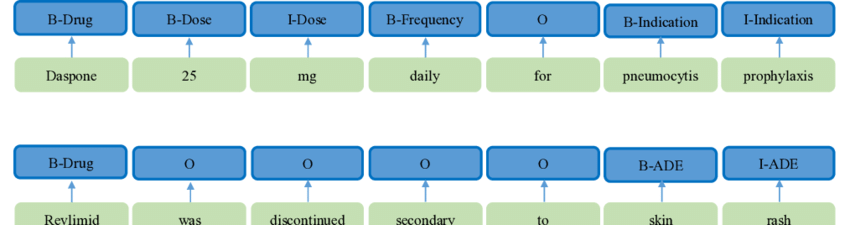
Same with Segmentation, just change the target label system.
Typical Task: POSTag Prediction, Named Entity Recognition
Can merge with Element Identification Task by merging the label system.
https://www.researchgate.net/publication/330424080_Adverse_Drug_Events_Detection_in_Clinical_Notes_by_Jointly_Modeling_Entities_and_Relations_Using_Neural_Networks
Pairwise Relationship Identification——Task Modeling
Pairwise Relationship Identification——Task Modeling
Elementwise Representation + Bi-Affine transformation → Pairwise Relationship
Bi-Affine transformation: is a vector with i-th element equals to:

Pairwise Relationship Identification——Task Modeling
Pairwise Relationship Identification——Task Modeling
Task Constraint:
Dependency Parsing: Tree structure;
Coreference: Multiple Fully Connected Graph;
OIA Graph: DAG;
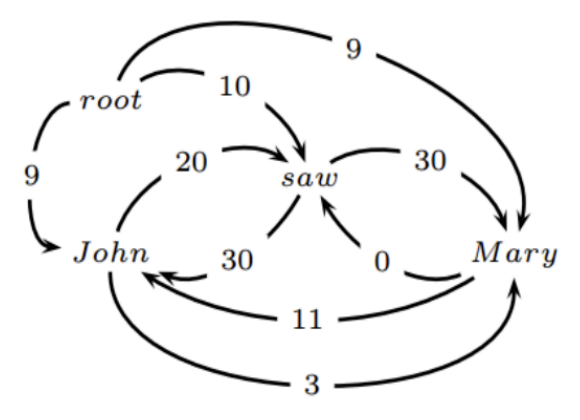
https://www.cs.princeton.edu/courses/archive/fall19/cos484/lectures/lec11.pdf
Pairwise Relationship Identification——Network Architecture
Pairwise Relationship Identification——Network Architecture
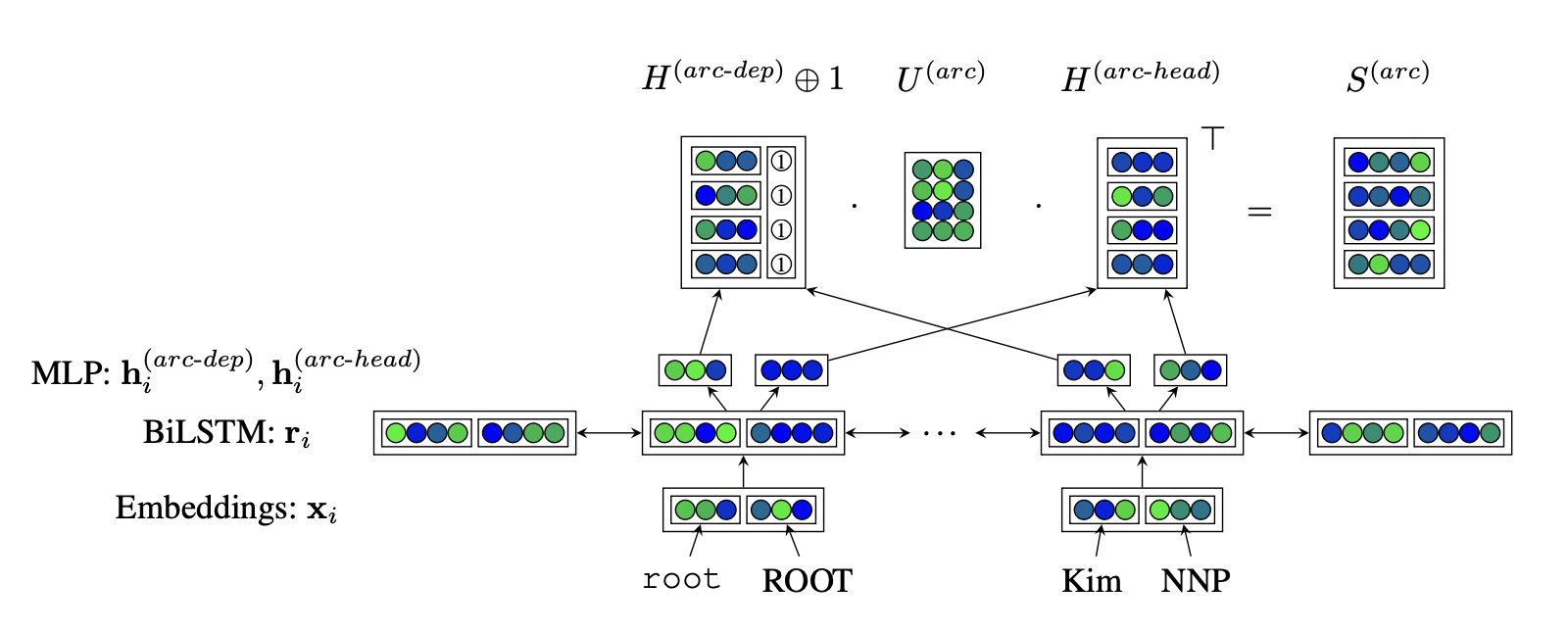
https://arxiv.org/pdf/1611.01734
Parsing Complex Graphs: Word-OIA
Parsing Complex Graphs: Word-OIA
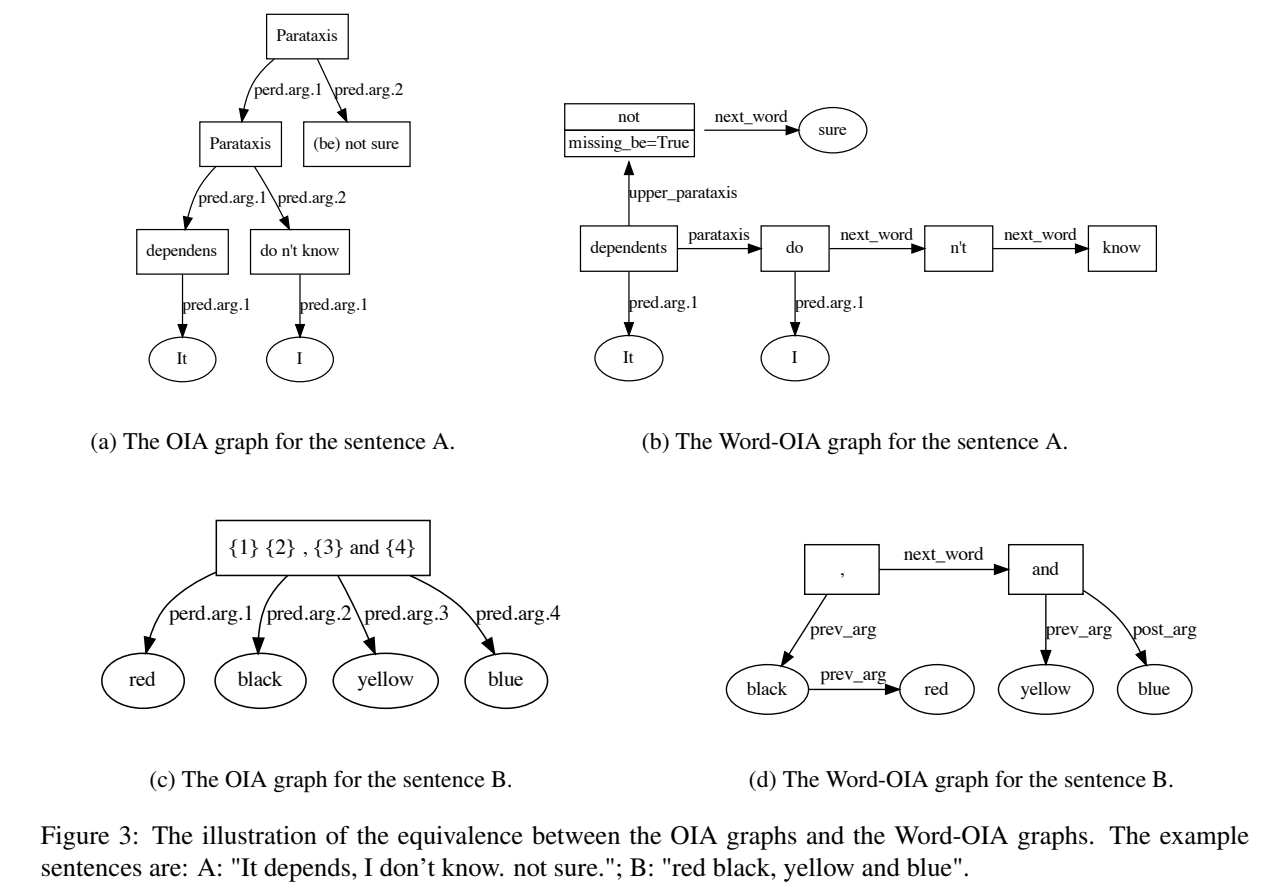
Xin Wang, et. al. 2022. OIE@OIA: an Adaptable and Efficient Open Information Extraction Framework. In Proceedings of ACL, pages 6213–6226, Dublin, Ireland.
1.1 Symbolic Representation of Language 1.1.5 Suggested Readings
1.1 Symbolic Representation of Language 1.1.5 Suggested Readings
Books
Books
Speech and Language Processing, Dan Jurafsky and James H. Martin. https://web.stanford.edu/~jurafsky/slp3/
Neural Network Methods in Natural Language Processing, Yoav Goldberg
Any Questions?
Any Questions?
Natural Language UnderstandingSymbolic Representation of Knowledge

Natural Language
Understanding
Symbolic Representation of
Knowledge
Understanding
Symbolic Representation of
Knowledge
Mingming Sun
BIMSA
Outline

Outline
History of Symbolic Knowledge Representation
Knowledge Based System
Knowledge Graph Overview
Knowledge Graph Construction
Knowledge Graph Refinement
1.2 Symbolic Representation of Knowledge 1.2.1 History of Symbolic Knowledge Representation
1.2 Symbolic Representation of Knowledge 1.2.1 History of Symbolic Knowledge Representation
Logical and Semantic Representations——Richard Montague, 1970s: Montague Grammar
Logical and Semantic Representations——Richard Montague, 1970s: Montague Grammar
Language can be given a formal, logical structure, much like the languages of mathematics and logic. (English as a Formal Language, 1970, and Universal Grammar, 1973)
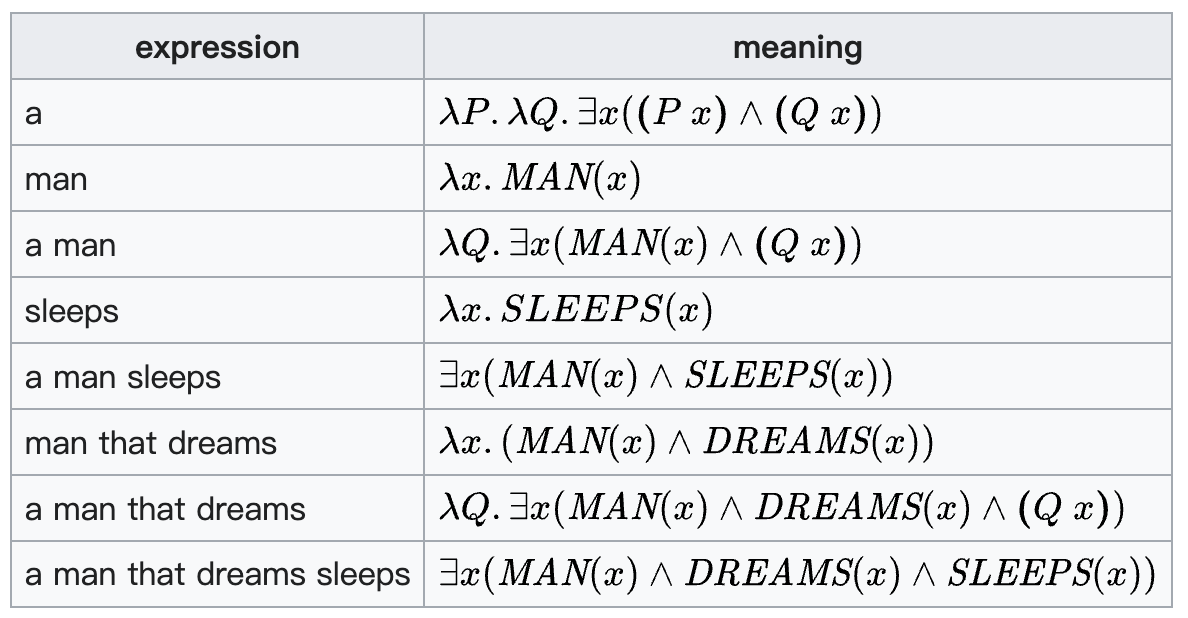
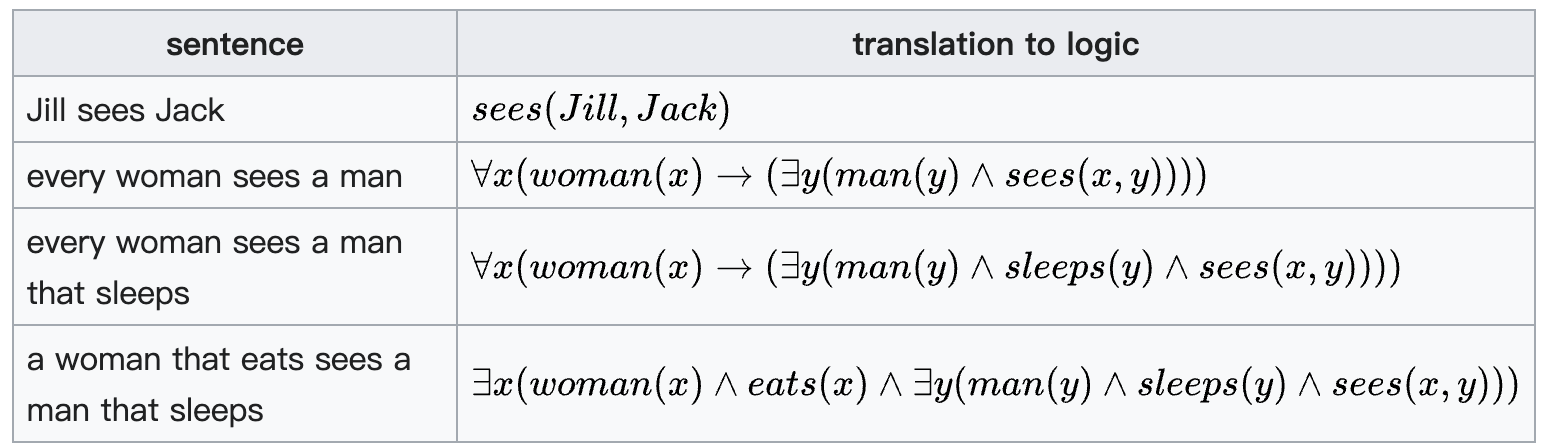
https://en.wikipedia.org/wiki/Montague_grammar
Knowledge-Based Representations——Semantic Networks (1960s–1980s)
Knowledge-Based Representations——Semantic Networks (1960s–1980s)
A semantic network is a directed graph :
Nodes represent concepts (entities, words, or ideas).
Edges represent relationships between concepts.
Instances: WordNet, ConceptNet
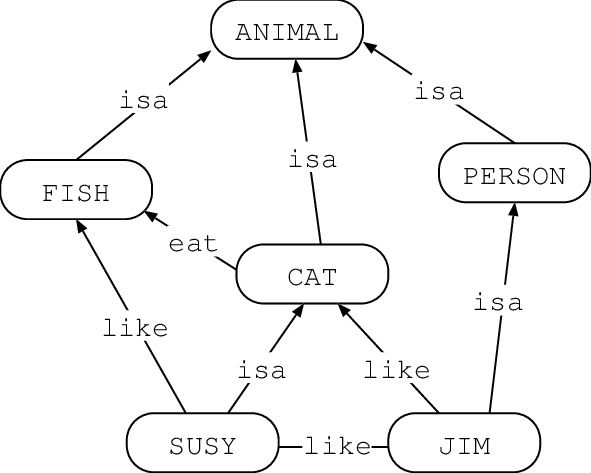
https://www.researchgate.net/publication/2701045_On_Generating_Semantic_Dispositions_in_a_Given_Subject_Domain
Types of Semantic Relations in Semantic Networks
Types of Semantic Relations in Semantic Networks
Category | Relation Type | Description | Example |
Hierarchical Relations (Taxonomy) | is-a (Hypernymy/Hyponymy) | X is a subtype of Y (generalization/specialization) | Dog is-a Mammal |
part-of (Meronymy/Holonymy) | X is a part of Y | Wheel part-of Car | |
has-a (Possession) | Y possesses X | Bird has-a Beak | |
Lexical Relations | Synonymy | X and Y have similar meanings | Big ↔ Large |
Antonymy | X and Y have opposite meanings | Hot ↔ Cold | |
Homonymy | X and Y have the same form but different meanings | Bank (financial) vs. Bank (riverbank) | |
Polysemy | X has multiple related meanings | Mouth (of a river, of a person) | |
Associative Relations | Causality (Cause-Effect) | X causes Y | Fire causes Smoke |
Entailment | If X is true, then Y must be true | Kill entails Die | |
Related-to | General associative relation | Doctor related-to Hospital | |
Thematic Roles (Case Roles) | Agent | The doer of an action | John (agent) eats an apple |
Patient | The receiver of an action | John eats an Apple (patient) | |
Instrument | The means used for an action | He wrote with a Pen (instrument) | |
Experiencer | The entity experiencing a state | She felt Happy (experiencer) | |
Event-Based Relations | Precondition | X must occur before Y | Study is required for Passing |
Temporal (Before/After) | X occurs before/after Y | Breakfast before Work | |
Subevent | X is a part of Y as an event | Buying includes Paying | |
Linguistic Relations | Coreference | X and Y refer to the same entity | John said he is happy. (he = John) |
Anaphora | X refers back to Y in discourse | Mary saw a dog. It was barking. | |
Ellipsis | Omitted elements understood from context | I like coffee, and she does too. (ellipsis of “likes coffee”) |
Knowledge-Based Representations——Frame Semantics (Charles Fillmore, 1970s)
Knowledge-Based Representations——Frame Semantics (Charles Fillmore, 1970s)
Structured representation of knowledge that provides a context for understanding words or concepts. It consists of:
Participants (Entities in the frame)
Roles (How participants interact)
Relations (Connections between roles and entities)
With the BUYING frame, when someone says: “Alice purchased a book from the store for $10.”
Instance: FrameNet
Role | Example |
Buyer | Alice |
Seller | Store |
Goods | A book |
Money | $10 |
The Central Problem: Surface Expression and Underlying Meaning
The Central Problem:
Surface Expression and Underlying Meaning
Surface Expression and Underlying Meaning
Theory | View on Surface Expression | View on Underlying Meaning | Key Mechanism of Mapping | Example |
Montague Semantics (Montague, 1970s) | Language is a formal system like logic. | Meaning is truth conditions in a formal logical system. | Lambda calculus and first-order logic assign formal meaning to expressions. | “Every student passed” = ∀x (Student(x) → Passed(x)) in logic. |
Frame Semantics (Fillmore, 1970s) | Words activate semantic frames (structured scenarios). | Meaning is a network of roles (agent, patient, action). | Words are linked to real-world experiences. | “Buy” involves a buyer, seller, goods, and money. |
Knowledge-Based Representations (WordNet, ConceptNet, 1990s–present) | Words are nodes in a network of meanings. | Meaning is defined by relations to other concepts. | Hierarchical & associative links between concepts. | “Dog” → “is-a” → “Mammal”. |
1.2 Symbolic Representation of Knowledge 1.2.2 Knowledge-Based Systems
1.2 Symbolic Representation of Knowledge 1.2.2 Knowledge-Based Systems
Components of Knowledge Based System
Components of Knowledge Based System
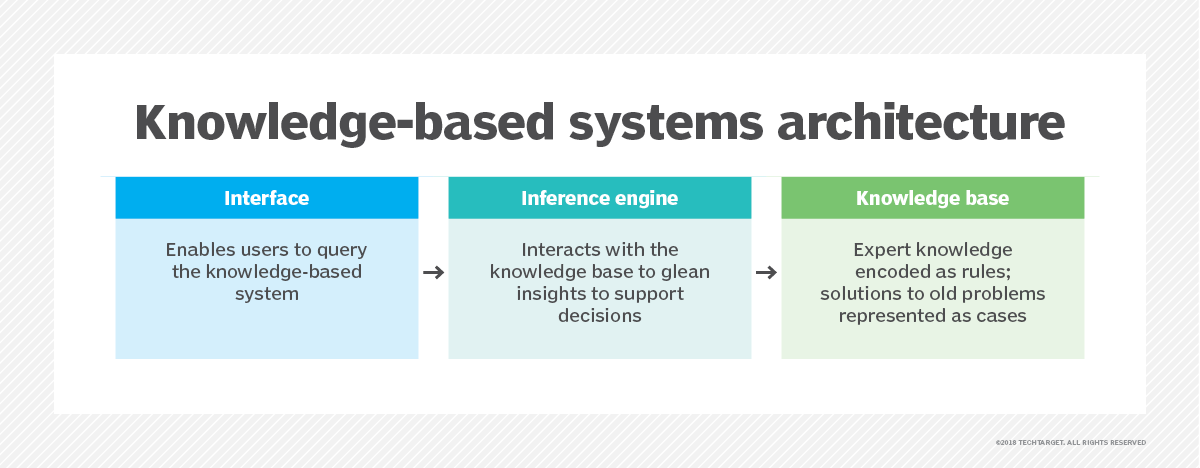
https://www.techtarget.com/searchcio/definition/knowledge-based-systems-KBS
Example of Schema/Ontology
Example of Schema/Ontology
A person owns a dog:
(isa Person Human)
(isa Dog Animal)
(owns ?person ?dog)# A person owns a dog.
A person is available:
(available ?person) # A person is available.
The weather is good:
(isa Weather Condition)
(goodWeather ?weather) # The weather is good.
Taking a dog for a walk involves the action of walking the dog:
(takesForWalk ?person ?dog) # This indicates the specific action of a person taking their dog for a walk.
Example of Knowledge
Example of Knowledge
Person availability:
(isa John Person)
(available John) #(John is available)
Ownership of the dog:
(owns John Rover) #(John owns a dog named Rover)
Weather condition:
(goodWeather Sunny) #(The weather is sunny, so it’s good)
Example of Reasoning Rules
Example of Reasoning Rules
If a person owns a dog, is available, and the weather is good, they are likely to take the dog for a walk:
(=> (and (owns ?person ?dog) (isa ?person Person) (goodWeather ?weather)) (canTakeForWalk ?person ?dog))
When apply this rule to the previous given knowledge, the following knowledge can be obtained:
(canTakeForWalk John Rover) #(John is likely to take Rover for a walk).
1.2 Symbolic Representation of Knowledge 1.2.3 Successes of Knowledge-Based Systems
1.2 Symbolic Representation of Knowledge 1.2.3 Successes of Knowledge-Based Systems
Early Breakthroughs (1950s-1970s)Logic Theorist (1956)
Early Breakthroughs (1950s-1970s)
Logic Theorist (1956)
Logic Theorist (1956)
Developed by Newell and Simon
Contribution: the first program capable of automatically proving mathematical theorems. It successfully proved 38 theorems from Principia Mathematica and even proposed more concise proof methods.
Significance: This was the first demonstration of how symbolic systems can simulate human reasoning, marking the birth of the symbolic school.
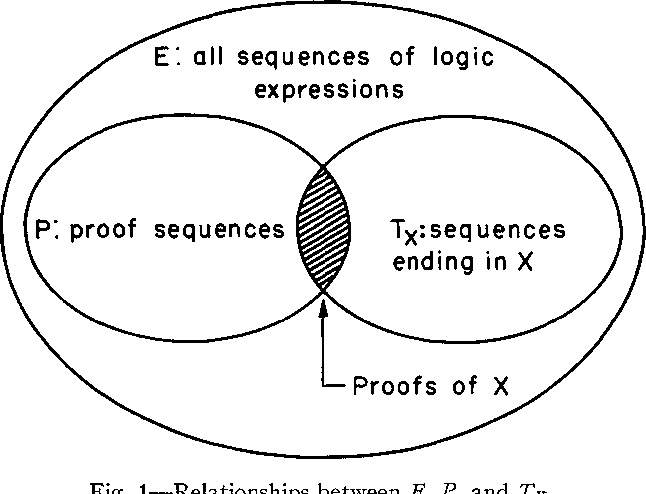
https://guillaumelauzier.com/1st-ai-projects/
Early Breakthroughs (1950s-1970s)General Problem Solver (GPS, 1957)
Early Breakthroughs (1950s-1970s)
General Problem Solver (GPS, 1957)
General Problem Solver (GPS, 1957)
Developed by Newell and Simon
Principle: The GPS used “Means-Ends Analysis” to decompose problems into sub-goals, solving them step by step.
Application: It was applied to classic problems like the Tower of Hanoi and cryptarithmetic, demonstrating that symbolic systems can handle structured problems.
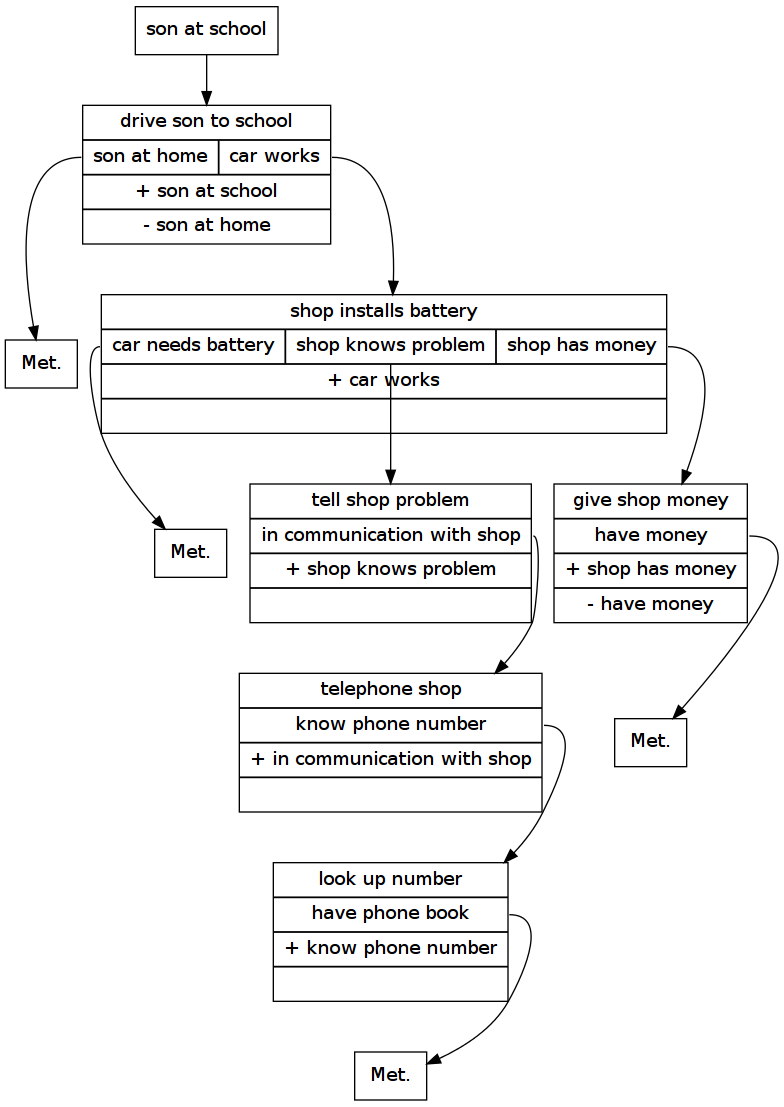
https://guillaumelauzier.com/1st-ai-projects/
Early Breakthroughs (1950s-1970s)LISP Programming Language (1958)
Early Breakthroughs (1950s-1970s)
LISP Programming Language (1958)
LISP Programming Language (1958)
Developer: John McCarthy.
Features: Specifically designed for symbolic processing, it supports recursion, list manipulation, and dynamic memory management, becoming a core tool for symbolic AI.
Impact: LISP influenced almost all programming language.
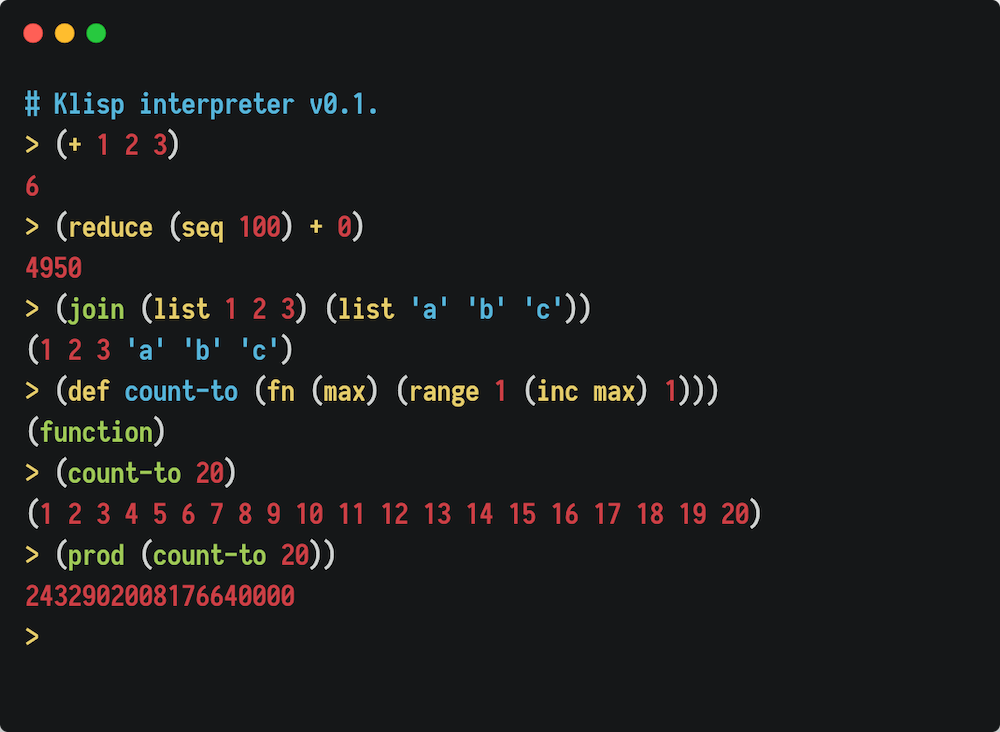
https://dotink.co/posts/klisp/
Early Breakthroughs (1950s-1970s)ELIZA: Pioneering the Conversation with Machines (1966)
Early Breakthroughs (1950s-1970s)
ELIZA: Pioneering the Conversation with Machines (1966)
ELIZA: Pioneering the Conversation with Machines (1966)
Developed in the mid-1960s by Joseph Weizenbaum at MIT
Contribution: It was one of the first AI programs to be developed and was designed to mimic human conversation by using a set of rules and patterns to generate responses to user input.
Foundational Impact: It inspired future developments in natural language processing (NLP) and chatbots, paving the way for modern AI-driven systems.
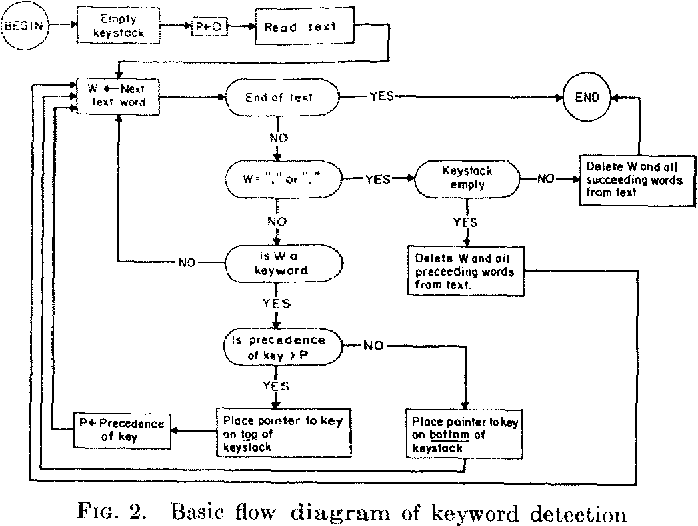
https://guillaumelauzier.com/1st-ai-projects/
Golden Age of Expert Systems (1970s-1980s)Edward Feigenbaum: Pioneer in Expert Systems and AI
Golden Age of Expert Systems (1970s-1980s)
Edward Feigenbaum: Pioneer in Expert Systems and AI
Edward Feigenbaum: Pioneer in Expert Systems and AI
Background:
Born 1936, Ph.D. in Computer Science from Stanford University.
Renowned for his work in symbolic AI and knowledge-based systems.
Key Contributions: DENDRAL (1960s-70s) and MYCIN (1970s)
Core Beliefs:
Advocated for symbolic AI using formal logic and rule-based reasoning to represent knowledge and simulate human intelligence.
Emphasized the importance of knowledge representation in solving complex problems.
Legacy:
Turing Award (1994) for his pioneering work in AI.
His work laid the foundation for modern AI applications in medicine, science, and more.
https://www.britannica.com/biography/Edward-Albert-Feigenbaum

Golden Age of Expert Systems (1970s-1980s)DENDRAL System (1965-1970s)
Golden Age of Expert Systems (1970s-1980s)
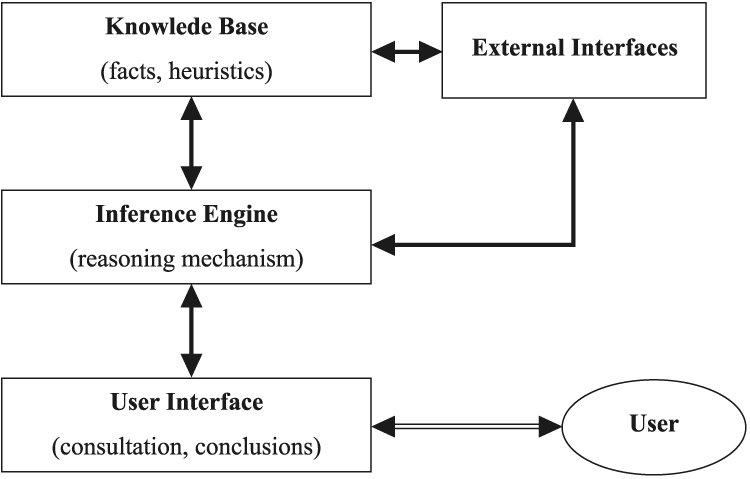
DENDRAL System (1965-1970s)
DENDRAL System (1965-1970s)
Domain: Chemical mass spectrometry analysis.
Function: Used rule-based reasoning to identify the molecular structure of unknown organic compounds.
Reasons for Success:
Combined a chemical expert knowledge base with heuristic search algorithms.
Achieved or even surpassed the accuracy of human experts in experiments.
https://expertsystem101.weebly.com/dendral.html
Golden Age of Expert Systems (1970s-1980s)MYCIN System (1976)
Golden Age of Expert Systems (1970s-1980s)
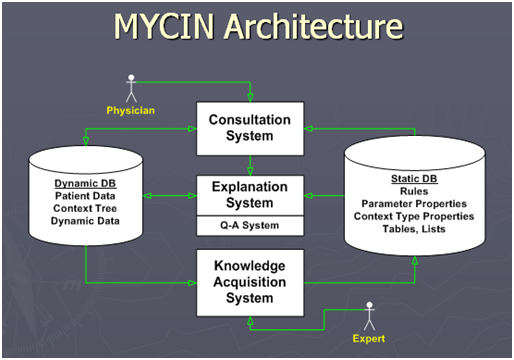
MYCIN System (1976)
MYCIN System (1976)
Domain: Medical diagnosis (blood infections).
Technical Highlights:
Used “production rules” (If-Then rule bases) to represent medical knowledge.
Introduced uncertainty reasoning (confidence factors).
Outcome:
Achieved diagnostic accuracy comparable to top doctors, becoming a milestone in medical AI.
https://medium.com/version-1/an-overview-of-the-rise-and-fall-of-expert-systems-14e26005e70e
Golden Age of Expert Systems (1970s-1980s)XCON (R1) System (1980s)
Golden Age of Expert Systems (1970s-1980s)
XCON (R1) System (1980s)
XCON (R1) System (1980s)
Domain: Computer hardware configuration (DEC Corporation).
Value: Saved DEC $25 million annually and reduced error rates from 30% to 2%.
Significance:
The first large-scale commercial expert system, demonstrating the practical economic value of symbolic AI.
Deepening Knowledge Engineering and Knowledge RepresentationParadigms of Knowledge Representation
Deepening Knowledge Engineering and Knowledge Representation
Paradigms of Knowledge Representation
Paradigms of Knowledge Representation
Frame Theory (1974):
Proposed by Marvin Minsky, it uses “frames” to represent the structured knowledge of objects.
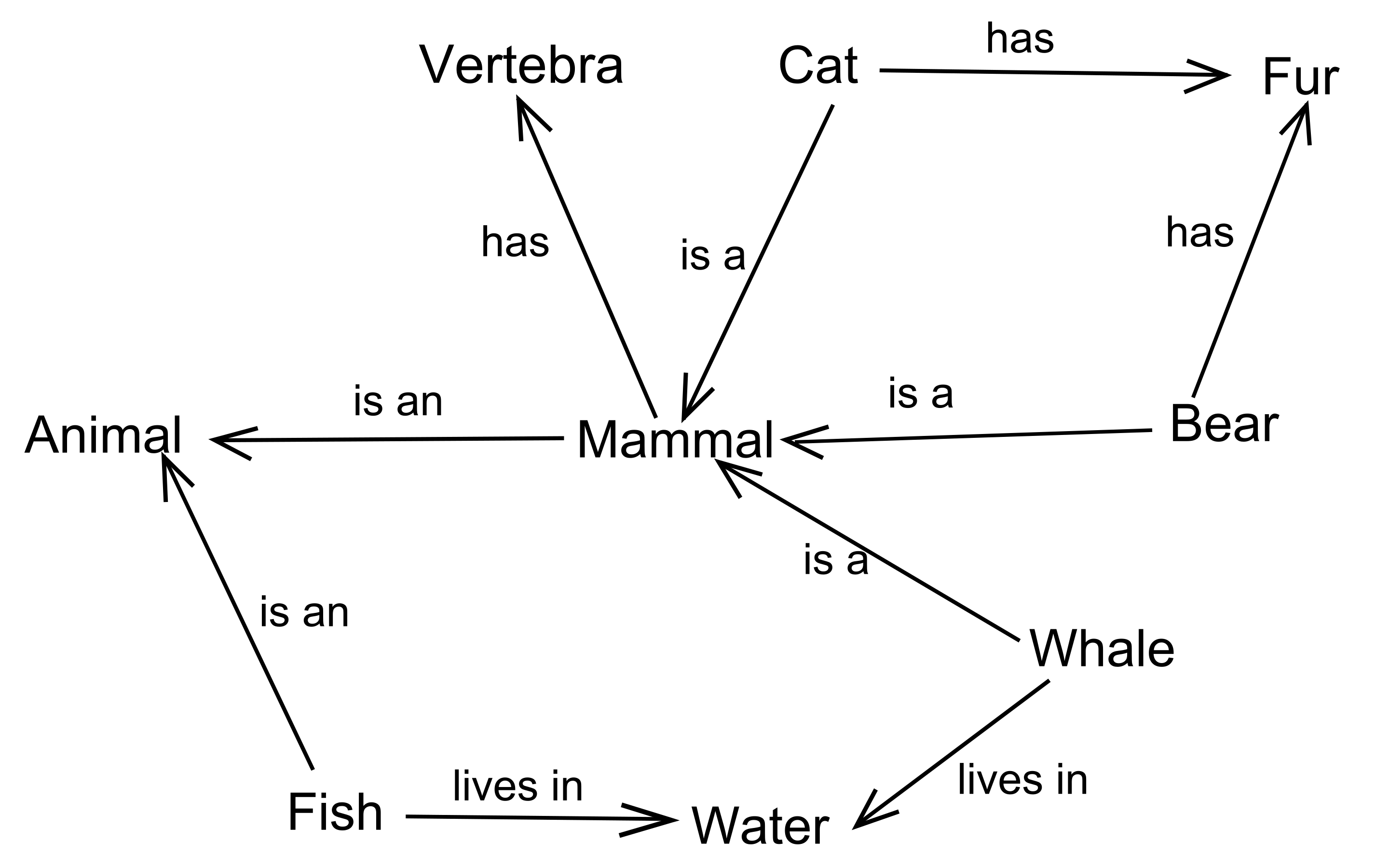
Semantic Networks:
Represent relationships between concepts using nodes and edges, laying the foundation for knowledge graphs.
https://en.wikipedia.org/wiki/Semantic_network#/media/File:Semantic_Net.svg
Deepening Knowledge Engineering and Knowledge RepresentationCyc Project (1984)
Deepening Knowledge Engineering and Knowledge Representation
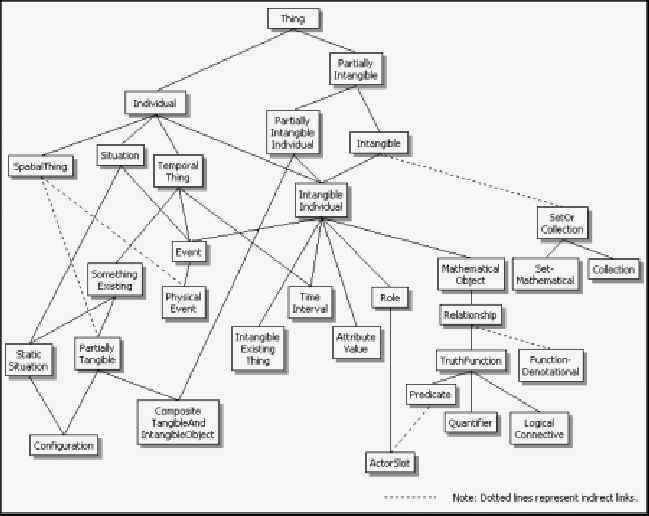
Cyc Project (1984)
Cyc Project (1984)
Goal: To build a massive knowledge base of human common sense.
Method: Manually encoding millions of logical assertions (e.g., “water is a liquid”).
Controversy and Insights: Although the goal was not fully achieved, it highlighted the challenges of symbolic systems in handling common sense and advanced knowledge representation research.
https://www.researchgate.net/figure/The-Upper-Cyc-Ontology_fig2_228368116
Deepening Knowledge Engineering and Knowledge RepresentationProlog Language (1972)
Deepening Knowledge Engineering and Knowledge Representation
Prolog Language (1972)
Prolog Language (1972)
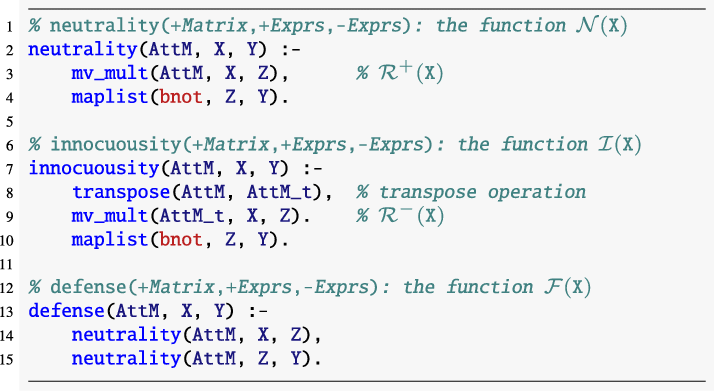
Developer: Alain Colmerauer.
Features: A declarative programming language based on first-order logic, supporting automatic reasoning.
Application: Core tool in Japan’s “Fifth Generation Computer Project,” promoting the international development of symbolic AI.
https://medium.com/@neerajsharma95/understanding-logical-programming-paradigm-with-prolog-49b738a293ca
1.2 Symbolic Representation of Knowledge 1.2.4 Limitations of Knowledge-Based Systems
1.2 Symbolic Representation of Knowledge 1.2.4 Limitations of Knowledge-Based Systems
Technical Bottlenecks and Classic FailuresDecline of Expert Systems (1980s-1990s)
Technical Bottlenecks and Classic Failures
Decline of Expert Systems (1980s-1990s)
Decline of Expert Systems (1980s-1990s)
Case: XCON System (DEC Corporation)
Early Success:
In the 1980s, the XCON system saved DEC tens of millions of dollars annually.
Reasons for Failure:
High Knowledge Maintenance Costs: Hardware configuration rules frequently updated with product iterations required continuous manual intervention.
Poor Generalization: The system could not be adapted to other domains (e.g., software design).
Outcome:
By the 1990s, DEC went bankrupt, and XCON was discontinued.
Industry-wide Collapse:
Companies found that the cost of developing expert systems far exceeded the benefits, and the commercial value bubble burst.
In 1993, the U.S. AI industry market shrank by 50%, leading to what is known as the “AI Winter.”
Technical Bottlenecks and Classic FailuresCyc Project: The Utopian Failure of Common Sense Engineering (1984-Present)
Technical Bottlenecks and Classic Failures
Cyc Project: The Utopian Failure of Common Sense Engineering (1984-Present)
Cyc Project: The Utopian Failure of Common Sense Engineering (1984-Present)
Goal:
Build a knowledge base covering human common sense (e.g., “birds can fly,” “glass cups are fragile”).
Failures:
Knowledge Encoding Disaster: After 40 years and over 25 million manually entered logical assertions, the complexity of common sense was still far from being covered.
Rigid Reasoning: Could not handle exceptions (e.g., “penguins are birds but cannot fly”) and context-dependent situations (e.g., “water is drinkable” vs. “floods are dangerous”).
Lesson:
Common sense cannot be realized through exhaustive rule systems as a “closed system.”
Technical Bottlenecks and Classic FailuresJapan’s Fifth Generation Computer Project (1982-1992)
Technical Bottlenecks and Classic Failures
Japan’s Fifth Generation Computer Project (1982-1992)
Japan’s Fifth Generation Computer Project (1982-1992)
Ambition:
Build an “intelligent computer” based on Prolog and symbolic logic to lead the global AI field.
Reasons for Failure:
Single Technology Path: Over-reliance on symbolic reasoning, neglecting other capabilities such as perception and learning.
Mismatch between Hardware and Algorithms: Parallel reasoning machines were difficult to implement, and Prolog’s efficiency was inadequate.
Outcome:
With a decade-long investment of $850 million, the results were almost negligible, severely damaging the international reputation of symbolic AI.
Theoretical Defects of the Symbolic SchoolKnowledge Acquisition Bottleneck
Theoretical Defects of the Symbolic School
Knowledge Acquisition Bottleneck
Knowledge Acquisition Bottleneck
Problem:
Knowledge depends on manual encoding, making it difficult to automatically learn from data.
Case: MYCIN Medical System
The system required doctors to input thousands of diagnostic rules, which took years.
When faced with new diseases (e.g., AIDS), the system could not autonomously update its knowledge base.
Theoretical Defects of the Symbolic SchoolInability to Handle Uncertainty
Theoretical Defects of the Symbolic School
Inability to Handle Uncertainty
Inability to Handle Uncertainty
Rigidity of Symbolic Logic:
Symbolic systems only support binary logic (True/False), making it impossible to handle probability, vagueness, or partial truths.
Counterexample:
In autonomous driving, real-time decisions like “a pedestrian suddenly appears” require probabilistic reasoning, which symbolic systems cannot address.
Theoretical Defects of the Symbolic SchoolCombinatorial Explosion
Theoretical Defects of the Symbolic School
Combinatorial Explosion
Combinatorial Explosion
Problem:
The search space of symbolic reasoning grows exponentially with the size of the problem.
Case: Automated Theorem Provers
These systems work efficiently for logical propositions with up to 10 steps but become uncontrollable in computation time when the number of steps exceeds 100.
In 1996, IBM’s Deep Blue defeated the world chess champion, relying on brute-force search rather than symbolic reasoning.
Theoretical Defects of the Symbolic SchoolLack of Common Sense and Contextual Understanding
Theoretical Defects of the Symbolic School
Lack of Common Sense and Contextual Understanding
Lack of Common Sense and Contextual Understanding
Vulnerability of Symbolic Systems:
Symbolic systems cannot understand “implicit knowledge” (e.g., “a cup overturned will spill water” requires physical common sense).
Classic Failures:
Early chatbots (e.g., ELIZA) simply matched keywords, leading to responses that were often absurd or nonsensical.
External Shocks and Paradigm ShiftRise of Connectionism (1980s-2000s)
External Shocks and Paradigm Shift
Rise of Connectionism (1980s-2000s)
Rise of Connectionism (1980s-2000s)
Technological Comparison:
Symbolism: Rule-driven (logic designed by humans), high interpretability, poor generalization.
Connectionism: Data-driven (automatically learning features), low interpretability, strong generalization.
Turning Point:
In 2012, AlexNet outperformed traditional symbolic methods in the ImageNet image recognition competition, and deep learning became mainstream.
External Shocks and Paradigm ShiftBig Data and Computational Power Revolution
External Shocks and Paradigm Shift
Big Data and Computational Power Revolution
Big Data and Computational Power Revolution
Critical Weakness of Symbolism:
Symbolic AI relies on small-scale manually annotated knowledge and cannot take advantage of the massive amounts of unstructured data available in the internet era (e.g., text, images).
Case Comparison:
Symbolic School: The Cyc project spent 40 years building 25 million rules.
Connectionism: GPT-3 learned 175 billion parameters from 450 TB of text data through automatic learning.
External Shocks and Paradigm ShiftShift in Industry Demands
External Shocks and Paradigm Shift
Shift in Industry Demands
Shift in Industry Demands
Reasons for Enterprises Abandoning Symbolic AI:
Expert systems had long development cycles and high costs, whereas deep learning models can iterate quickly (e.g., recommendation systems, speech recognition).
Symbolic systems struggled to be embedded into real-time applications (e.g., autonomous driving requires millisecond-level responses).
Simplified Version: Knowledge Graph
Simplified Version: Knowledge Graph
Focus on Specific Domains/Tasks/Products
Simplified Knowledge Expression
Natural Incorporate Machine Learning Techniques for Acquiring and Maintaining Knowledge
Able to Handling Ambiguity and Uncertainty
Simplified Reasoning Methods
1.2 Symbolic Representation of Knowledge 1.2.5 Introduction to Knowledge Graphs
1.2 Symbolic Representation of Knowledge 1.2.5 Introduction to Knowledge Graphs
Representing Knowledge via Graphs
Representing Knowledge via Graphs
Why not Tables?
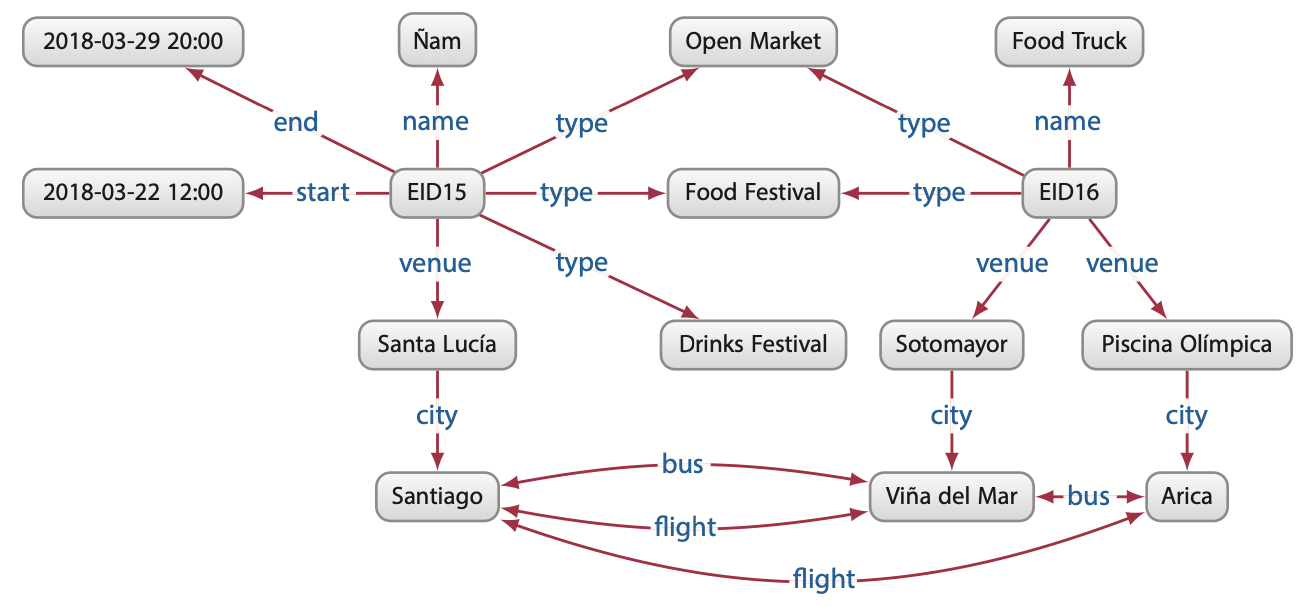
Example: Table Event(name, venue, type, start, end)
Problems: multiple names, multiple types, unknown fields
New representing method:
EventName(id,name);
EventStart(id,start);
EventEnd(id,end);
EventVenue(id,venue);
EventType(id,type);
Schema
Schema
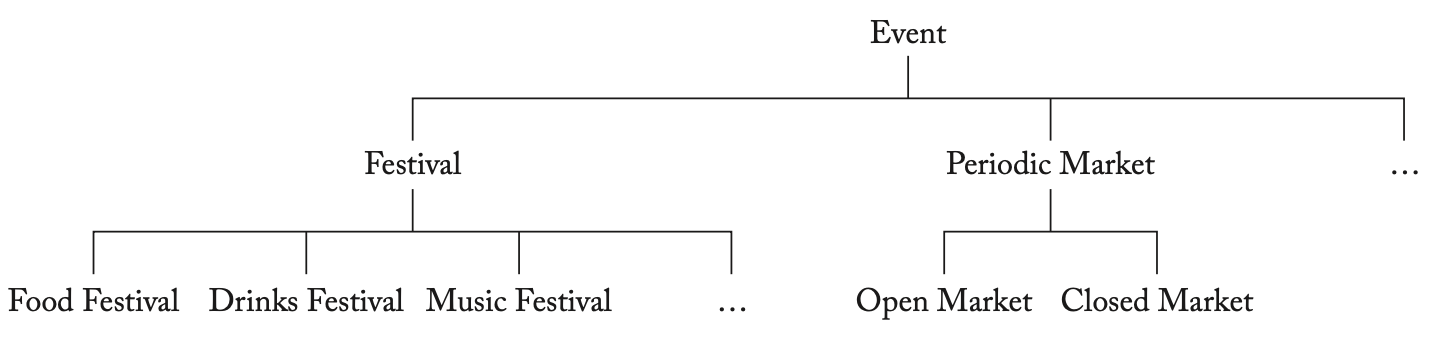
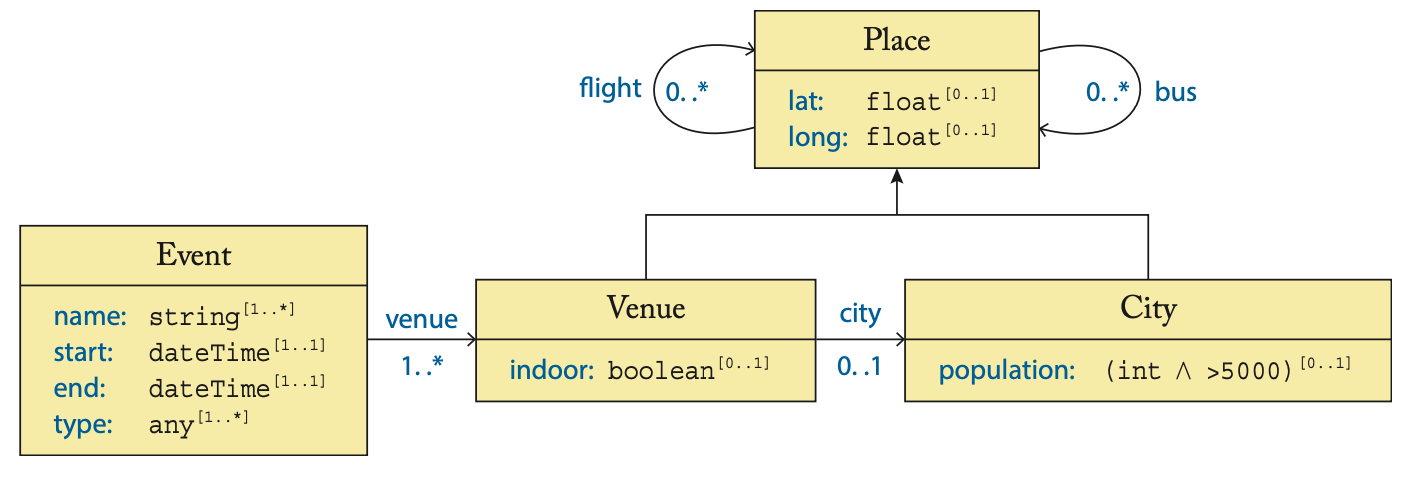
Schema prescribes a high-level structure and/or semantics that the graph follows or should follow.
Aidan Hogan, et.al, Knowledge Graphs, 2021
Identity
Identity
Globally-unique identifiers to help avoid such ambiguity.
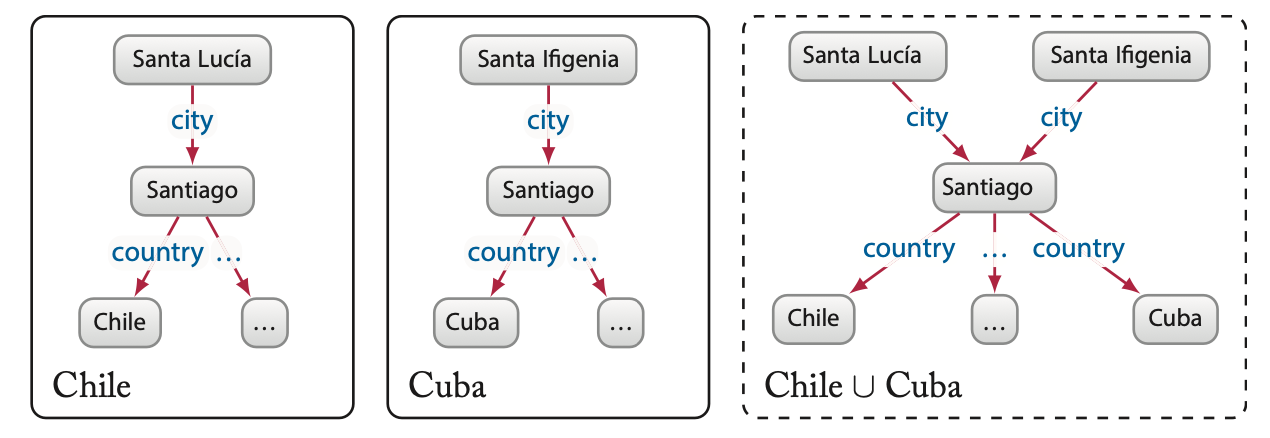
Aidan Hogan, et.al, Knowledge Graphs, 2021
Context
Context
Many (arguably all) facts can be considered true with respect to a certain context.
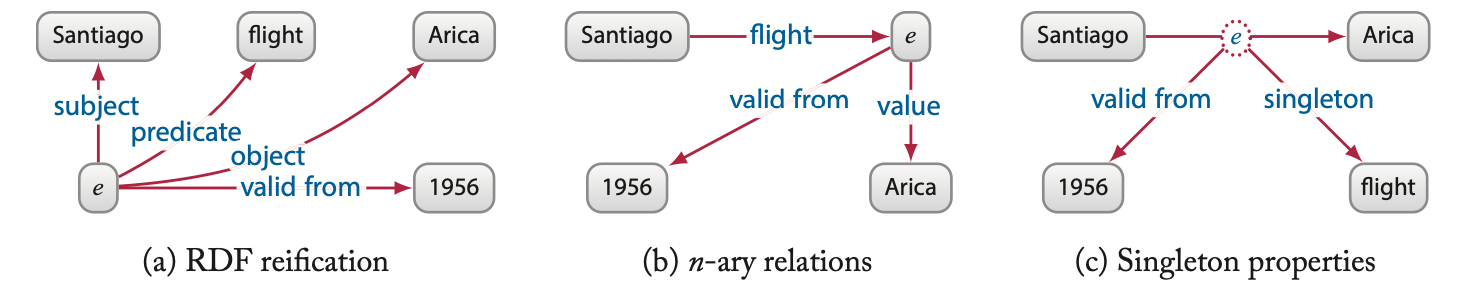
Aidan Hogan, et.al, Knowledge Graphs, 2021
Representing Knowledge as Graphs
Representing Knowledge as Graphs
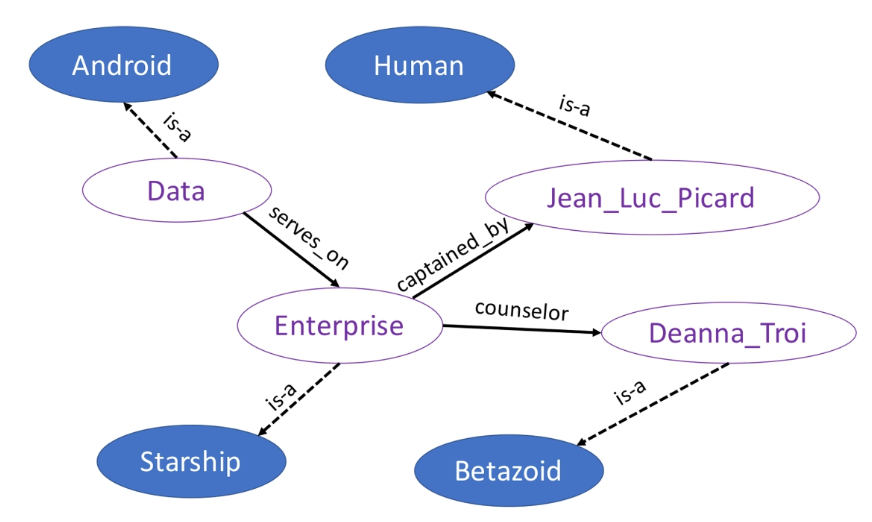
Taxonomy
Ontologies
More Examples: Scientific Publications
More Examples: Scientific Publications
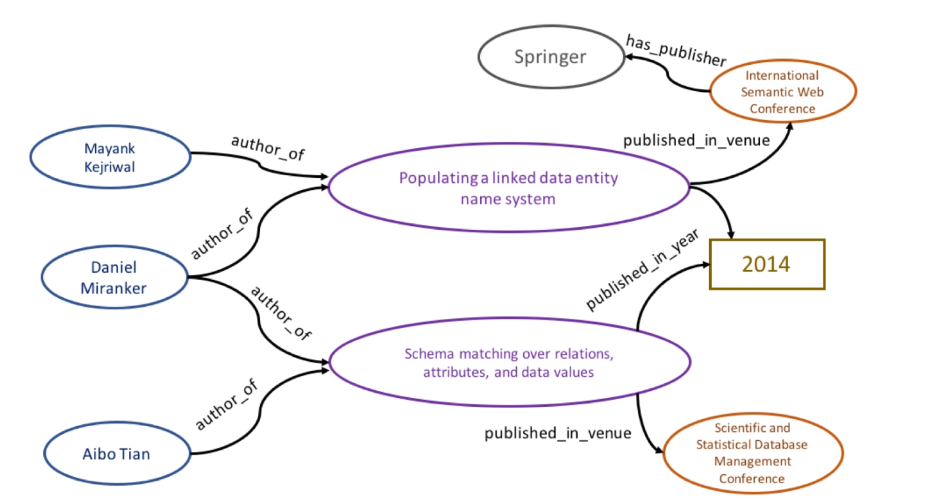
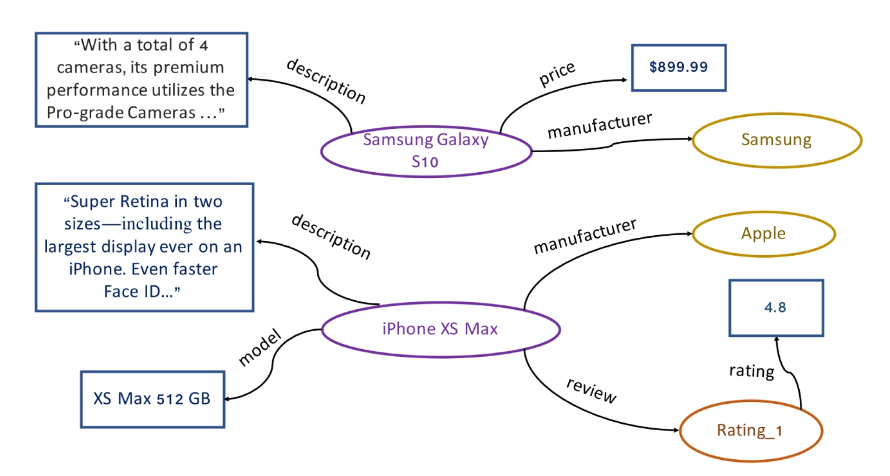
More Examples: E-Commerce
More Examples: E-Commerce
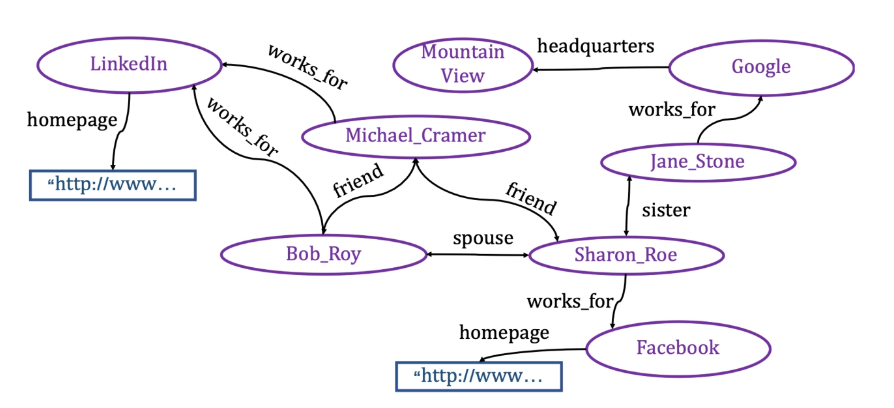
More Examples: Social Networks
More Examples: Social Networks
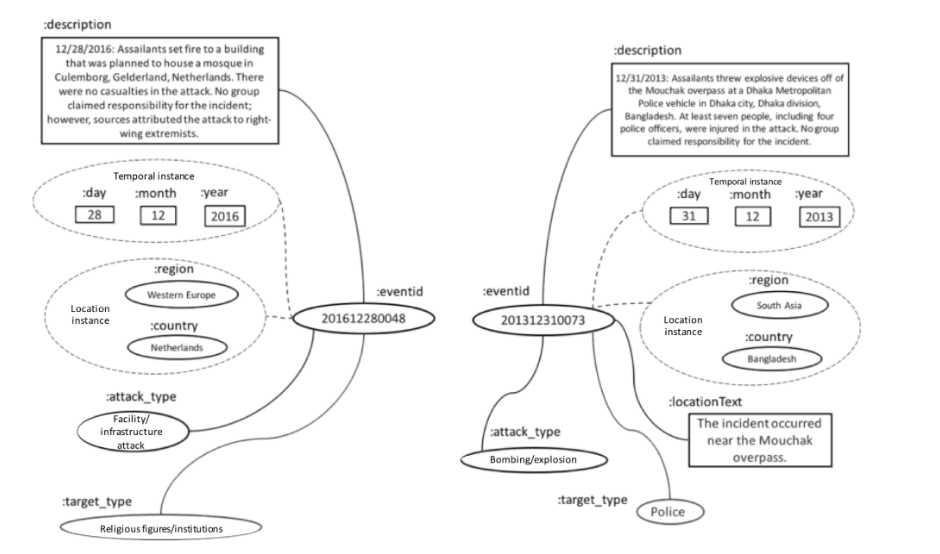
More Examples: Geopolitical Events
More Examples: Geopolitical Events
Query/Edit the Graphs
Query/Edit the Graphs
MATCH (startContent:Content)-[relationship:IS_RELATED_TO]->(endContent:Content) WHERE endContent.source = 'user' OPTIONAL MATCH (endContent)-[r]-() DELETE relationship, endContent
Cypher for Neo4J
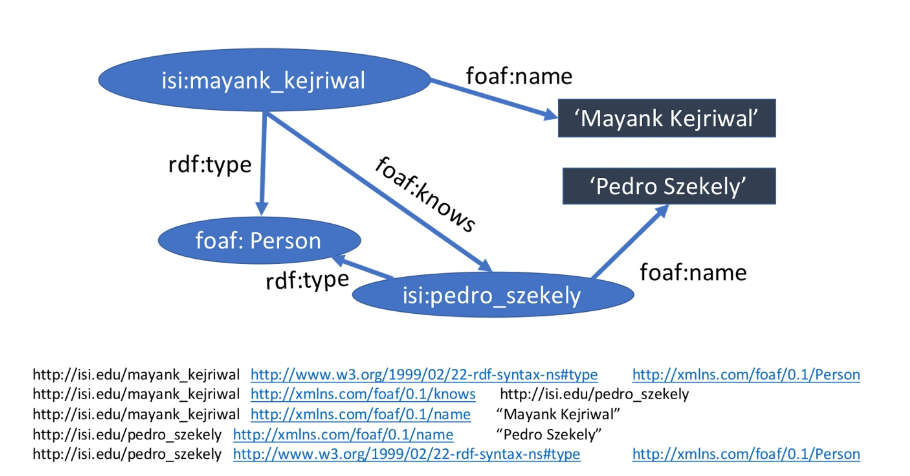
Framework: Resource Description Framework
Framework: Resource Description Framework
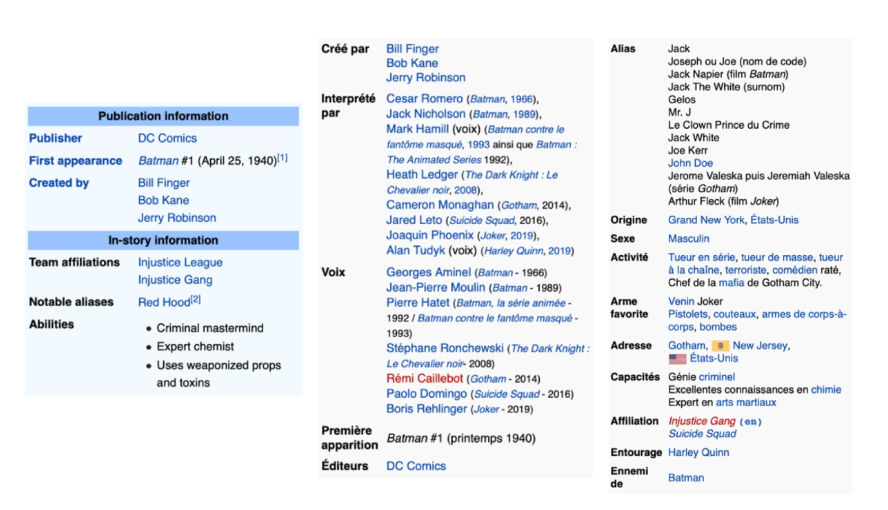
Framework: Wikidata
Framework: Wikidata
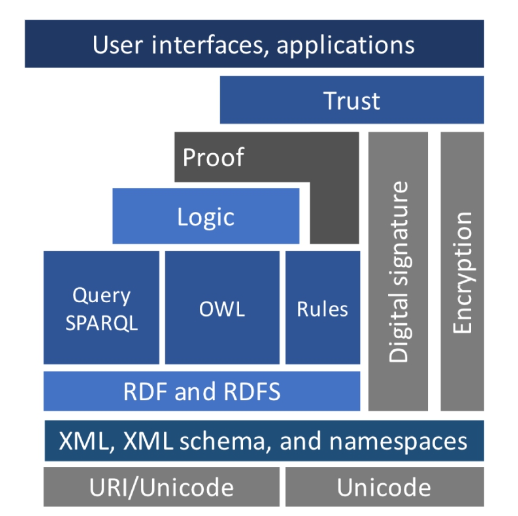
Framework: Semantic Web
Framework: Semantic Web
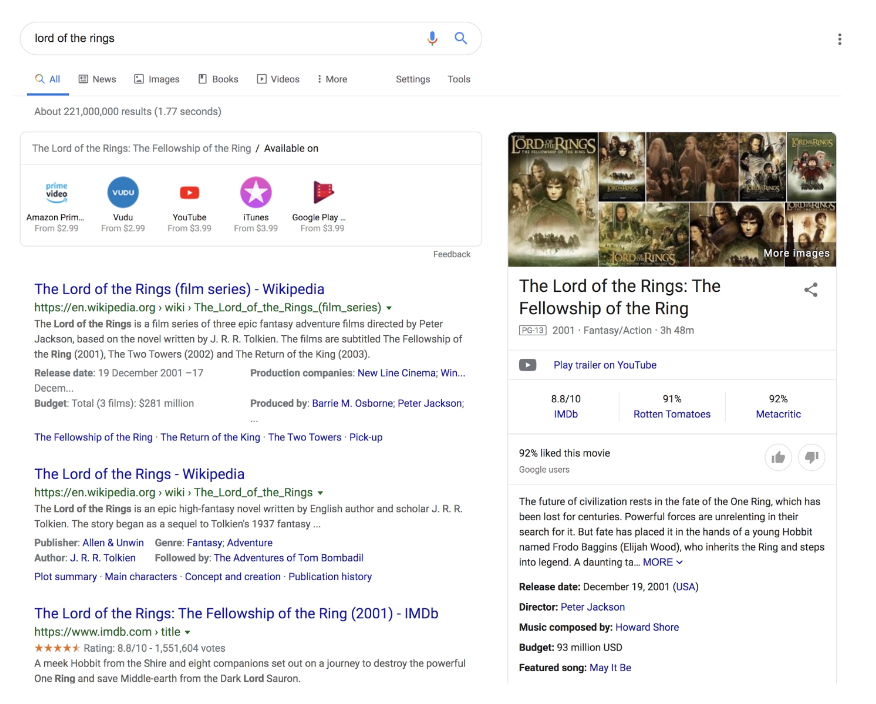
The Value of Knowledge Graph in Web Search
The Value of Knowledge Graph in Web Search

The Value of Knowledge Graph in LLM Ages
The Value of Knowledge Graph in LLM Ages
Memory System for LLM
Reducing Hallucinations with Reliable Knowledge Source (vs LLM Knowledge Editing)
Multi-Hop reasoning and efficient calculation over Graphs
Entity Linking and Disambiguation
Cross-Document Information Gathering.
1.2 Symbolic Representation of Knowledge 1.2.6 Knowledge Graph Construction
1.2 Symbolic Representation of Knowledge 1.2.6 Knowledge Graph Construction
Whole Picture
Whole Picture
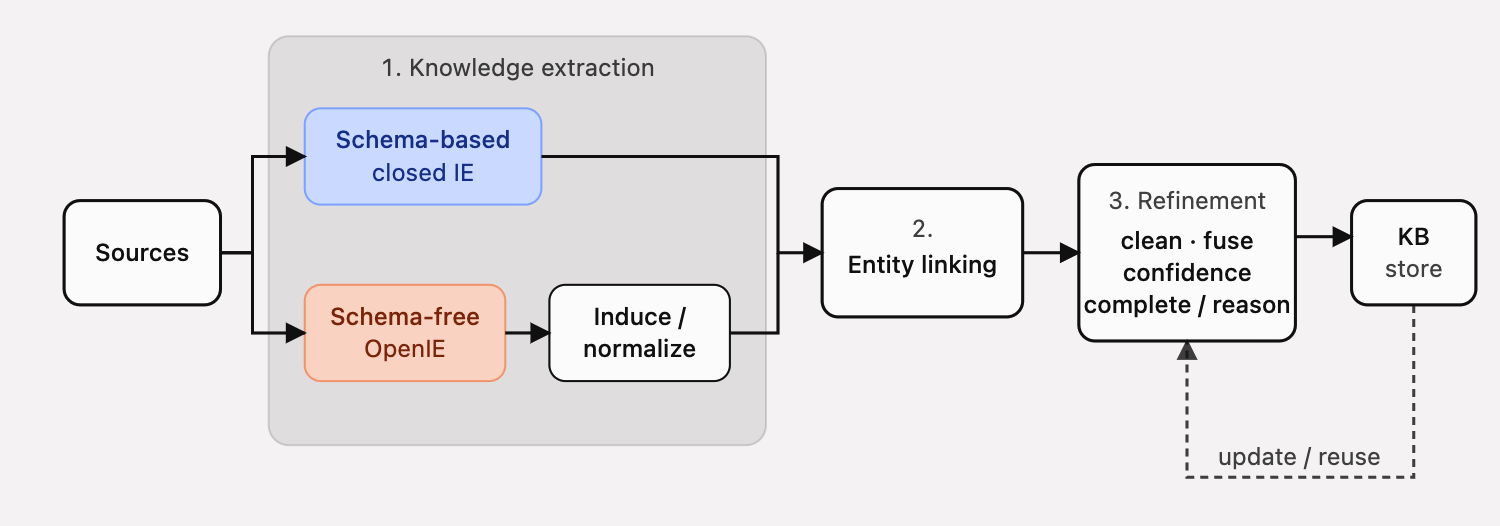
Knowledge extraction: Schema or Not?
Knowledge extraction: Schema or Not?
Dimension | Schema-based | Schema-free |
Prior knowledge | Strong (know what you need) | Weak (discover what the text contains) |
Quality profile | Precise, consistent, alignable | Broad, noisy, needs post-processing |
Evolution | Schema changes are costly | Easy to absorb new relations |
Typical pipeline | Define schema → extract → ingest | Open extraction → induce/normalize → ingest |
1.2 Symbolic Representation of Knowledge 1.2.7 Schema-Based Knowledge Extraction
1.2 Symbolic Representation of Knowledge 1.2.7 Schema-Based Knowledge Extraction
Expert Interview and Schema Design
Expert Interview and Schema Design
Expert Interviews: To capture domain expertise and tacit knowledge, identify key entities, relationships, and attributes within the domain.
Schema Design: To define the structure of the Knowledge Graph, ensuring it can accurately represent the domain knowledge.
Output: A well-defined schema that captures domain knowledge efficiently and serves as the blueprint for building the Knowledge Graph.
Seed Sample Mining or Labeling
Seed Sample Mining or Labeling
Seed Sample Mining: To identify a small set of initial entities and relationships that can serve as the foundation of the Knowledge Graph under the guidance of the schema;
Labeling Existing Data: To manually label data or use semi-automated techniques to identify relevant entities and relationships in existing datasets.
Outcome: This stage produces a set of labeled or mined seed samples that will form the basis of the Knowledge Graph.
Training Knowledge Acquisition Components
Training Knowledge Acquisition Components
Named Entity Recognition (NER): Identify and classify entities (into the schema’s typing system) from unstructured data.
Relation Extraction: Automatically detect and extract relationships between entities.
Entity Linking: Connect identified entities to their corresponding entries the knowledge graph;
Acquire Knowledges and Evaluation
Acquire Knowledges and Evaluation
Run the trained acquisition components at scale on unstructured text to populate the Knowledge Graph;
Or acquire knowledge from other sources (table, other KG, LLM);
Systematically evaluating the quality and coverage of the acquired knowledge.
Outcome: This stage delivers a populated, structured, and evaluated Knowledge Graph ready for deployment.
1.2 Symbolic Representation of Knowledge 1.2.8 Named Entity Recognition
1.2 Symbolic Representation of Knowledge 1.2.8 Named Entity Recognition
Named Entity Recognition For Specific Domain/Task
Named Entity Recognition For Specific Domain/Task
Generally, tasks want entities belonging to several given types and neglect other entities.
Joint learning detection and typing.
https://www.researchgate.net/publication/330424080_Adverse_Drug_Events_Detection_in_Clinical_Notes_by_Jointly_Modeling_Entities_and_Relations_Using_Neural_Networks
Existing Models and Tools: Spacy
Existing Models and Tools: Spacy
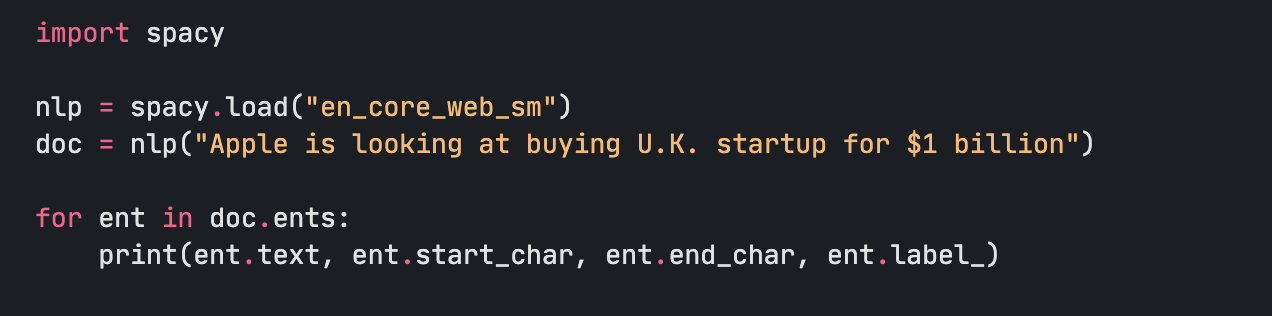
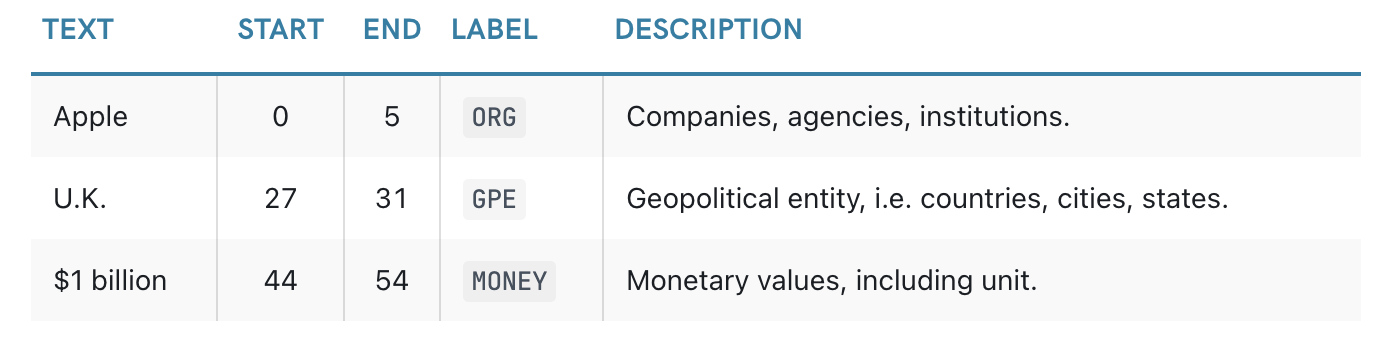
https://spacy.io/usage/linguistic-features#named-entities
Challenge: Nested Entities
Challenge: Nested Entities
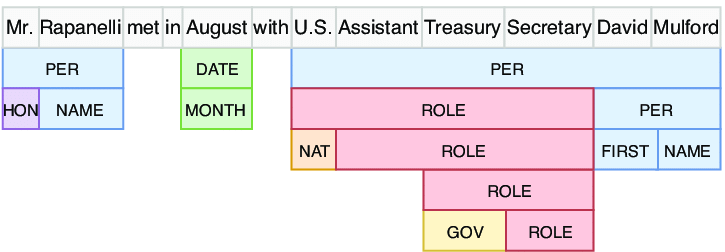
Sławomir Dadas, Bidirectional Iterative Algorithm for Nested Named Entity Recognition, 2020

Challenge: Different Criterion
Challenge: Different Criterion
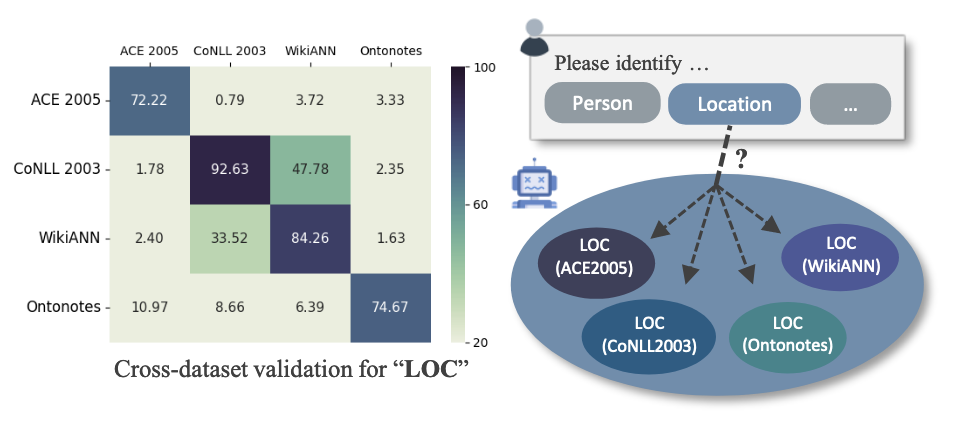
The Great wall
The Great wall, Beijing
Yuming Yang, et. al, Beyond Boundaries: Learning a Universal Entity Taxonomy across Datasets and Languages for Open Named Entity Recognition, 2024
1.2 Symbolic Representation of Knowledge 1.2.9 Relation Extraction
1.2 Symbolic Representation of Knowledge 1.2.9 Relation Extraction
Relation Extraction Problem
Relation Extraction Problem
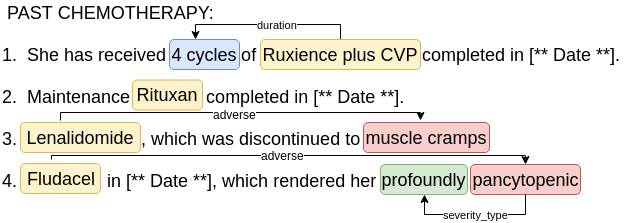
Multiple Features for Clinical Relation Extraction: a Machine Learning Approach, Journal of Biomedical Informatics
When a pair of Entities/Interested Phrases are detected, one can identify whether there exists a relation between them, and the type of the relation if exists.
Relation Extraction Methods
Relation Extraction Methods
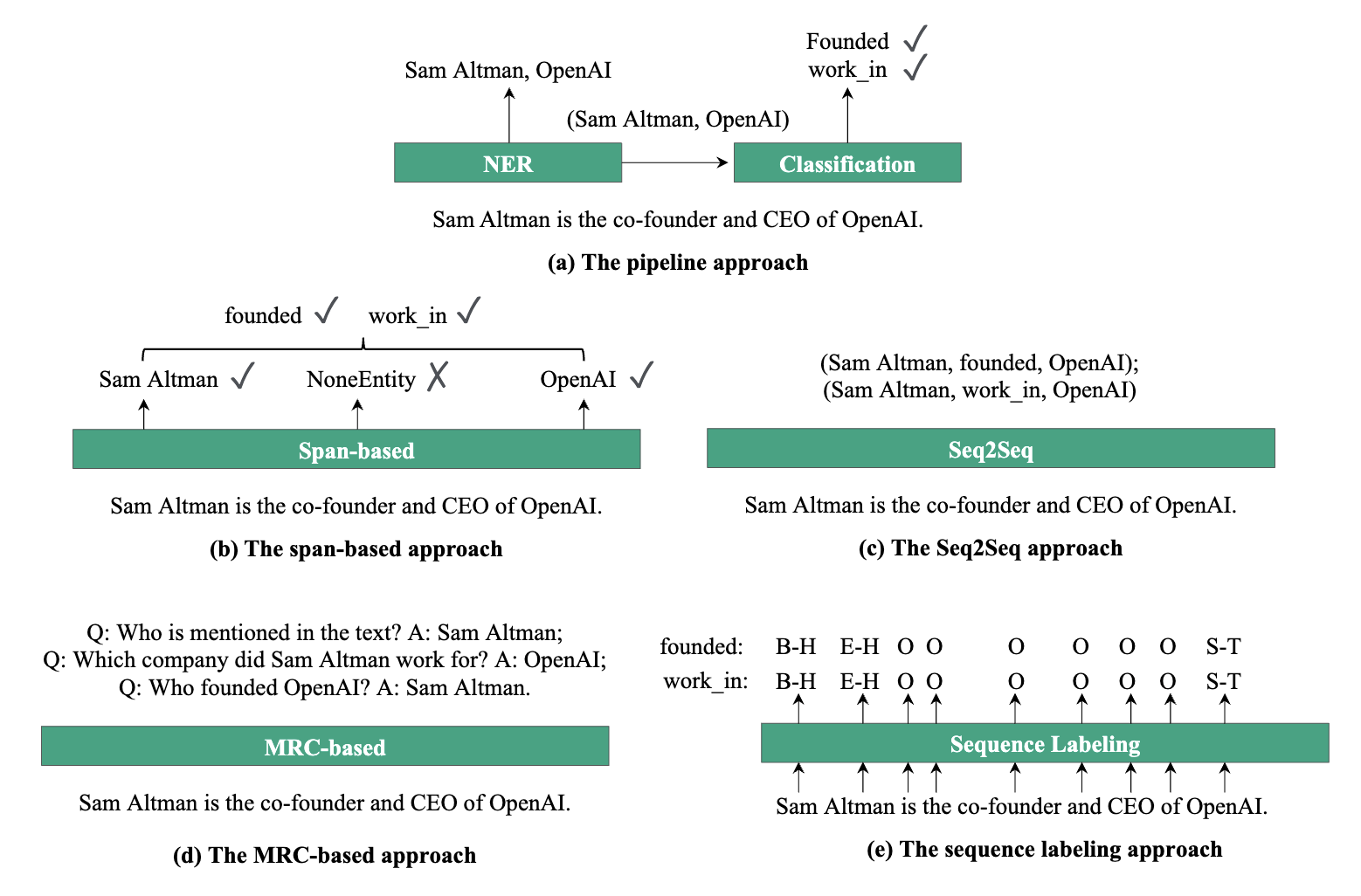
https://arxiv.org/pdf/2306.02051v3
Beyond the Sentence Level
Beyond the Sentence Level
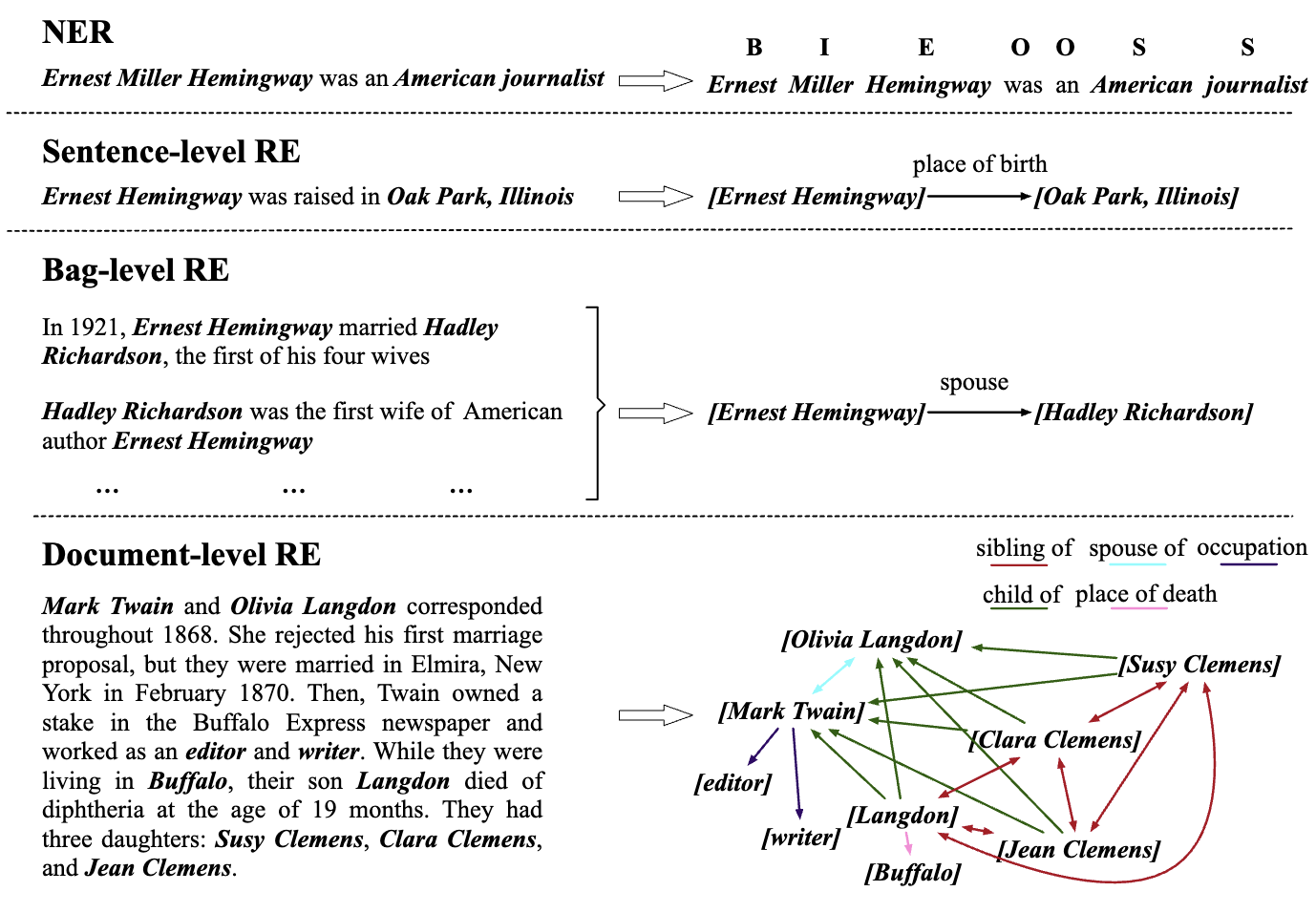
https://aclanthology.org/D19-3029.pdf
Existing Models and Tools
Existing Models and Tools
OpenNRE: An Open and Extensible Toolkit for Neural Relation Extraction
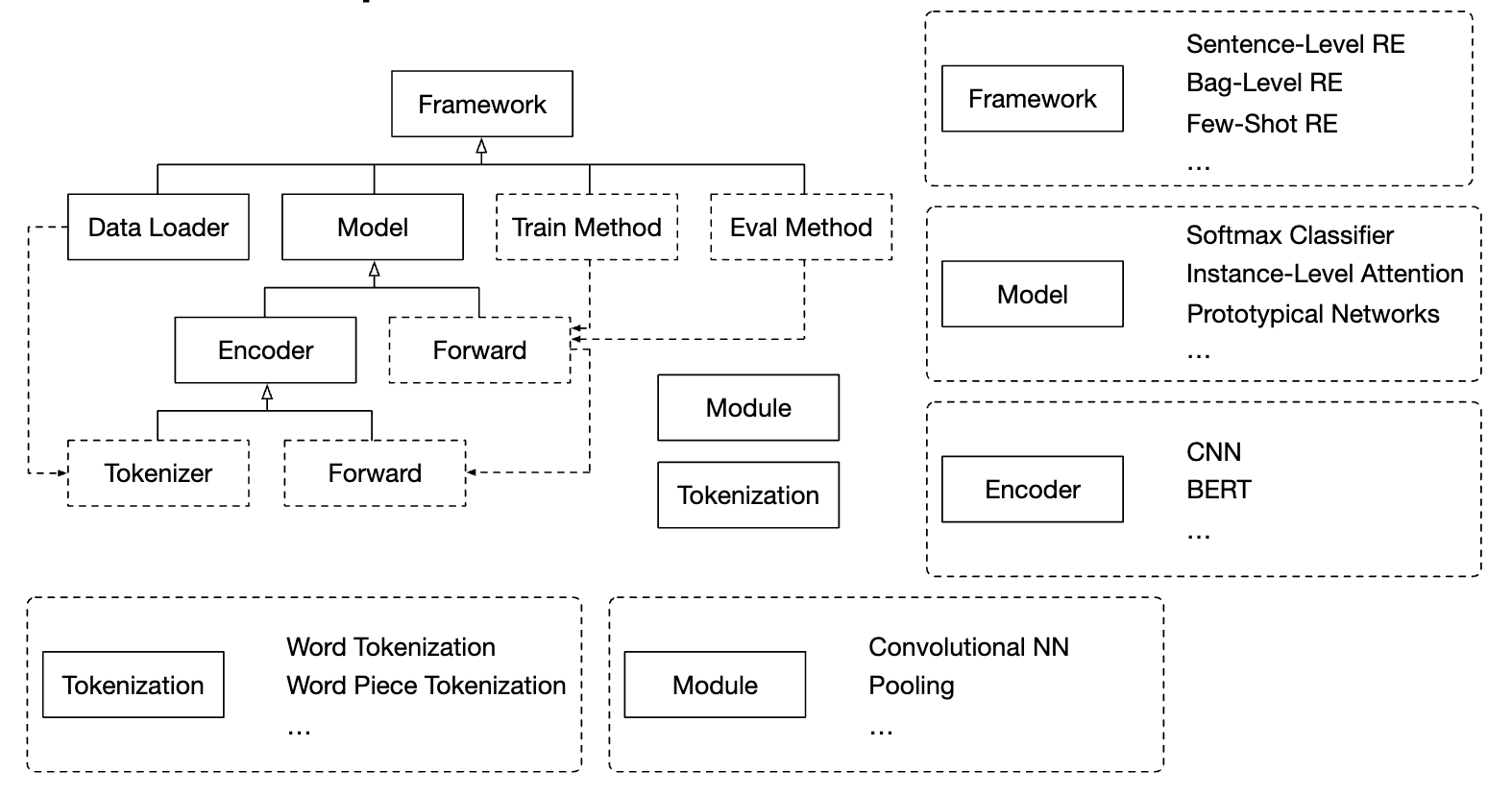
https://aclanthology.org/D19-3029.pdf
1.2 Symbolic Representation of Knowledge 1.2.10 Schema-Free Knowledge Extraction
1.2 Symbolic Representation of Knowledge 1.2.10 Schema-Free Knowledge Extraction
Discover Knowledge System from Plain Text
Discover Knowledge System from Plain Text
Knowledge = Facts and relation between facts;
All these can be naturally expressed by human language;
But how
language express complex knowledge?
knowledge be organized in human brain for reasoning ability and efficiency?
Towards universal knowledge schema.
1.2 Symbolic Representation of Knowledge 1.2.11 Open Information Extraction
1.2 Symbolic Representation of Knowledge 1.2.11 Open Information Extraction
Open Information Extraction
Open Information Extraction
Definition: extract structured information (e.g., relationships, facts) from unstructured text without relying on predefined schema.
Goal: To discover triples (subject, relation, object) directly from text.
→ < , , >
→
IE vs OIE
IE vs OIE
Feature | Information Extraction (IE) | Open Information Extraction (OpenIE) |
Predefined Schemas | Requires predefined schemas. | Does not require predefined schemas. |
Relation Expression | Predefined Symbols | Natural phrase from original text |
Scope | Typically domain-specific (e.g., medical, legal, financial). | Domain-independent; works on any text. |
Input Type | Structured or semi-structured text, sometimes annotated data. | Raw unstructured text (e.g., news articles, blogs). |
Extraction | Focuses on extracting specific entities or relations using rules. | Extracts general subject-relation-object triples without prior knowledge. |
Supervision | Often supervised (requiring labeled data for training). | Primarily unsupervised, does not need labeled training data. |
Flexibility | Less flexible; works best with a fixed domain and predefined structure. | Highly flexible; can be applied to a variety of domains. |
OIE Methods: Rule Based Method
OIE Methods: Rule Based Method
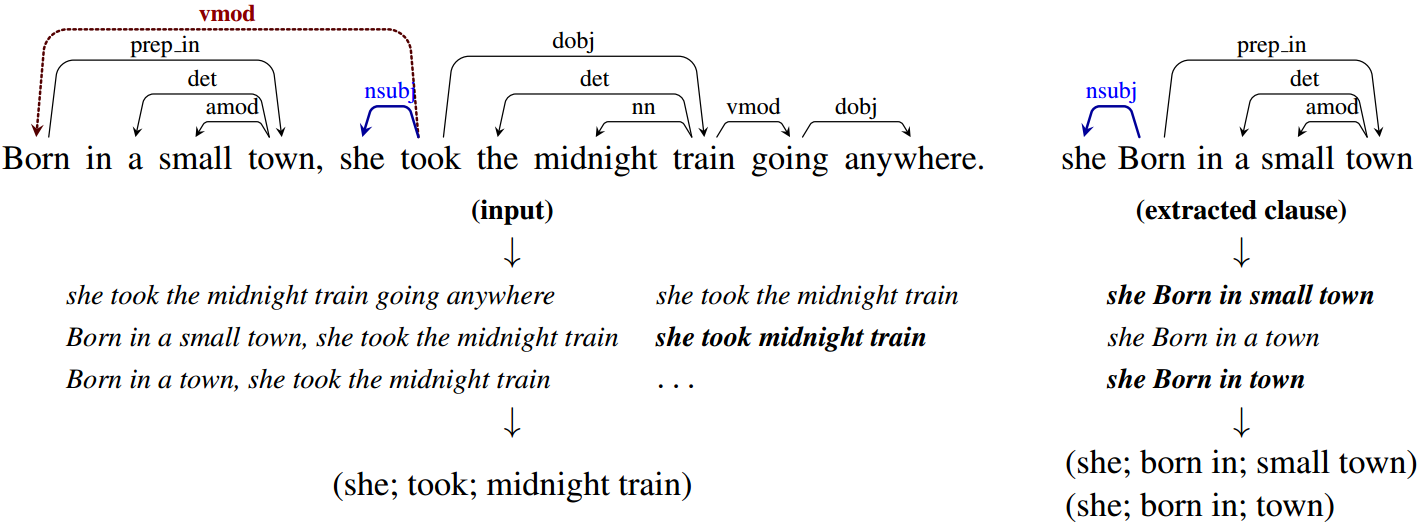
https://nlp.stanford.edu/software/openie.html
OIE Methods: Neural Based Method
OIE Methods: Neural Based Method
https://arxiv.org/pdf/2009.08128
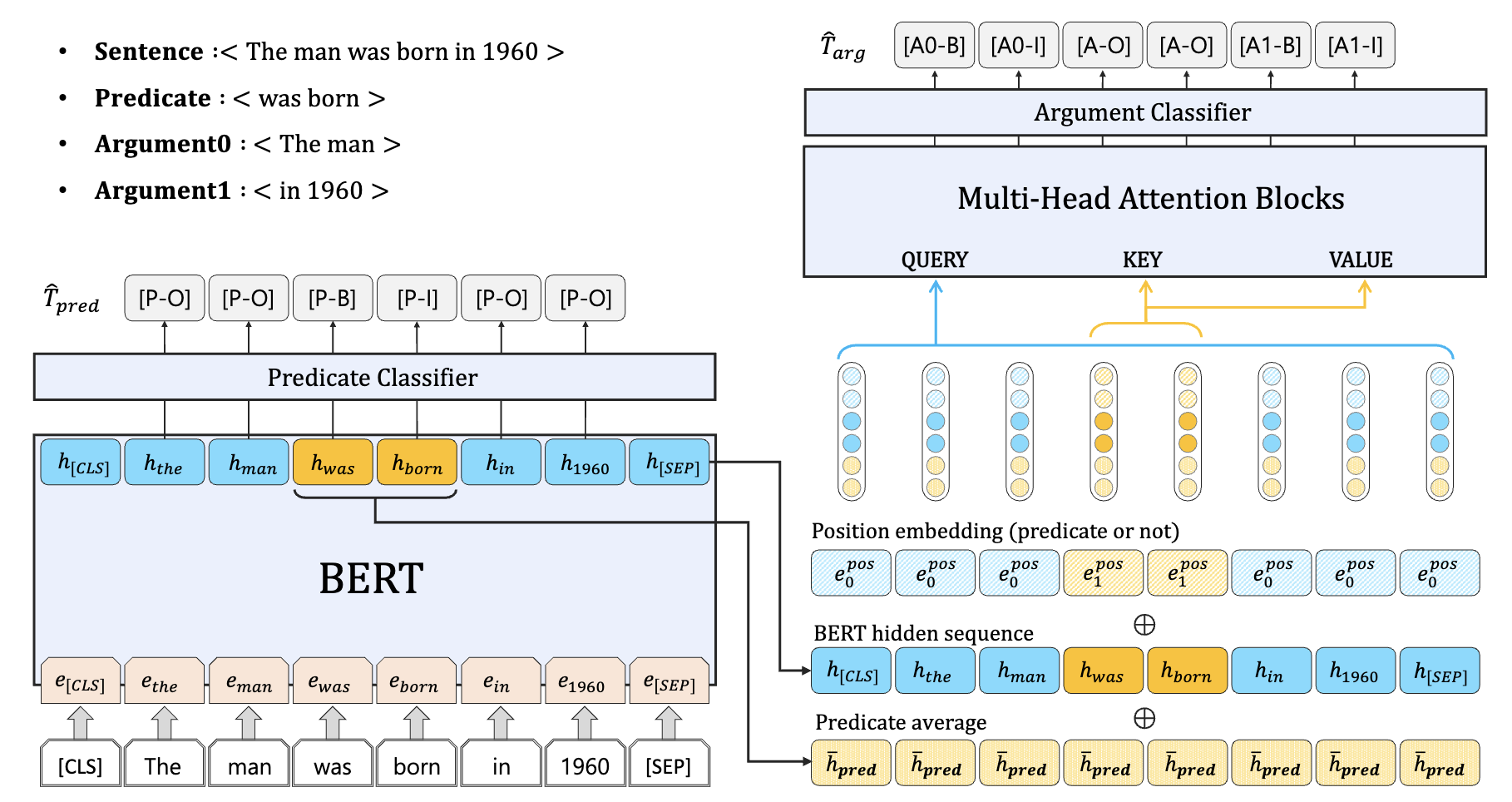
Challenges
Challenges
Different Definition of Facts
Cannot express Implicit Relations
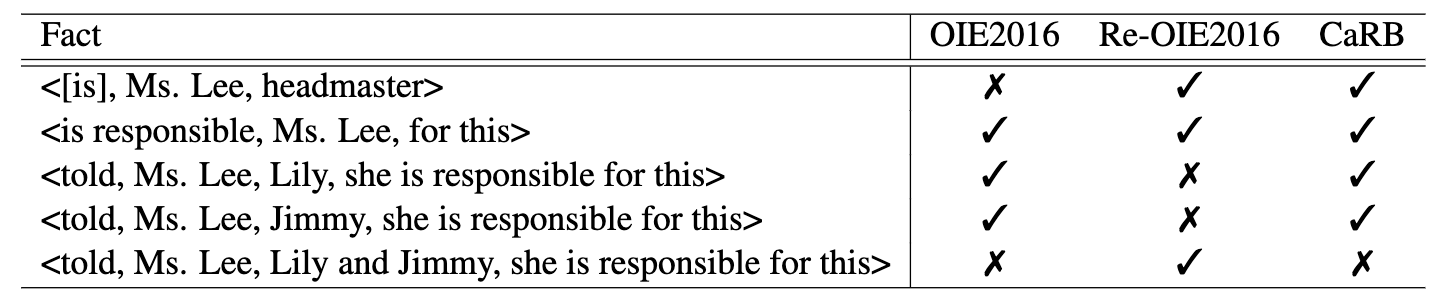
https://aclanthology.org/2022.acl-long.430.pdf
→ IE → < , , >
→ OIE → < , >
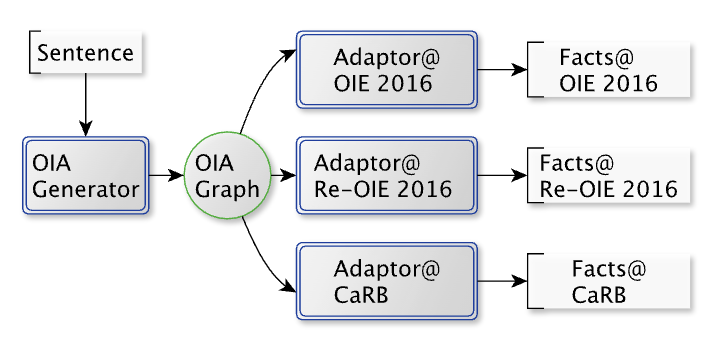
OIE@OIA: Parsing Based OIE
OIE@OIA: Parsing Based OIE
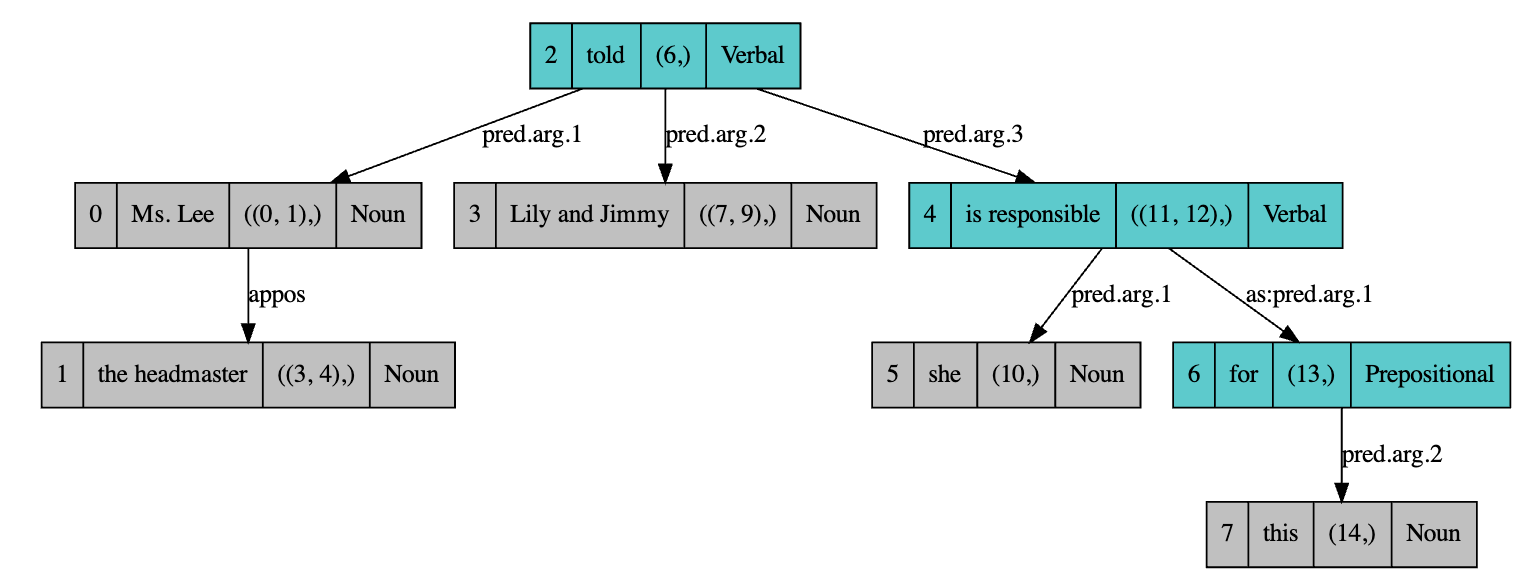
https://aclanthology.org/2022.acl-long.430.pdf
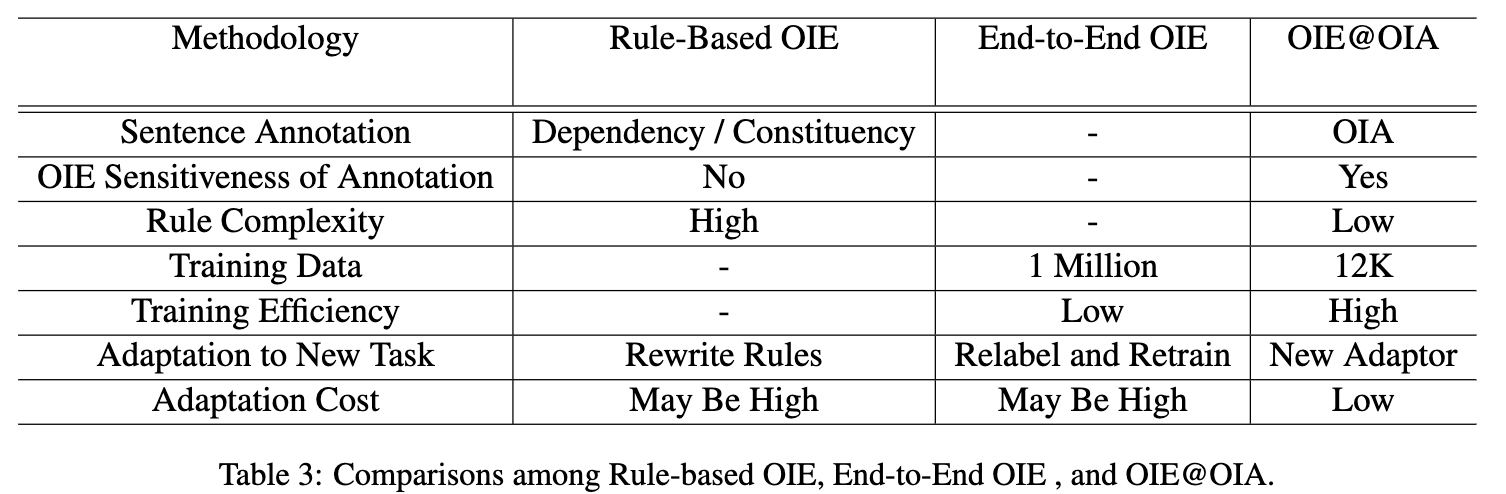
OIE@OIA: Comparison
OIE@OIA: Comparison
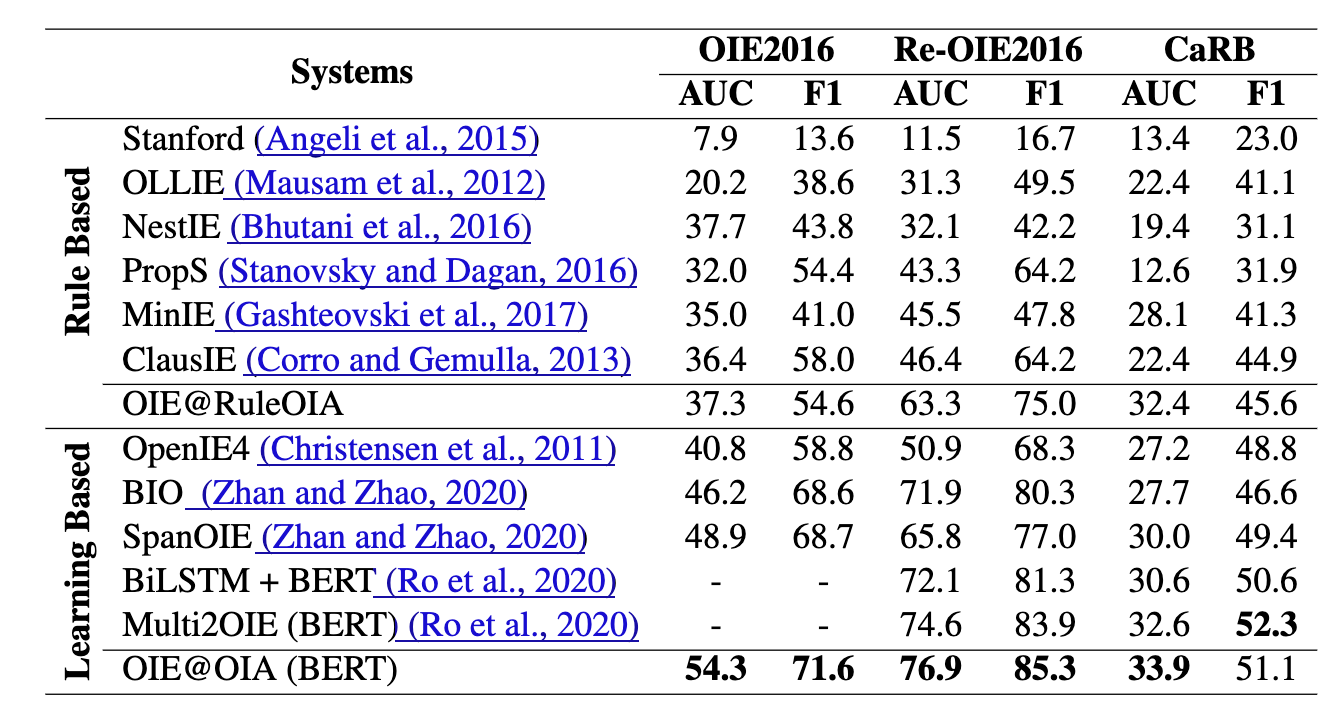
OIE@OIA: Results
OIE@OIA: Results
Lingua Graph
Lingua Graph
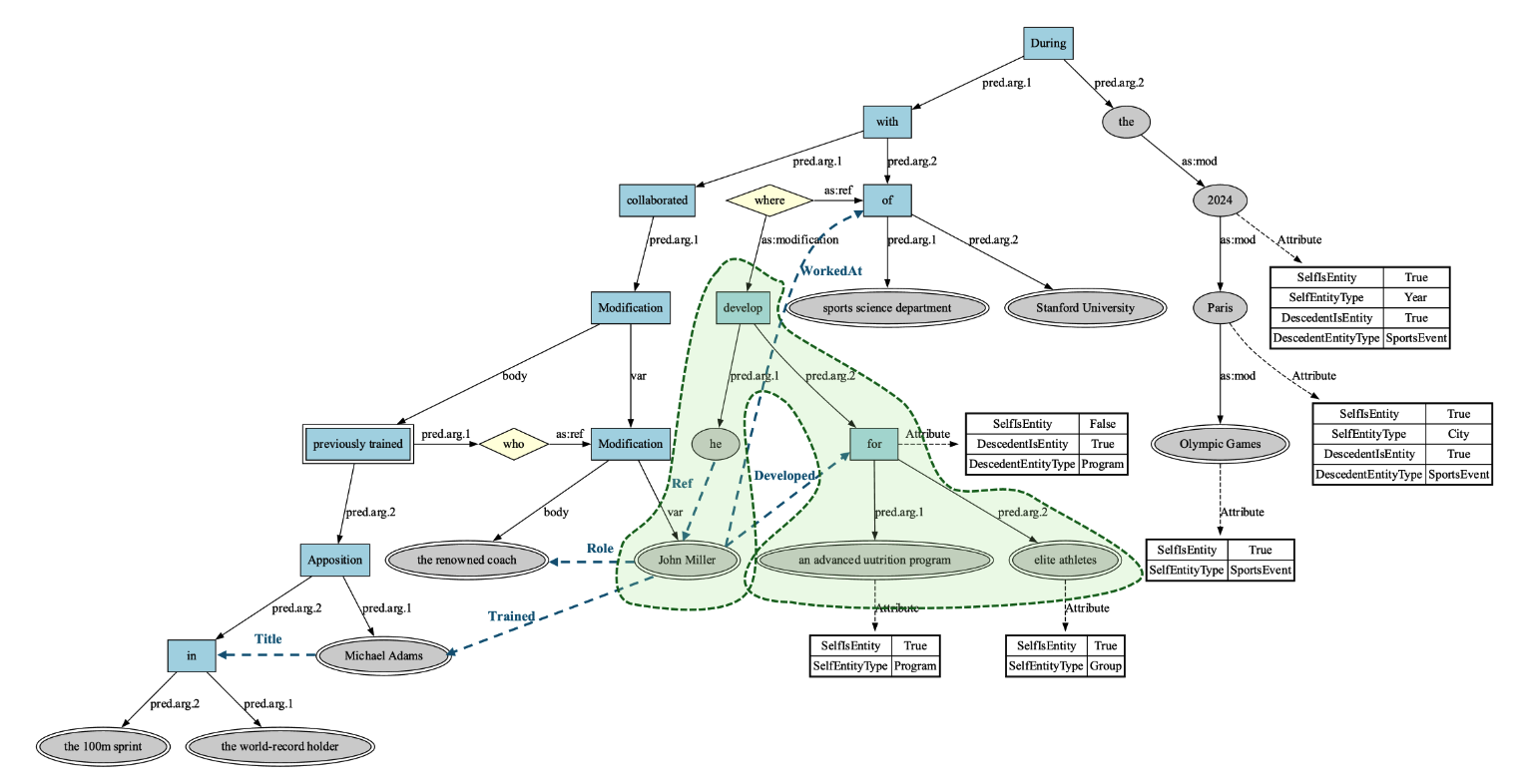
Lingua Graph
Lingua Graph
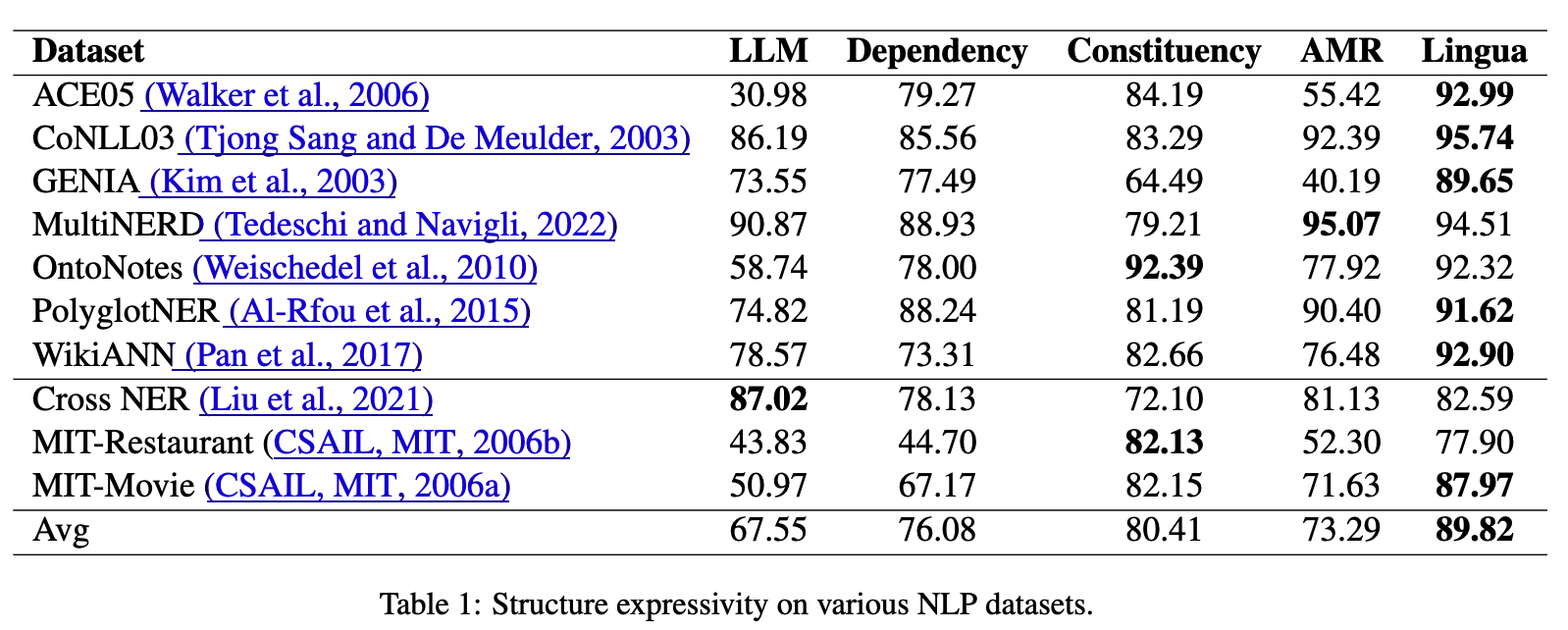
1.2 Symbolic Representation of Knowledge 1.2.12 Taxonomy and Ontology Learning
1.2 Symbolic Representation of Knowledge 1.2.12 Taxonomy and Ontology Learning
Steps of Learning the Taxonomy/Ontology
Steps of Learning the Taxonomy/Ontology
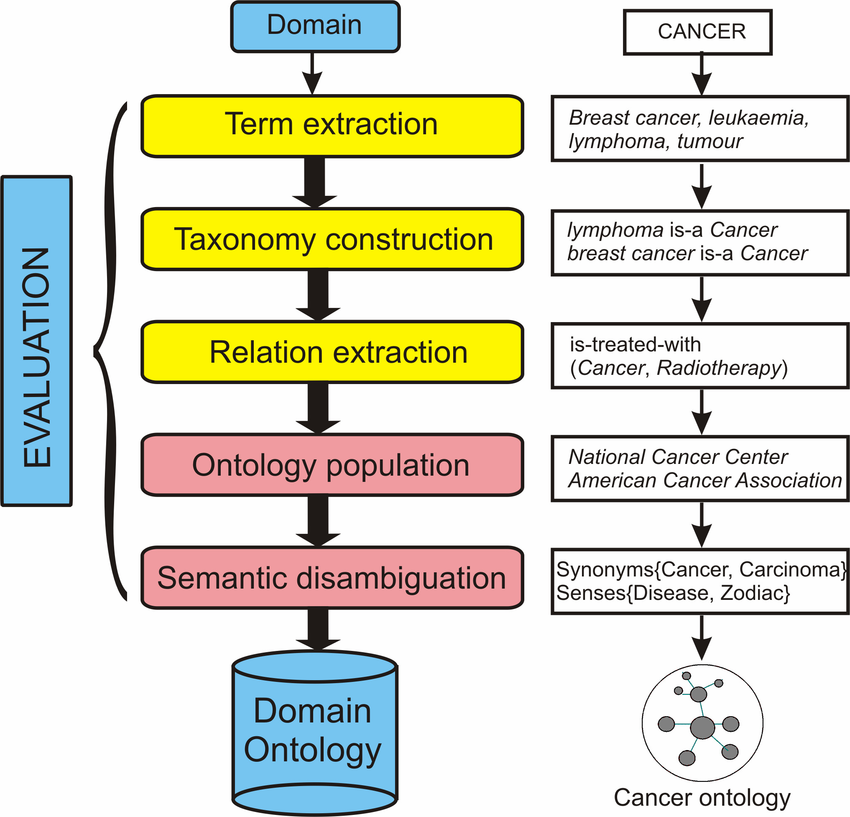
Learning Medical Ontologies from the Web, January 2007
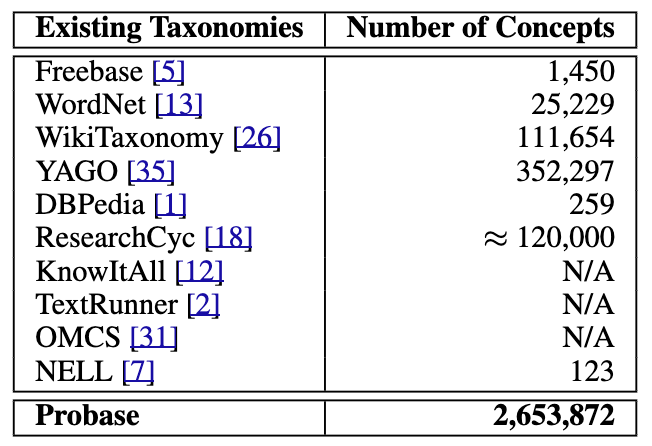
Taxonomy Discovery: Probase
Taxonomy Discovery: Probase
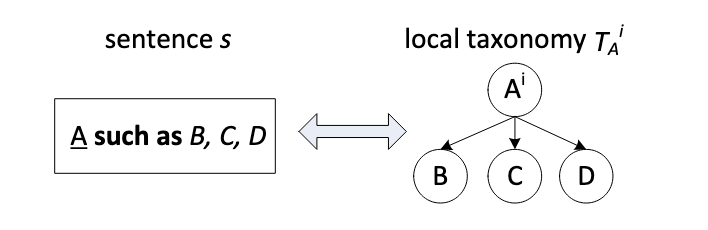
Noun Phrases are taken as entities;
Typing is discovered by patterns like “such as”.
Wu et,al - Probase A Probabilistic Taxonomy for Text Understanding
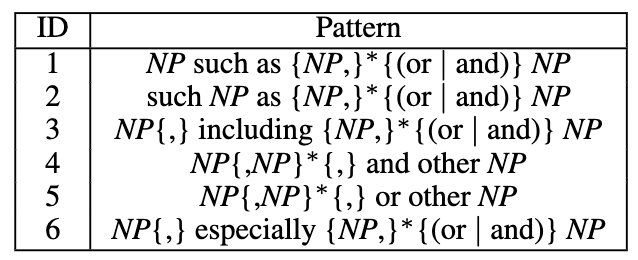
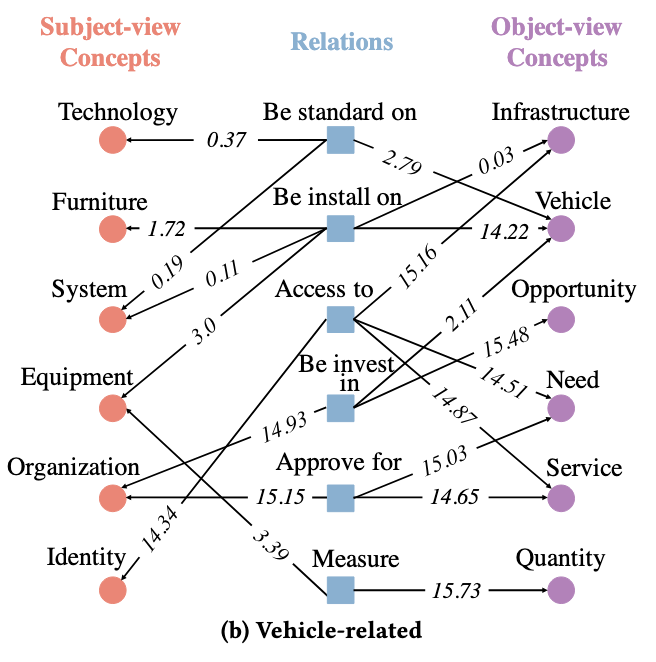
Ontology Learning
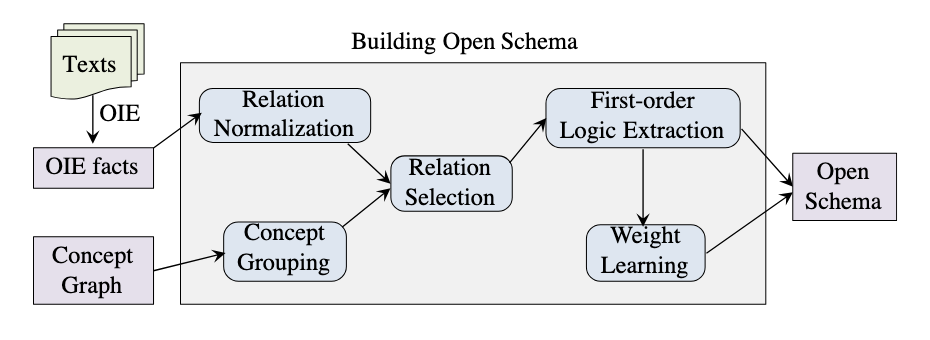
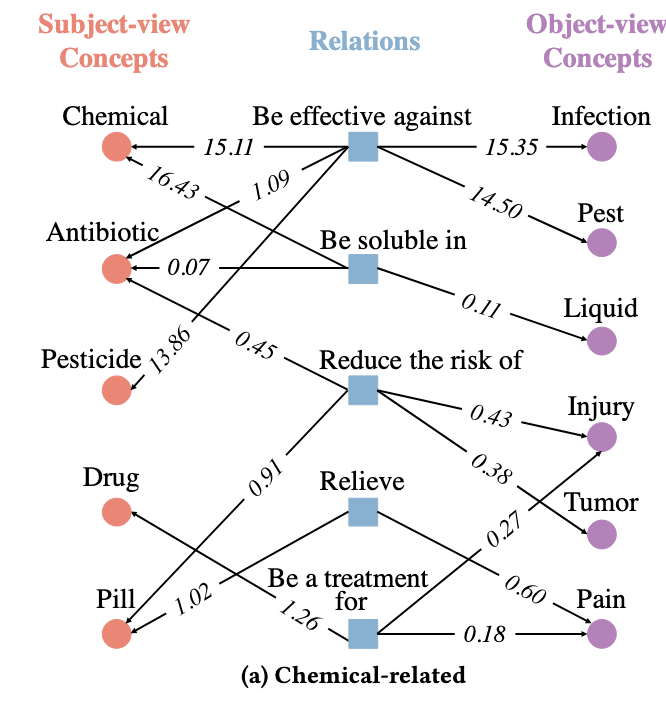
Ontology Learning
Starting with triplets extracted by Open IE: ;
Map the Entity Mentions to their Types: ;
Find the significant Relation Mentions between Types.
Ontology Learning
Ontology Learning
1.2 Symbolic Representation of Knowledge 1.2.13 Entity Linking
1.2 Symbolic Representation of Knowledge 1.2.13 Entity Linking
Entity Linking Problem
Entity Linking Problem
Aidan Hogan, et.al, Knowledge Graphs, 2021
When querying or completing a Knowledge Graph with queries/texts;
When a name of an entity is mentioned, we should know the exact entity it refers to.
Otherwise, the entity information will be mistakenly mixed.
Entity Linking System
Entity Linking System
https://medium.com/nerd-for-tech/building-bi-encoder-based-entity-linking-system-with-transformer-6c111d86500
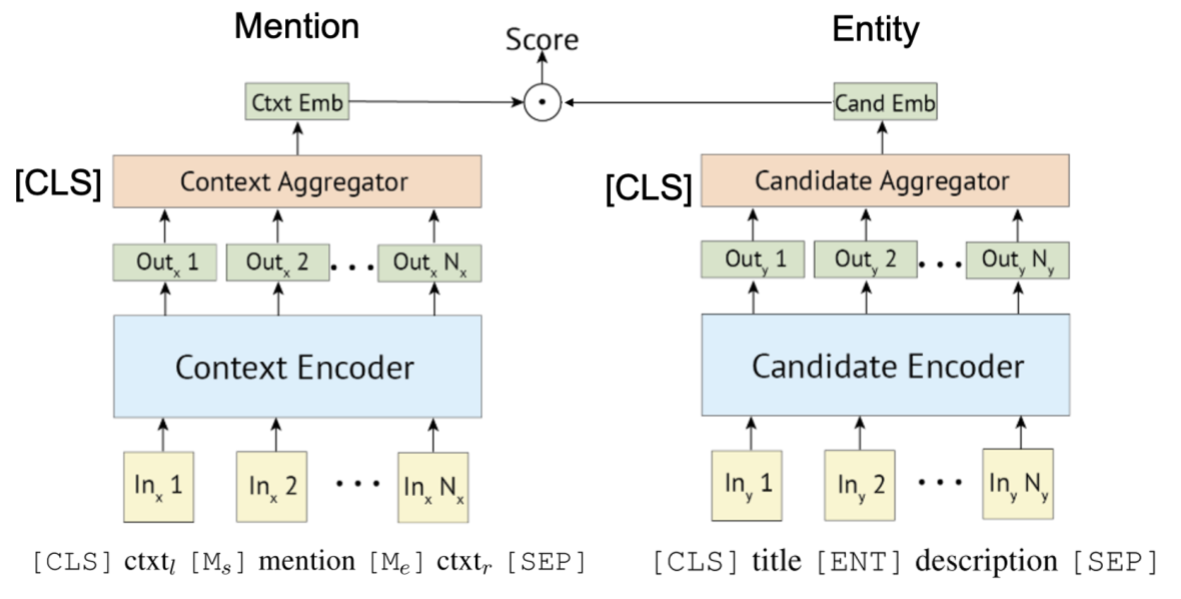
Based on Representation Learning;
Match the Entity Mention Representation to Candidate Entity Representation
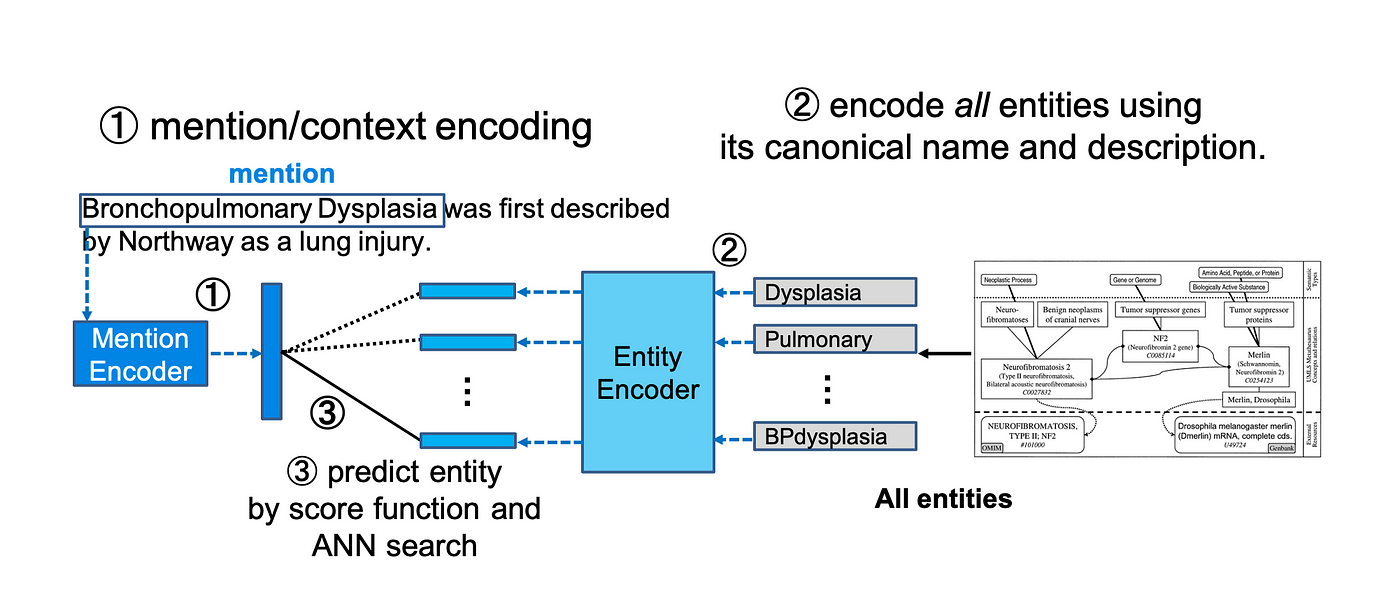
The Mention - Entity Matching Model
The Mention - Entity Matching Model
https://medium.com/nerd-for-tech/building-bi-encoder-based-entity-linking-system-with-transformer-6c111d86500
Challenges
Challenges
Similarity != Identity: Limited Resolution of Embedding;
Limited Context Information;
Incomplete Knowledge Graph: Empty Linking.

1.2 Symbolic Representation of Knowledge 1.2.14 Knowledge from Other Sources
1.2 Symbolic Representation of Knowledge 1.2.14 Knowledge from Other Sources
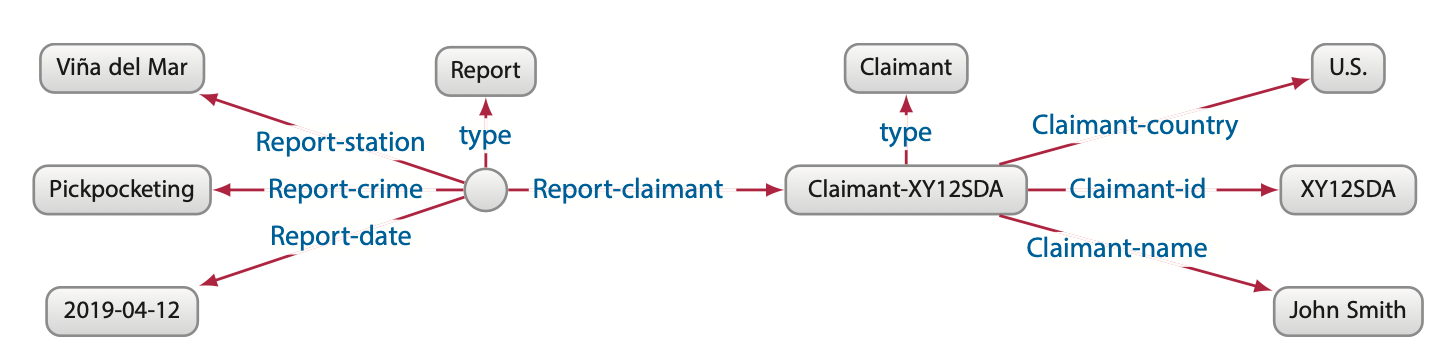
Tables
Tables

Challenges
Challenges
The table information can be complete only if we consider the title of the table and surrounding texts.
It would be better to use Table2Text to convert it into text chunk and then extract information from the text chunk.
Other KGs
Other KGs
https://arxiv.org/pdf/2307.11772
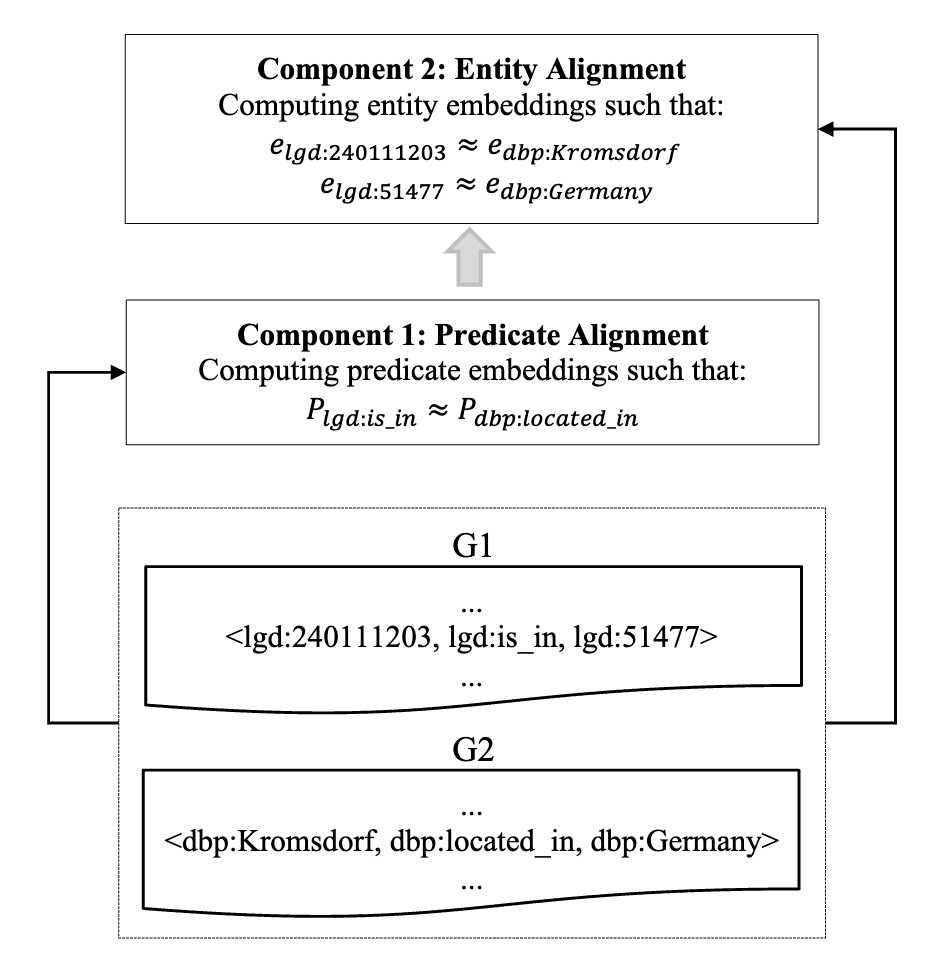
If another KG is available, you can merge it’s knowledge into your KG by align the entities and the relations between these two KGs.
Distant Supervision
Distant Supervision
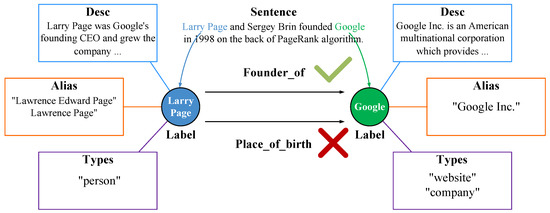
Or you can make training samples using another KG through distant supervision and train your own knowledge acquisition models.
https://www.mdpi.com/2076-3417/12/17/8821
LLMs
LLMs
LLMs have exhibited strong ability in:
Extracting entities/relations/facts from texts;
Directly answer factoid questions.
So it is a strong tools for the initial knowledge graph construction.
1.2 Symbolic Representation of Knowledge 1.2.15 Knowledge Graph Refinement
1.2 Symbolic Representation of Knowledge 1.2.15 Knowledge Graph Refinement
Background
Background
After Knowledge Graph Construction, we obtained a KG with knowledge extracted from multiple external resources.
But there are mistakes, conflicts, missing facts in KG;
Refinements is vital to eliminate the mistakes, solve conflicts and completing the missing facts.
These are very difficult tasks.
Methods
Methods
Logical refinements:
Confliction Detection
Rules-based Constraints
Statistical refinements:
Neural Representation Learning
Statistical Relational Learning
1.2 Symbolic Representation of Knowledge 1.2.16 Knowledge Graph Construction: Case Study
1.2 Symbolic Representation of Knowledge 1.2.16 Knowledge Graph Construction: Case Study
DBpedia
DBpedia
DBpedia is a collaborative project that extracts structured information from Wikipedia, initiated in 2007 by several German Universities.

https://en.wikipedia.org/wiki/DBpedia
DBpedia
DBpedia
DBpedia “Largest Diamond” Graph:
~2.2 billion RDF triples and over 220 million entities from DBpedia, Geonames, DNB, MusicBrainz, and more.
External Links:
Over 130 million links to 179 external datasets (e.g., Wikidata, VIAF, YAGO), enabling linked data integration.
Entity Type | Count |
Persons | ~1,792,308 |
Places | ~748,372 |
Creative Works | ~610,589 |
Organizations | ~345,523 |
Species | ~1,933,436 |
Diseases | ~10,591 |
DBpedia
DBpedia
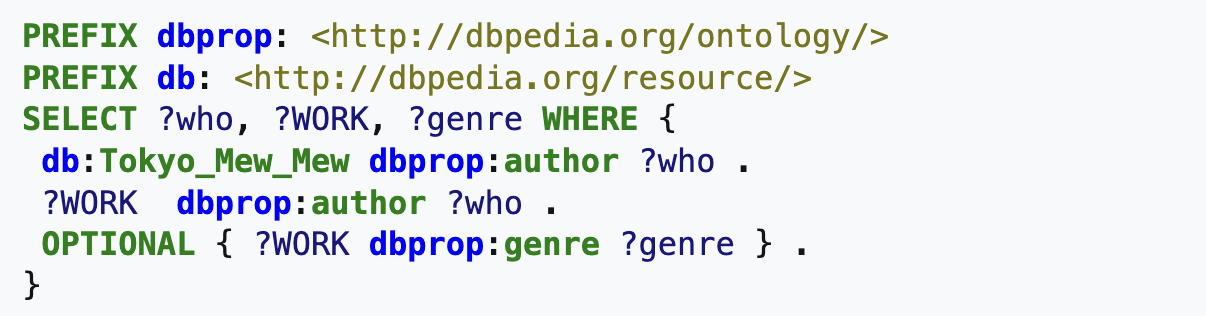
If one were interested in the Japanese shōjo manga series Tokyo Mew Mew:
https://en.wikipedia.org/wiki/DBpedia
DBpedia Construction
DBpedia Construction
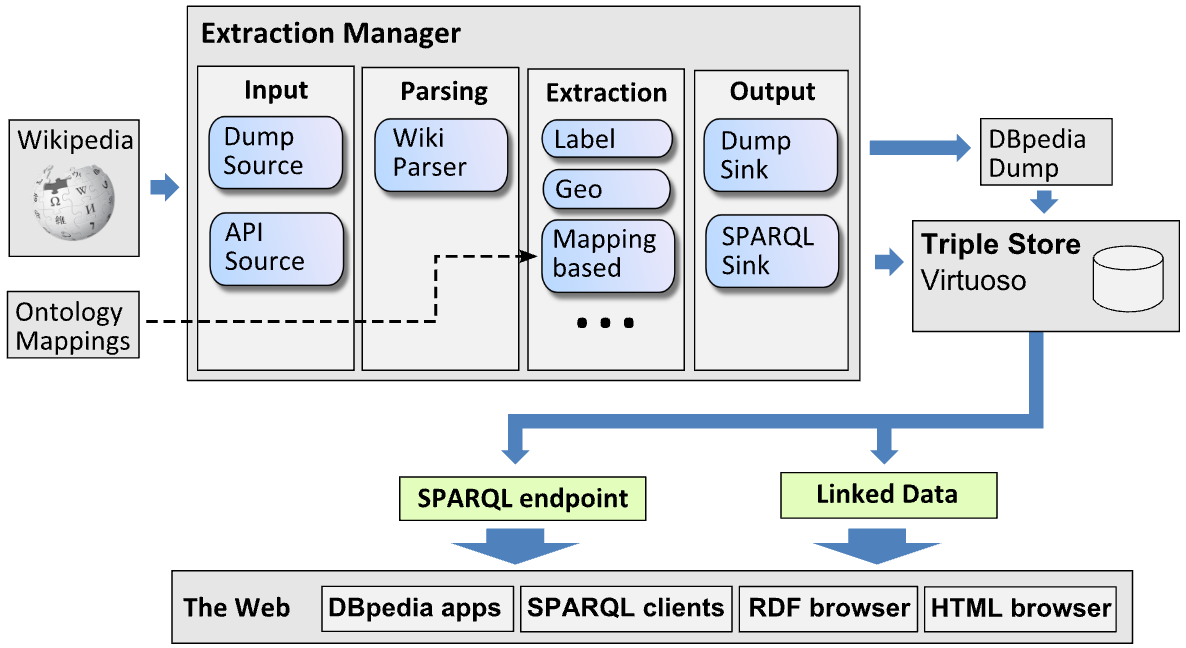
https://svn.aksw.org/papers/2013/SWJ_DBpedia/public.pdf
1.2 Symbolic Representation of Knowledge 1.2.17 Suggested Readings
1.2 Symbolic Representation of Knowledge 1.2.17 Suggested Readings
Books
Books
Aidan Hogan, et.al, Knowledge Graphs, SYNTHESIS LECTURES ON DATA, SEMANTICS, AND KNOWLEDGE, 2022
Mayank Kejriwal, et.al, Knowledge Graphs Fundamentals, Techniques, and Applications, the MIT Press, 2021
Any Questions?
Any Questions?
Natural Language UnderstandingStatistical Representation of Language and Knowledge

Natural Language
Understanding
Statistical Representation
of Language and Knowledge
Understanding
Statistical Representation
of Language and Knowledge
Mingming Sun
BIMSA
Outline

Outline
Why Statistical Representation
Vector Semantics for Word and Document
Topic Modeling
Neural Representations for Language
Neural Representations for Knowledge
1.3 Statistical Representation of Language and Knowledge 1.3.1 Why Statistical Representation
1.3 Statistical Representation of Language and Knowledge 1.3.1 Why Statistical Representation
Statistical Nature: Evolutionary Perspective
Statistical Nature: Evolutionary Perspective
As Natural Outcome of Language Emergence
Language is invented for maximizing information transition efficiency and reducing ambiguity.
So according to information theory, the human language naturally forms a certain distribution:
Zipf’s Law: The frequency of word usage in language follows a power-law distribution (a few words are used very frequently, while many words are used rarely), indicating a statistical regularity.
Menzerath’s Law: Longer linguistic units (e.g., sentences) tend to be composed of shorter components (e.g., words), which is also a statistical phenomenon.
Statistical Nature: Cognitive Perspective
Statistical Nature: Cognitive Perspective
Cognitive Perspective: Language Learning and Statistical Patterns
Child Language Acquisition: Studies show that infants use statistical learning abilities to identify phonetic patterns (such as word boundaries), indicating a strong link between language acquisition and statistical mechanisms.
Neuroscience: The brain utilizes probabilistic inference to predict the next word or sentence when processing language, a mechanism similar to modern neural language models (e.g., GPT).
Statistical Nature
Statistical Nature
The statistical nature of language is not an innate, a prior chacteristic but a natural property that gradually emerges during language evolution.
This statistical nature likely results from a combination of cognitive constraints, information transmission optimization, and biological evolution.
Statistical Representation vs Symbolic Representation
Statistical Representation vs Symbolic Representation
Symbolic Representation: Map Surface Form into Inner Symbolic Form with connection to real-world entities, facts, logics.
Statistical Representation: Find statistical connection between elements in the Surface Form, and connection to real-world may emerge.
1.3 Statistical Representation of Language and Knowledge 1.3.2 Vector Semantics for Words
1.3 Statistical Representation of Language and Knowledge 1.3.2 Vector Semantics for Words
What is Word: Recall the Structuralism
What is Word: Recall the Structuralism
A sign is the basic unit of meaning in language. It consists of:
Signifier (signifiant): The sound pattern or written form (e.g., the word “tree”).
Signified (signifié): The concept or meaning associated with the signifier (the mental image of a tree).
In N-Gram model, word is just surface strings (Signifier), and we do not directly care about its meaning (Signified).
We also talked about the logic representation of language, where the meaning of words is entity or relations.
Lets consider the meaning of word (Signified) more thoroughly.
Lemmas and Senses
Lemmas and Senses
Lemma is Signifier, and Sense can be considered some kind of Signified.
sense
mouse (N)
1. any of numerous small rodents...
2. a hand-operated device that controls a cursor...
1. any of numerous small rodents...
2. a hand-operated device that controls a cursor...
lemma
Modified from the online thesaurus WordNet
Relations: Synonymy
Relations: Synonymy
Synonyms have the same meaning in some or all contexts.
filbert / hazelnut
couch / sofa
big / large
automobile / car
vomit / throw up
water / H20
Relations: No Perfect Synonymy
Relations: No Perfect Synonymy
Note that there are probably no examples of perfect synonymy.
Even if many aspects of meaning are identical
Still may differ based on politeness, slang, register, genre, etc.
Examples:
water/H20: "H20" in a surfing guide?
big/large: my big sister != my large sister
The Linguistic Principle of Contrast
The Linguistic Principle of Contrast
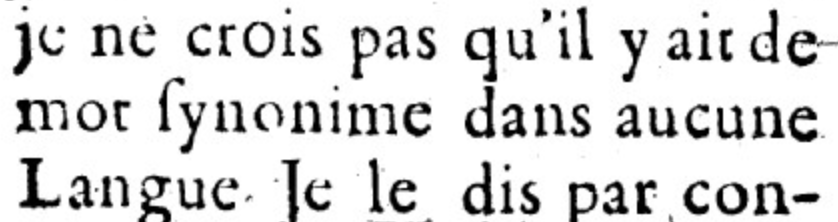
Difference in form → difference in meaning
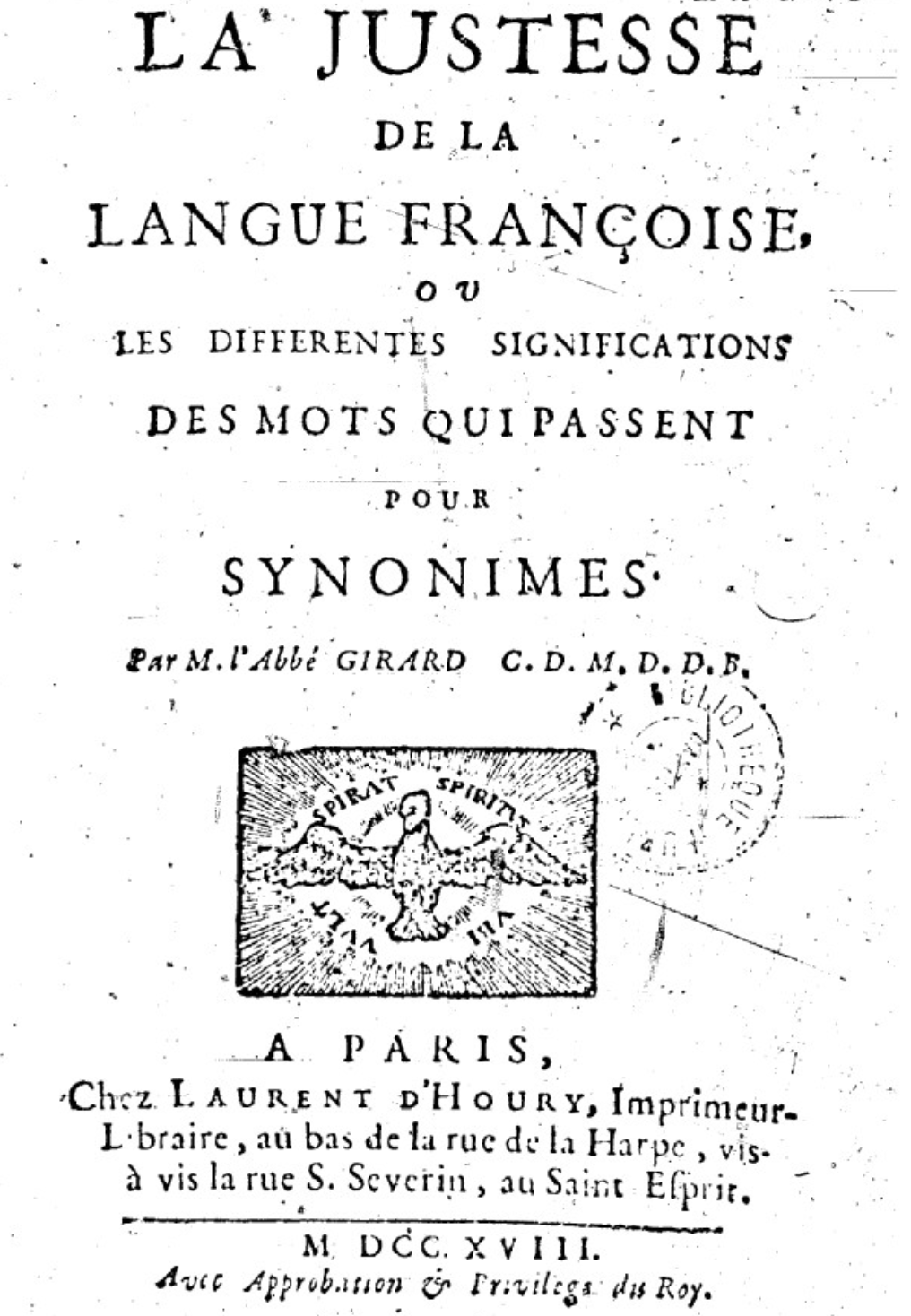
I do not believe that there is a synonymous word in any language
Relations: Similarity
Relations: Similarity
Not synonyms, but sharing some element of meaning
word1 | word2 | similarity |
vanish | disappear | 9.8 |
behave | obey | 7.3 |
belief | impression | 5.95 |
muscle | bone | 3.65 |
modest | flexible | 0.98 |
hole | agreement | 0.3 |
SimLex-999 dataset (Hill et al., 2015)
Relations: Antonymy
Relations: Antonymy
Senses that are opposites with respect to only one specific semantic feature, while they remain similar in other aspects.
For example:
hot vs. cold → Opposites in temperature, but both describe a degree of heat.
buy vs. sell → Opposites in perspective (buyer vs. seller), but both refer to the same transaction.
teacher vs. student → Opposites in role, but both exist within the context of education.
Relations: Relatedness
Relations: Relatedness
Words can be related in any way:
<coffee, tea>: similar; <coffee, cup>: related.
Semantic Field: Words that
cover a particular semantic domain
bear structured relations with each other.
Hospitals
surgeon, scalpel, nurse, hospital
Restaurants
waiter, menu, plate, food
Semantic Frame: Words that:
denote perspectives or participants in a particular type of event.
Buy :
buy, sell, goods
Travel
traveler, source, destination
Relations: Connotation(Sentiment)
Relations: Connotation(Sentiment)
Words have affective meanings
Positive connotations (happy, great, love)
Negative connotations (sad, terrible, hate)
Connotations can be subtle:
Positive connotation: copy, replica, reproduction
Negative connotation: fake, knockoff, forgery
Relations: Connotation(Sentiment)
Relations: Connotation(Sentiment)
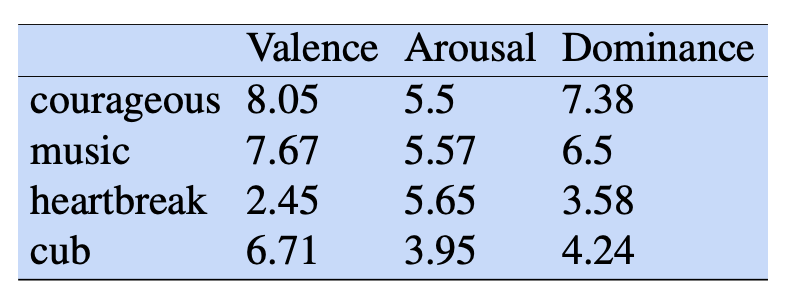
Words seem to vary along 3 affective dimensions(Osgood et al. (1957)):
valence: the pleasantness of the stimulus
arousal: the intensity of emotion provoked by the stimulus
dominance: the degree of control exerted by the stimulus
Summary: Senses and Relations
Summary: Senses and Relations
Senses (symbolic Signified)
Have a complex many-to-many association with words (Signifier)
Have relations with each other
Synonymy
Antonymy
Similarity
Relatedness
Connotation
The relation cannot be obtained from the sense through calculation.
The meaning of a word is its use in the language (Ludwig Wittgenstein)
The meaning of a word is its use in the language (Ludwig Wittgenstein)
Words are defined by their environments (the words around them)
If A and B have almost identical environments we say that they are synonyms. -- Zellig Harris (1954)
What does ongchoi mean?
What does ongchoi mean?
Suppose you see these sentences:
Ong choi is delicious sautéed with garlic.
Ong choi is superb over rice
Ong choi leaves with salty sauces
And you've also seen these:
…spinach sautéed with garlic over rice
Chard stems and leaves are delicious
Collard greens and other salty leafy greens
Conclusion:
Ongchoi is a leafy green like spinach, chard, or collard greens
Based on words like "leaves" and "delicious" and "sauteed"
ongchoi
ongchoi

Yamaguchi, Wikimedia Commons, public domain
空心菜
kangkong
rau muống
…
Basic Ideas
Basic Ideas
Idea 1: Defining meaning by linguistic distribution
Let's define the meaning of a word by its distribution in language use, meaning its neighboring words or grammatical environments.
Idea 2: Meaning as a point in multidimensional space
Defining meaning as a point in space based on distribution
Defining meaning as a point in space based on distribution
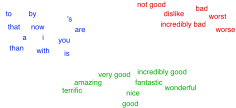
Each word = a vector (embedding) (not just "good" or "w45")
Similar words are "nearby in semantic space"
We build this space automatically by seeing which words are nearby in text
Vector Representation vs Symbolic Representation
Vector Representation vs Symbolic Representation
With words, a feature is a word identity
Feature 5: 'The previous word was "terrible"'
requires exact same word to be in training and test
With embeddings:
Feature is a word vector
'The previous word was vector [35,22,17…]
Now in the test set we might see a similar vector [34,21,14]
We can generalize to similar but unseen words!!!
Two kinds of embeddings
Two kinds of embeddings
Sparse Embedding
Representation calculated by explicit statistics of environments;
Dimension has explicit meaning;
Dense Embedding
Representation obtained by neural learning from environments;
Dimension generally has no explicit meaning.
From now on: Computing with meaning representationsinstead of string representations
From now on: Computing with meaning representations
instead of string representations
instead of string representations

1.3 Statistical Representation of Language and Knowledge 1.3.3 Sparse Embeddings
1.3 Statistical Representation of Language and Knowledge 1.3.3 Sparse Embeddings
The environment of words are documents;
Vector or distributional models of meaning are generally based on how words co-occur in documents;
We’ll look at two model methods: the word-document matrix and the word-word matrix.
Term-Document Matrix
Term-Document Matrix
Each document is represented by a vector of words
Each word can be represented by a vector of documents


Visualizing document vectors
Visualizing document vectors
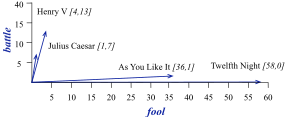
Word-word Matrix
Word-word Matrix
The count of word A co-occur with word B in a context range:
The whole document;
The limited window;


Visualizing word-word vectors
Visualizing word-word vectors
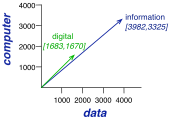
Raw frequency is a bad representation
Raw frequency is a bad representation
The co-occur frequency is the source of valuable information;
But overly frequent words like the, it, or they are not very informative about the context
It's a paradox! How can we balance these two conflicting constraints?
TF-IDF for Word-Document Representation
TF-IDF for Word-Document Representation
TF: Frequence of Term t in Document d
IDF: Inverse Document Frequence of Term t in Corpus
measure the importance of a word in the entire document collection D
TF-IDF:
If a word appears frequently in a document (high TF) but is relatively rare in the entire corpus (high IDF), then its importance in that document is greater.
Conversely, if a word is common across all documents (such as “the” or “is”), its IDF is low, resulting in a lower TF-IDF value.



PMI for Word-Word Representation
PMI for Word-Word Representation
PMI: (Pointwise mutual information)
It is a measure of how often two events x and y occur, compared with what we would expect if they were independent:
1.3 Statistical Representation of Language and Knowledge 1.3.4 Vector Semantics for Documents
1.3 Statistical Representation of Language and Knowledge 1.3.4 Vector Semantics for Documents
Let’s focus on Document
Let’s focus on Document
Could be a play or a Wikipedia article
But documents can be anything; even a paragraph can be considered a document.
However, we generally consider document to have complete and explicit meaning.
Bag of Words
Bag of Words
Recall the Word-Document Matrix:
Bag of Words (BOW): each document is represented by a vector of size with element of count/frequency.
TF-IDF Model
TF-IDF Model
TF-IDF: each document is represented by a vector of size with element of tf-idf value.

Applications of Document Embedding
Applications of Document Embedding
Text Classification
Used to train machine learning models (e.g., Naïve Bayes, SVM) for spam detection, sentiment analysis, and topic categorization.
Example: Detecting whether an email is spam based on the presence of certain words.
Text Clustering
Helps group similar documents together (e.g., k-means clustering).
Example: Categorizing news articles into topics like politics, sports, and entertainment.
Search Engine Ranking
Used to prioritize documents based on how uniquely relevant a term is.
Example: Google ranking a webpage higher if it contains unique words related to the search query.
Recommendation Systems
Measures similarity between documents using cosine similarity on TF-IDF vectors.
Example: Suggesting similar news articles based on the words in a given article.
Go deeper into Document Representation
Go deeper into Document Representation
One most fundamental attribute is Topics.
Recall the Synonymy and Semantic Field of word relatedness, words may be different but talking about the same topic;
Topic Similarity is an essential similarity of documents.
But BOW and TF-IDF do not represent the topic information.
How to model it?
Topics and Words
Topics and Words
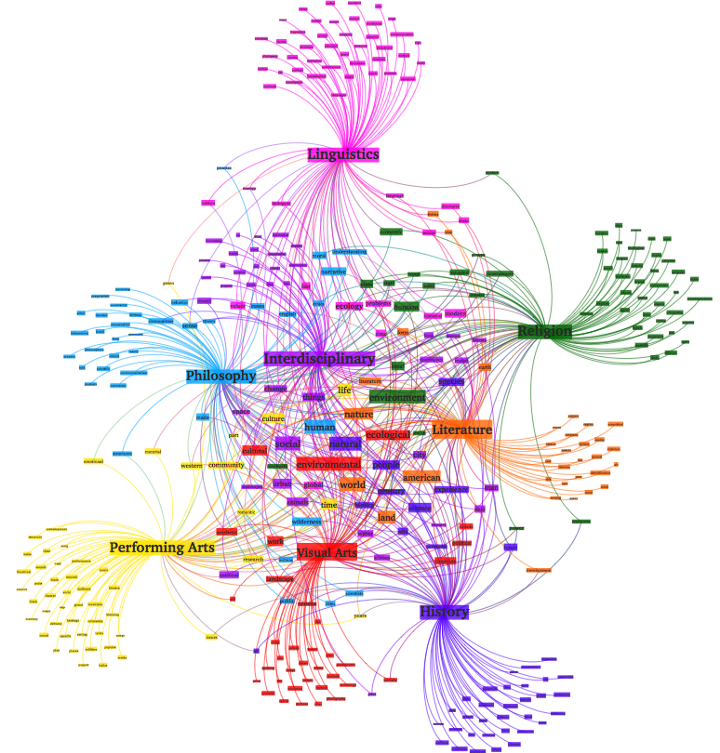
https://nanonets.com/blog/topic-modeling-with-lsa-plsa-lda-lda2vec/
Words are related by Semantic Field
Topic Modeling
Topic Modeling
Key assumption:
each document consists of a mixture of topics, and
each topic consists of a collection of words.
The semantics of the document are governed by some “topics”;
We cannot observing the topics directly; It is hidden or “latent”;
The goal of topic modeling is to uncover these latent variables — topics — that shape the meaning of our document and corpus;
Latent Semantic Analysis (LSA)
Latent Semantic Analysis (LSA)
What we have: Documents and Terms (Words) Matrix (TF-IDF)
The matrix is very sparse, very noisy, and very redundant across its many dimensions;
Topics:
are hidden inner intermediate structures between the documents and words;
are with limited number, generally much smaller than that of doc and words.
How to discover the structures from the documents-words matrix?
Matrix Decomposition!
Latent Semantic Analysis (LSA)
Latent Semantic Analysis (LSA)
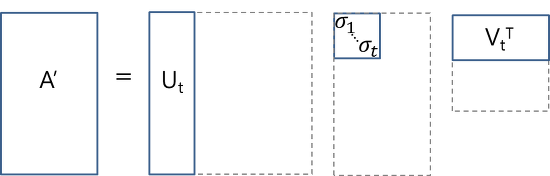
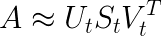
U ∈ ℝ^(m ⨉ t) emerges as our document-topic matrix,
V ∈ ℝ^(n ⨉ t) becomes our word-topic matrix.
S ∈ ℝ^(t ⨉ t) represents importance of a latent topic.
https://nanonets.com/blog/topic-modeling-with-lsa-plsa-lda-lda2vec/
Application of Topic related Embeddings
Application of Topic related Embeddings
With these document vectors and word vectors, we can now easily apply measures such as cosine similarity to evaluate:
the similarity of different documents
the similarity of different words
the similarity of terms (or “queries”) and documents (which becomes useful in information retrieval, when we want to retrieve passages most relevant to our search query).
Limitation of LSA
Limitation of LSA
Computationally Expensive
need for really large set of documents and vocabulary to get accurate results, where SVD is expensive for large-scale datasets;
Sensitivity to Noise and Parameter Selection
The choice of k (number of singular values retained) significantly impacts performance.
Lacks of Interpretation
We don’t know what the topics are (no modeling about topics).
Statistical Topic Modeling
Statistical Topic Modeling
Statistical View Point:
Document as a mixture of topics
Topic as a distribution over words;
Generative model for documents:
document features as being generated by sampling from the conditional probability of topic and words.
The goal of statistical topic modeling is to recover the distribution that best fit our observations -- document-term matrix.
Statistical Topic Modeling
Statistical Topic Modeling
Training on (large) corpus to learn:
Per-topic word distributions
Per-document topic distributions
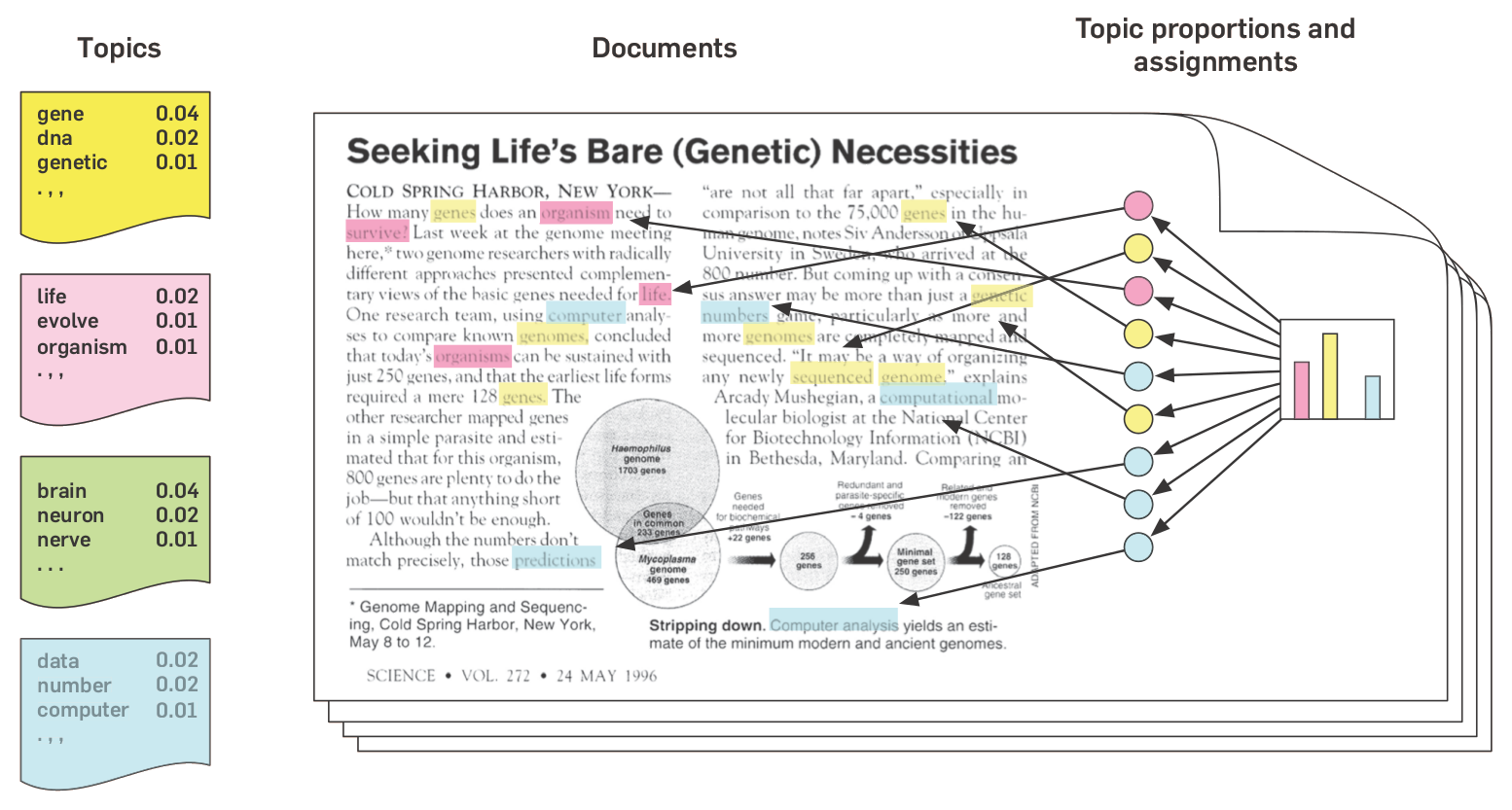
PLSA: Document Generation Procedure
PLSA: Document Generation Procedure
Document Generation Procedure:
Choose a document d from the document collection.
Select a topic z according to (each doc has a topic distribution, the parameter of PLSA).
Choose a word w according to (each topic has a word distribution, the parameter of PLSA).
Repeat steps 2 and 3 for each word in the document.
PLSA: Document, Topic, Words
PLSA: Document, Topic, Words
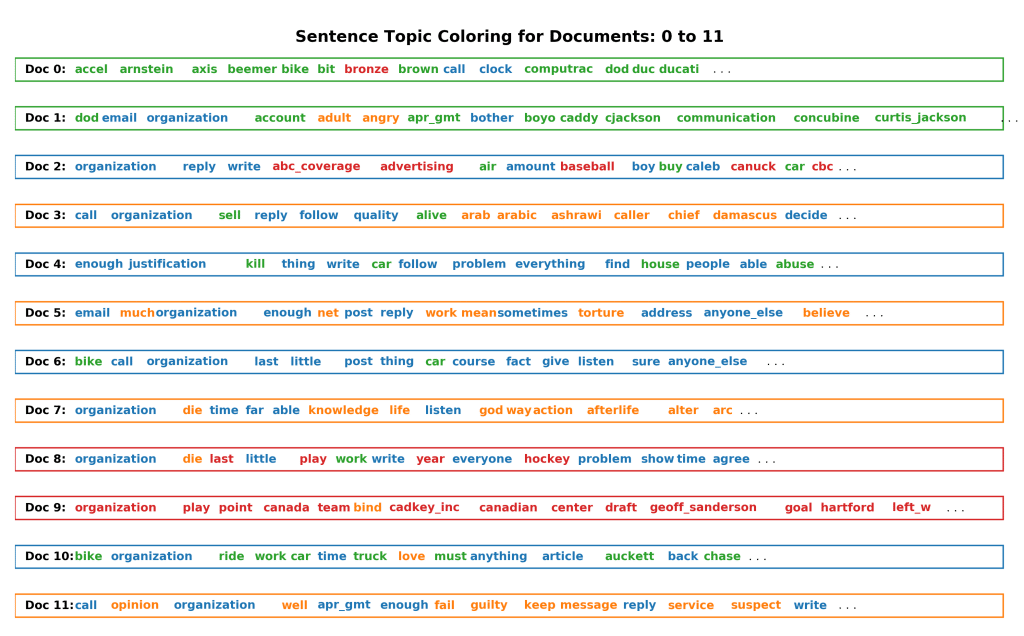
https://www.machinelearningplus.com/nlp/topic-modeling-visualization-how-to-present-results-lda-models/
PLSA
PLSA
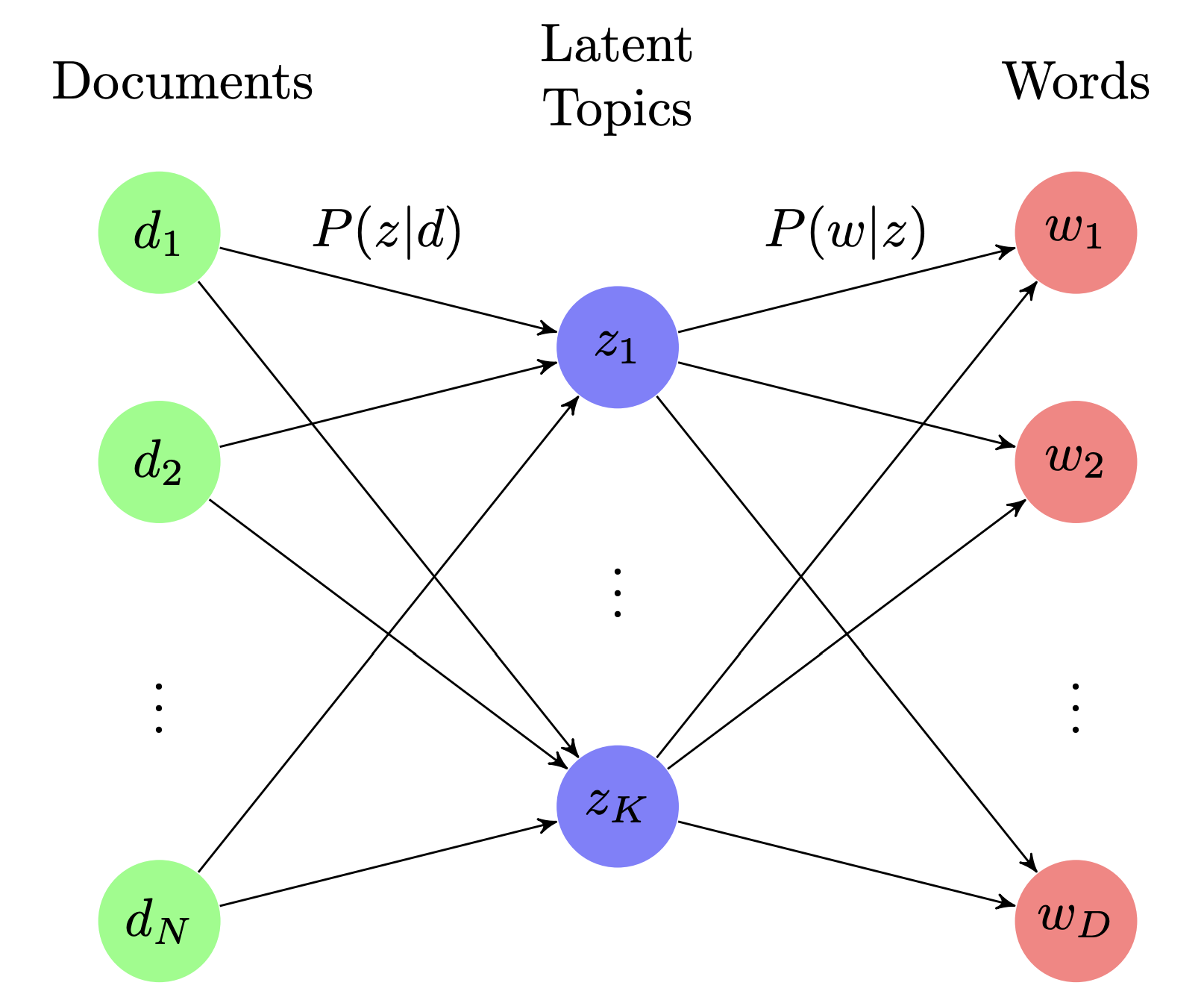
https://homepages.inf.ed.ac.uk/rbf/CVonline/LOCAL_COPIES/AV1011/oneata.pdf
PLSA
PLSA
We want the model P(D,W) such that for any document d and word w, P(d,w) corresponds to that entry in the document-term matrix.
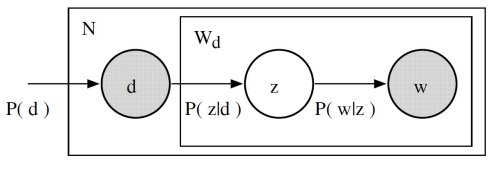
PLSA Training
PLSA Training
Joint probability model:
Likelihood
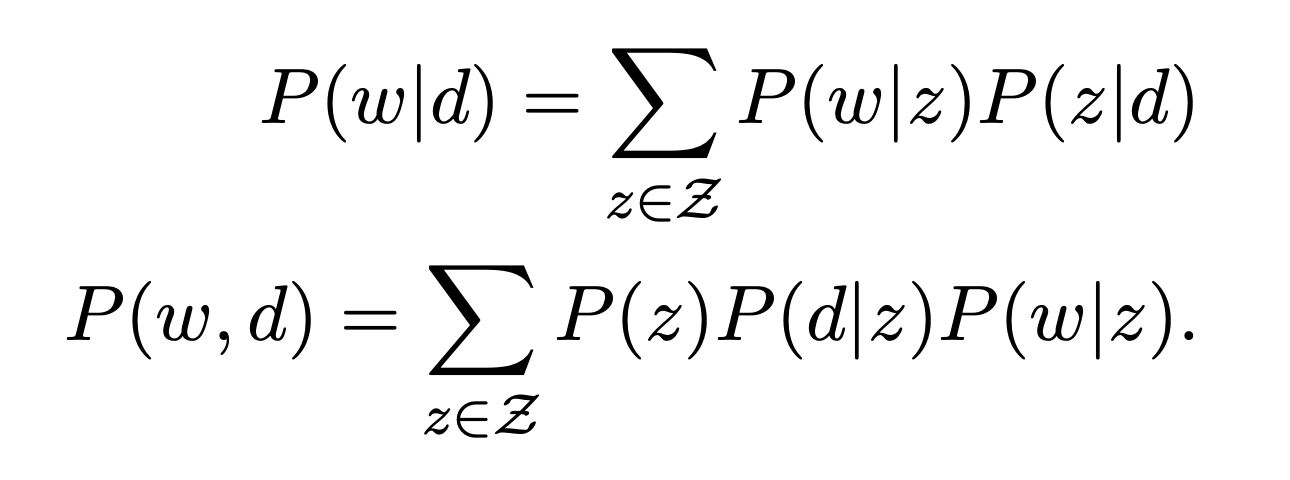

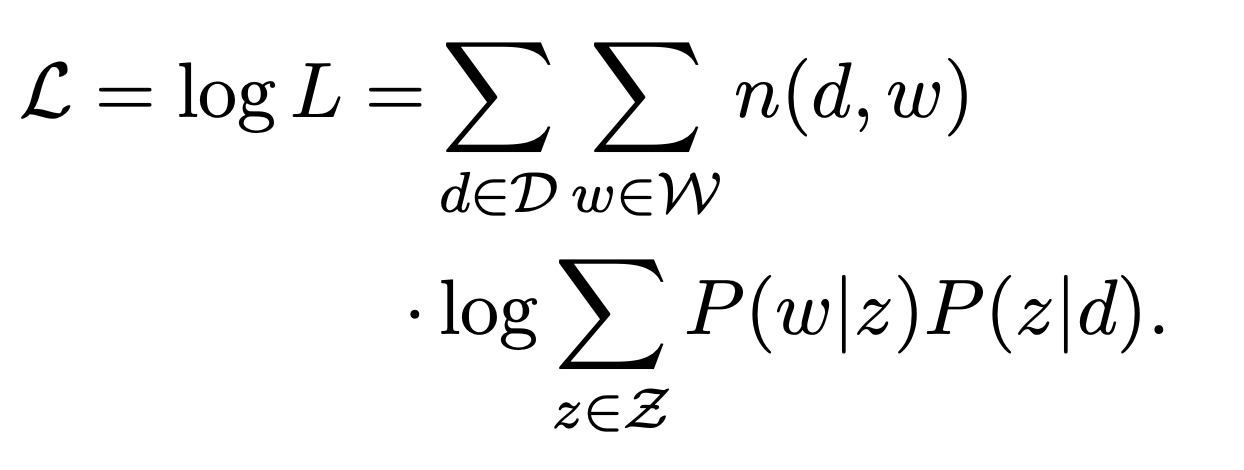
PLSA Training
PLSA Training
Training with EM:
Initialization of the per-topic word distributions and per-document topic distributions
E-step:
M-step:

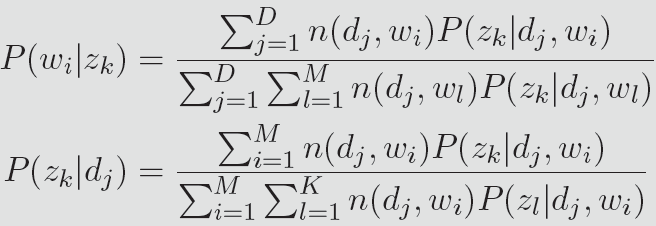
PLSA and LSA
PLSA and LSA
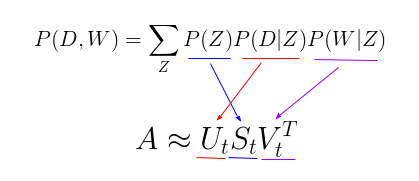
https://nanonets.com/blog/topic-modeling-with-lsa-plsa-lda-lda2vec/
Limitations of PLSA
Limitations of PLSA
No Generative Capability:
PLSA does not model how new, unseen documents are generated—it just assigns topics to existing documents.
Prone to Overfitting:
The number of parameters for PLSA is ;
Grows linearly with the number of documents.
Rarely used in practice.
Prior Distributions
Prior Distributions
If we have priors for the document-topic and word-topic distributions;
We can:
generate new document by sampling from the prior document-topic distribution;
reduced the number of parameter of the model to ;
Lending itself to better generalization.
The document-topic and word-topic distribution is multi-nominal;
What is the distribution of multi-nominal distribution?
Dirichlet Distribution
Dirichlet Distribution
The Dirichlet distribution is a probability distribution over the space of multinomial distributions:
to generate data X from a Dirichlet distribution with parameters ;
you first draw .
and then draw .

Explanation
Explanation
The overall distribution shape depends on the relative magnitudes of all ’s.
Relative magnitude determines the mean proportions: . A larger implies a higher expected proportion.
Absolute magnitude determines the degree of uncertainty: a larger leads to a more concentrated distribution, while a smaller leads to a more dispersed or sparse distribution
If all are small (<1) → The distribution is sparse, meaning most categories have near-zero probabilities, and only a few dominate.
If all are large (>1) → The distribution is dense, meaning all categories tend to have moderate values.
If values are imbalanced → Some categories (with larger values) are more dominant than others.
Example of Dirichlet Distribution
Example of Dirichlet Distribution
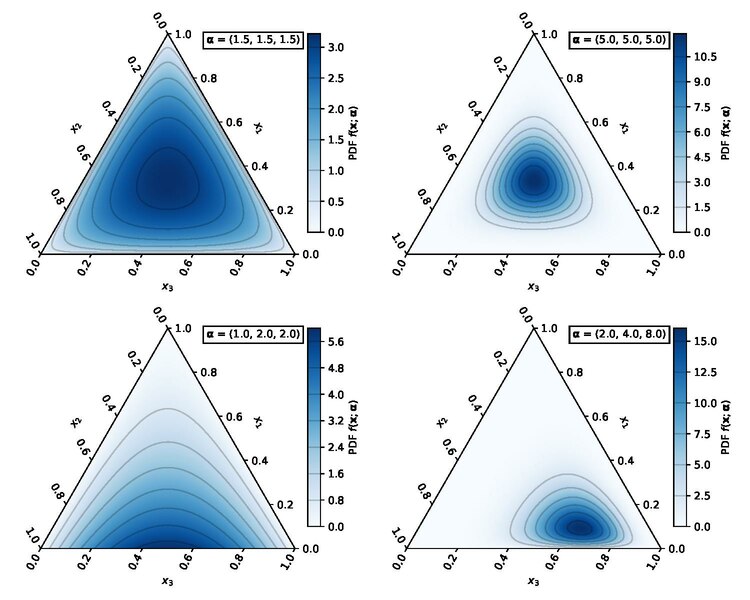
https://en.wikipedia.org/wiki/Dirichlet_distribution
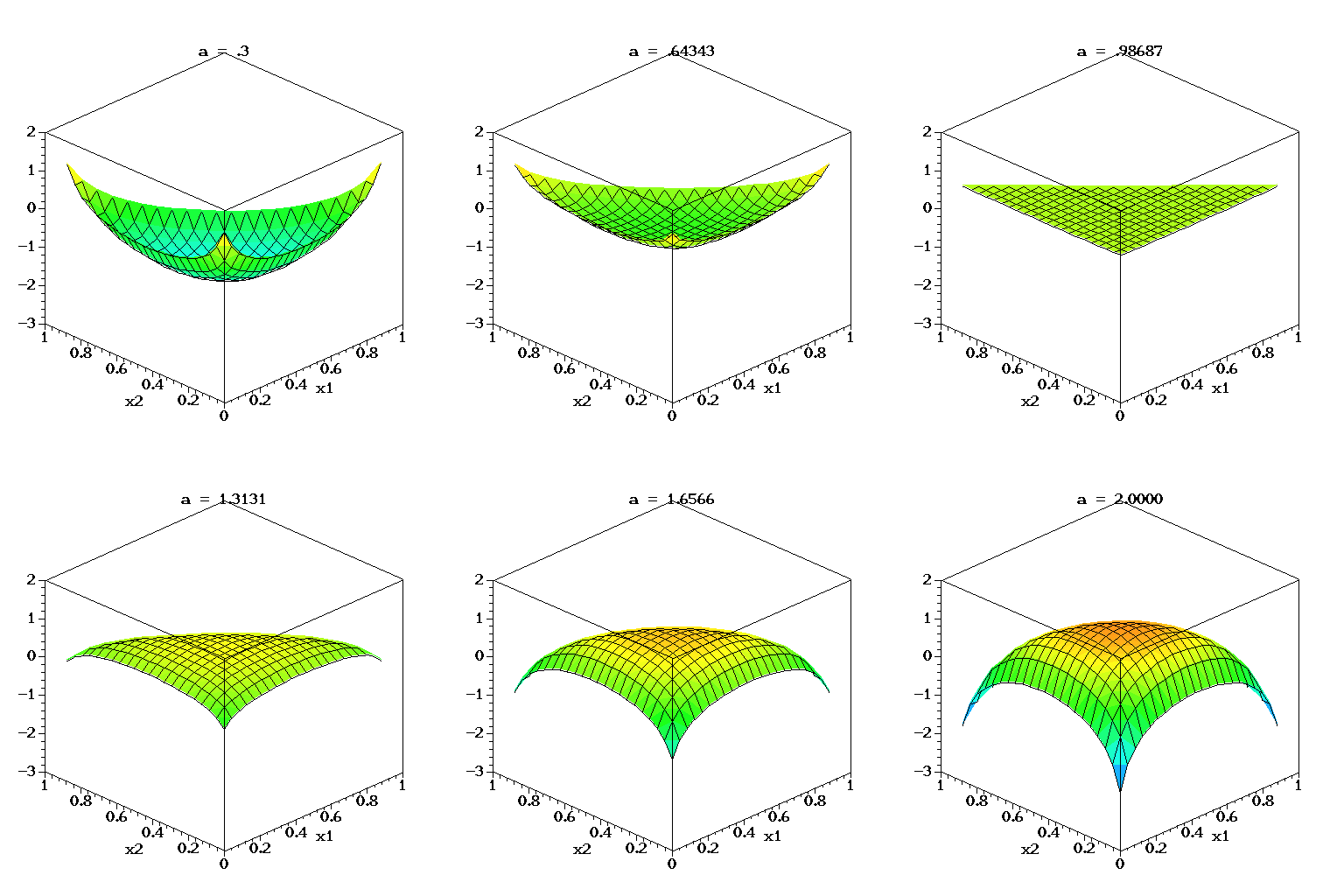
Latent Dirichlet Allocation
Latent Dirichlet Allocation
https://www.jmlr.org/papers/volume3/blei03a/blei03a.pdf
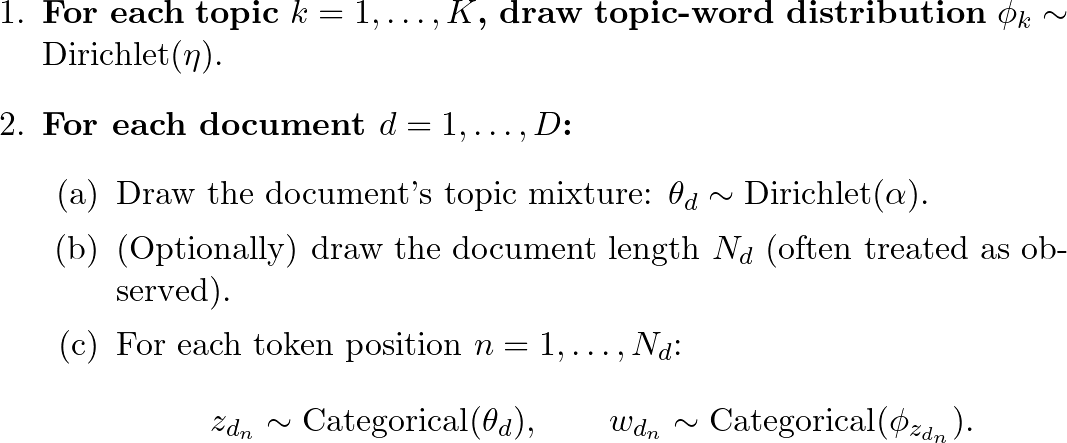
Latent Dirichlet Allocation
Latent Dirichlet Allocation
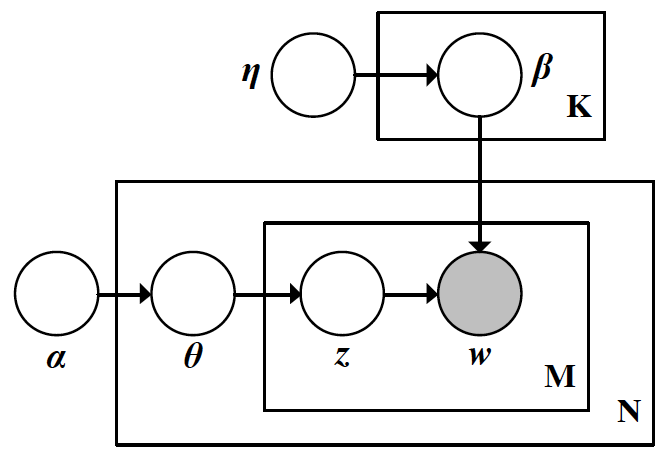
For each doc in a collection of N docs
For each word position in a doc of length M
Topic assignment to a word at position i in doc dj
Word token at position i in doc dj
Per-document topic distribution
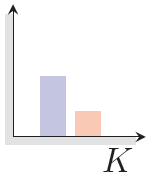
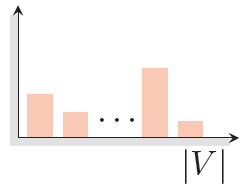
Per-topic word distribution
[Moens and Vulic, Tutorial @WSDM 2014]
Latent Dirichlet Allocation
Latent Dirichlet Allocation
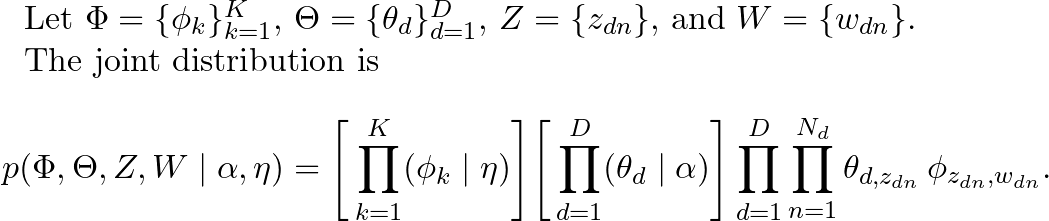
Parameter Estimation
Parameter Estimation
Given a corpus of documents , we are to find parameter and that maximize the log likelihood:
Can be solved by variational EM algorithm.
Inference
Inference
Given a document , we are to find the and .
Variational EM
Gibbs sampling
Case Analysis: LDA on News Data
Case Analysis: LDA on News Data
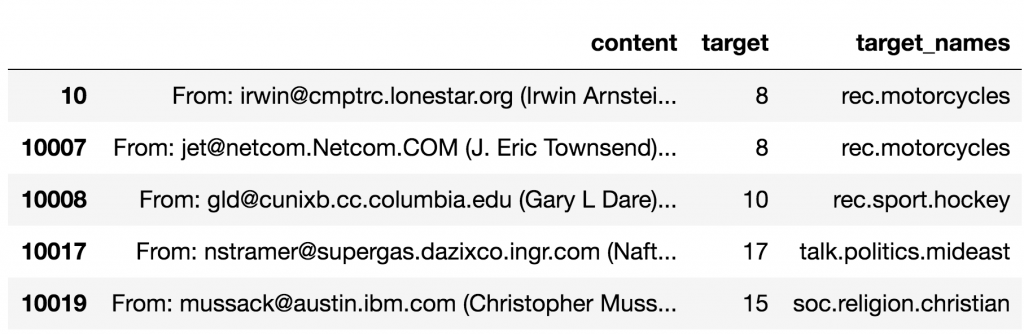
https://www.machinelearningplus.com/nlp/topic-modeling-visualization-how-to-present-results-lda-models/
Case Analysis: learned LDA Topics by Gensim
Case Analysis: learned LDA Topics by Gensim
https://www.machinelearningplus.com/nlp/topic-modeling-visualization-how-to-present-results-lda-models/
0, 0.017*"write" + 0.015*"people" + 0.014*"organization" + 0.014*"article" +
#> 0.013*"time" + 0.008*"give" + 0.008*"first" + 0.007*"tell" + 0.007*"new" +
#> 0.007*"question
1, 0.008*"christian" + 0.008*"believe" + 0.007*"god" + 0.007*"law" +
#> 0.006*"state" + 0.006*"israel" + 0.006*"israeli" + 0.005*"exist" +
#> 0.005*"way" + 0.004*"bible"
2, 0.024*"armenian" + 0.012*"bike" + 0.006*"kill" + 0.006*"work" +
#> 0.005*"well" + 0.005*"year" + 0.005*"sumgait" + 0.005*"soldier" +
#> 0.004*"way" + 0.004*"ride"
3 0.019*"team" + 0.019*"game" + 0.013*"hockey" + 0.010*"player" +
#> 0.009*"play" + 0.009*"win" + 0.009*"nhl" + 0.009*"year" + 0.009*"hawk" +
#> 0.009*"season"
Case Analysis: Top-N words cloud in Each Topic
Case Analysis: Top-N words cloud in Each Topic
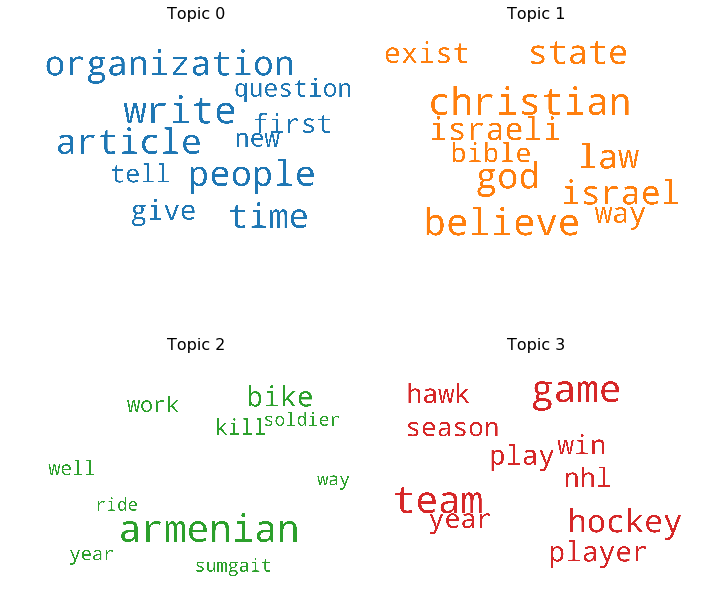
Case Analysis: Dominant topic and its percentage contribution in each document
Case Analysis: Dominant topic and its percentage contribution in each document
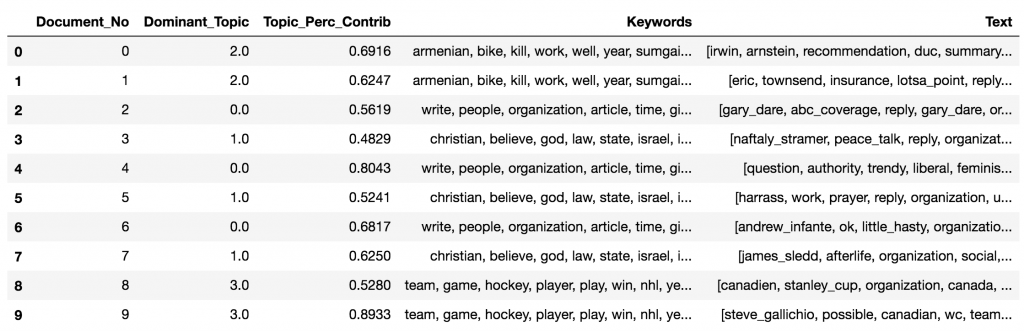
Case Analysis: Dominant topic and its percentage contribution in each document
Case Analysis: Dominant topic and its percentage contribution in each document
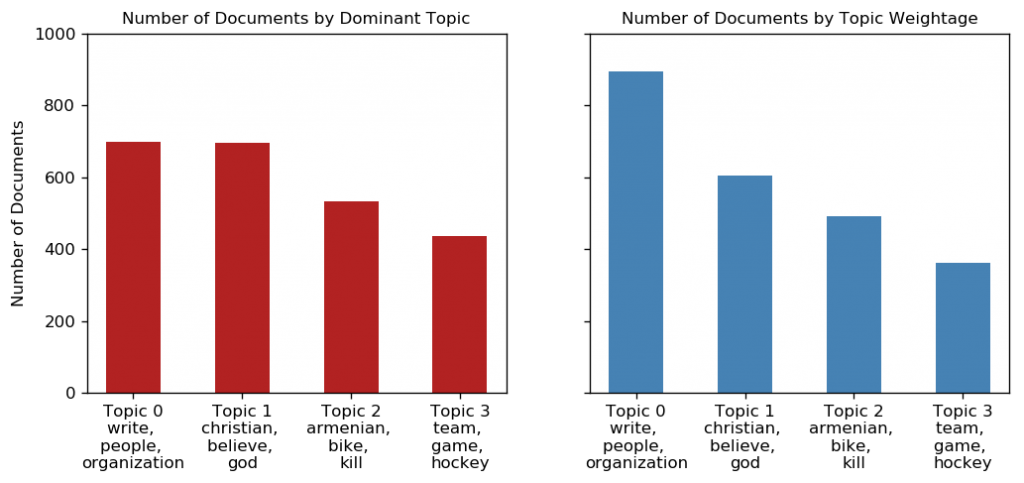
Case Analysis: t-SNE Visualization of Documents
Case Analysis: t-SNE Visualization of Documents
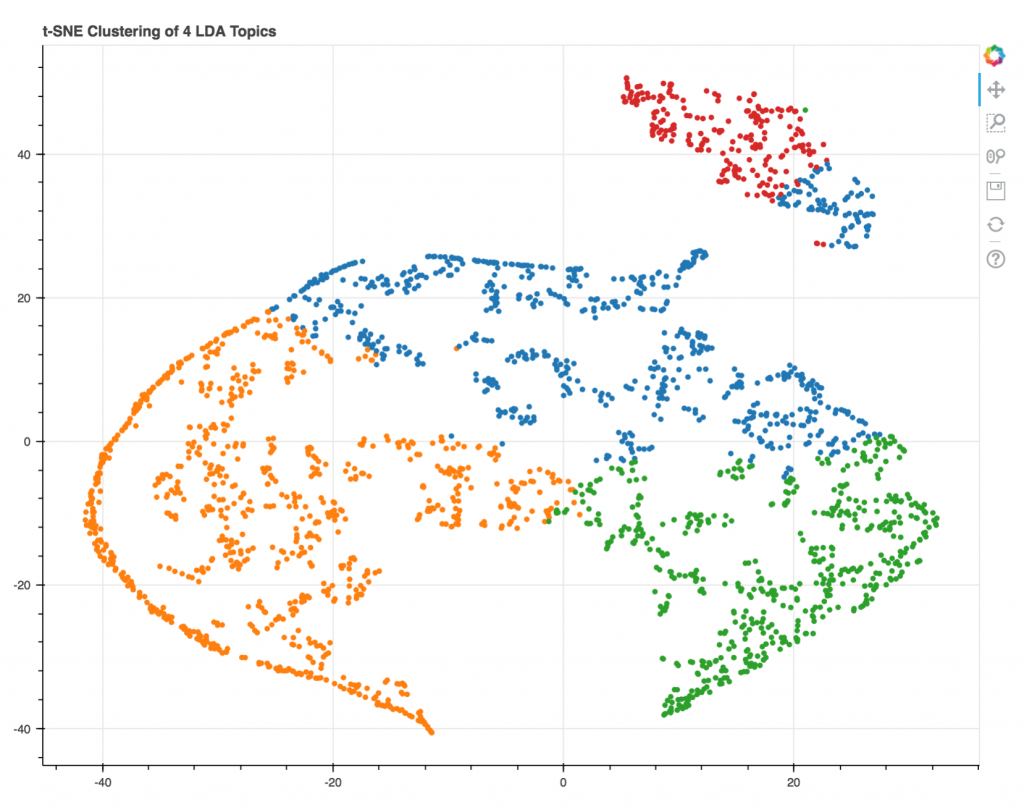
1.3 Statistical Representation of Language and Knowledge 1.3.5 Neural Embeddings
1.3 Statistical Representation of Language and Knowledge 1.3.5 Neural Embeddings
Relax the Constraint of Parametric Model
Relax the Constraint of Parametric Model
Parametric Models
A parametric model assumes a fixed number of parameters and a specific functional form (structure). The learning process involves estimating these parameters based on the given data.
Sparse Embeddings are Parametric Models:
TF-IDF, PMI, PLSA, LDA
Focus on objective, relax the capacity of models, let the data drive the direction of the model.
Learning Representation
Learning Representation
Recall: The meaning is determined by its environment, that is, neighborhood;
Words cooccur means their embeddings has certain relations.
How about predicting the neighborhood from the embedding?
Predicting each other: Word2Vec
Predicting the co-occurrence: GloVe
Word embeddings = the weights of learned machines.
Big idea: self-supervision by co-occurrence information without human label;
1.3 Statistical Representation of Language and Knowledge 1.3.6 Word2Vec
1.3 Statistical Representation of Language and Knowledge 1.3.6 Word2Vec
Word2Vec Overview
Word2Vec Overview
We have a large corpus (“body”) of text: a long list of words
Every word in a fixed vocabulary is represented by a vector
Go through each position t in the text, which has a center word c and context (“outside”) words o
Use the similarity of the word vectors for c and o to calculate the probability of o given c (or vice versa)
Keep adjusting the word vectors to maximize this probability
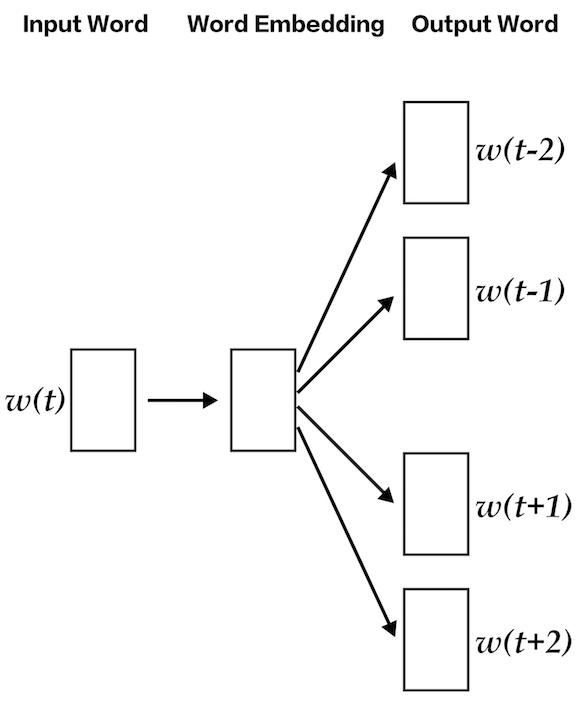
(Mikolov et al. 2013)
Skip-Gram: The context window
Skip-Gram: The context window
Assume a +/- 2 word window, given training sentence:
…lemon, a [tablespoon of apricot jam, a] pinch…
c1 c2 [target] c3 c4
Skip-Gram: Positive Samples
Skip-Gram: Positive Samples
Assume a +/- 2 word window, given training sentence:
…lemon, a [tablespoon of apricot jam, a] pinch…
c1 c2 [target] c3 c4

Skip-Gram: Negative Samples
Skip-Gram: Negative Samples
Assume a +/- 2 word window, given training sentence:
…lemon, a [tablespoon of apricot jam, a] pinch…
c1 c2 [target] c3 c4
For each positive example we'll grab k negative examples, sampling by frequency
Skip-Gram: Negative Samples
Skip-Gram: Negative Samples
Assume a +/- 2 word window, given training sentence:
…lemon, a [tablespoon of apricot jam, a] pinch…
c1 c2 [target] c3 c4
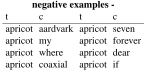
Skip-Gram: Probabilities
Skip-Gram: Probabilities
Assume a +/- 2 word window, given training sentence:
Given a candidate (word, context) pair :
(apricot, jam)
(apricot, aardvark)
…
We want to compute the probability using their embeddings
…lemon, a [tablespoon of apricot jam, a] pinch…
c1 c2 [target] c3 c4
How to Compute 𝑃(+|𝑤, 𝑐)
How to Compute 𝑃(+|𝑤, 𝑐)
The probability of prediction should be definitely related to relatedness or similarity.
Two vectors are similar if they have a high dot product
Cosine is just a normalized dot product
So
𝑃(+|𝑤, 𝑐) can be obtained by normalize it to a probability.
For one context word: 𝑃(+|𝑤, 𝑐)
For one context word: 𝑃(+|𝑤, 𝑐)

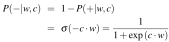
For the Full Context: 𝑃(+|𝑤, 𝑐1:𝐿)
For the Full Context:
We have lots of context words.
We'll assume independence and just multiply them:
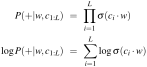
The Parameters – Embeddings
The Parameters -- Embeddings
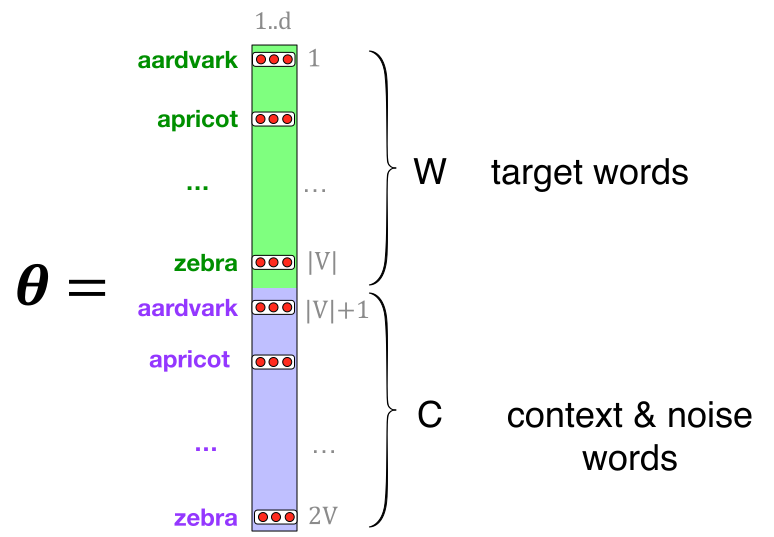
Learning Procedure
Learning Procedure
Given the set of positive and negative training instances, and an initial set of embedding vectors
The goal of learning is to adjust those word vectors such that we:
Maximize the similarity of the target word, context word pairs drawn from the positive data
Minimize the similarity of the pairs drawn from the negative data.
Loss Function
Loss Function
Maximize the similarity of the target with the actual context words, and minimize the similarity of the target with the k negative sampled non-neighbor words.
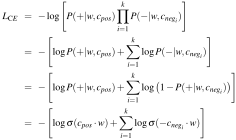
Optimization: Gradient Descent
Optimization: Gradient Descent
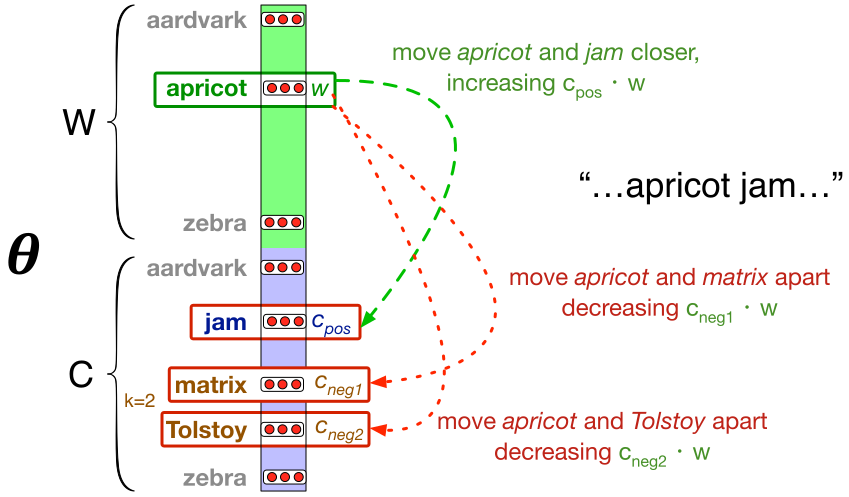
Gradients
Gradients
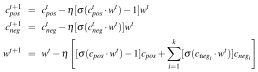
Start with randomly initialized C and W matrices, then incrementally do updates
Two representations?
Two representations?
Skip-Gram with Negative Sampling learns two sets of embeddings
Target embeddings matrix W
Context embedding matrix C
It's common to just add them together, representing word i as the vector
Learning Procedure Summary
Learning Procedure Summary
Start with random d-dimensional vectors as initial embeddings
Train a classifier based on embedding similarity
Take a corpus and take pairs of words that co-occur as positive examples
Take pairs of words that don't co-occur as negative examples
Train the classifier to distinguish these by slowly adjusting all the embeddings to improve the classifier performance
Throw away the classifier code and keep the embeddings.
Trained Word2Vec Embeddings
Trained Word2Vec Embeddings
Google Word2Vec: includes pre-trained vectors trained on a portion of the Google News dataset (consisting of about 100 billion words). The model contains 300-dimensional vectors for about 3 million words and phrases.
1.3 Statistical Representation of Language and Knowledge 1.3.7 GloVe
1.3 Statistical Representation of Language and Knowledge 1.3.7 GloVe
Glove: Basic Idea
Glove: Basic Idea
Word co-occurrence is the most important statistical information available for the model to ‘learn’. the word representation.
Glove: Use a Log-Bilinear (LBL) Regression Model to approximate the co-occurrence information:
the name of “Global”: Focus on the global co-occurrence information over the entire corpus.
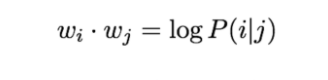
Why the Log-Bilinear Form?
Why the Log-Bilinear Form?
Let’s check the co-occurrence probability carefully.
Ratio of co-occur probabilities is more informative than the raw prob.
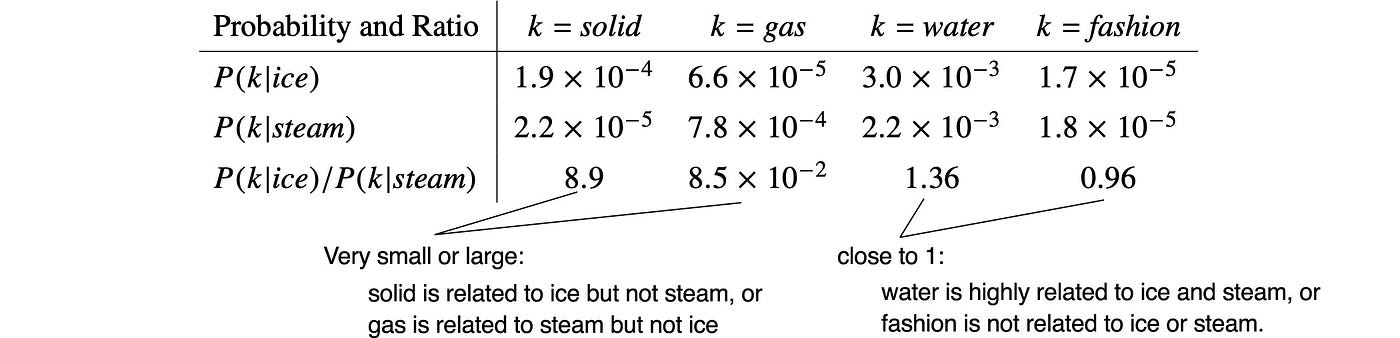
https://jonathan-hui.medium.com/nlp-word-embedding-glove-5e7f523999f6
Why the Log-Bilinear Form?
Why the Log-Bilinear Form?
let us consider a function ‘F’ that models the ratio of probabilities relationship.


Add Linear Structure
Add Linear Structure
We want to given some desirable behavior for the embedding vector
Linearity
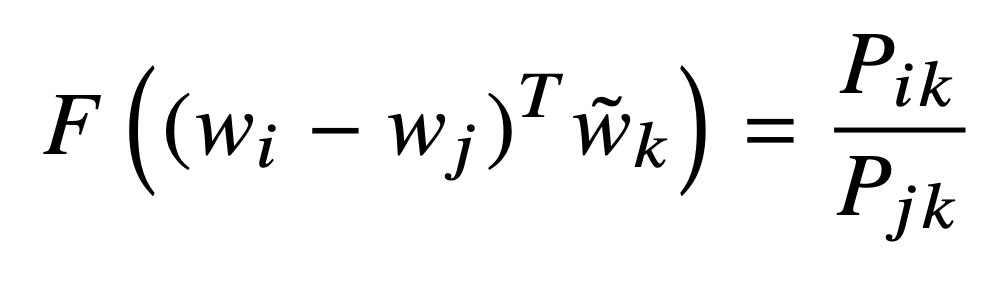
Add Symmetry between Words
Add Symmetry between Words
F be a homomorphism between the groups (R,+) and (R>0, ×),
Make it symmetry:
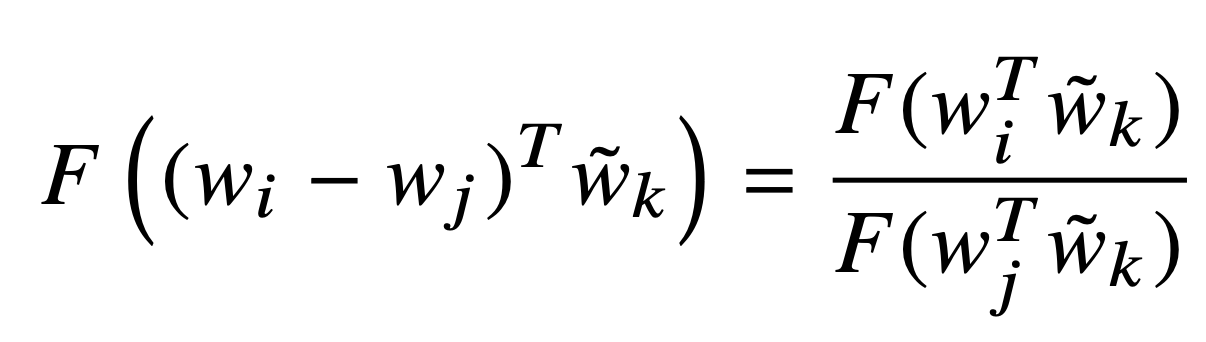
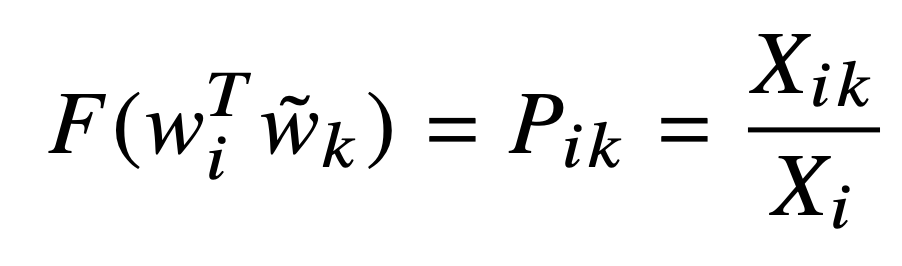


Loss: Weighting the co-occurrence
Loss: Weighting the co-occurrence
Large amount of rare cooccurrences are noisy and carry less information than the more frequent ones

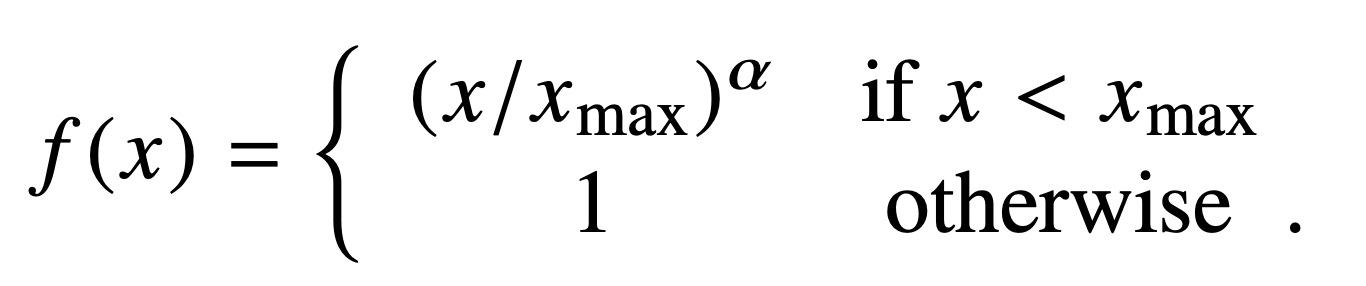
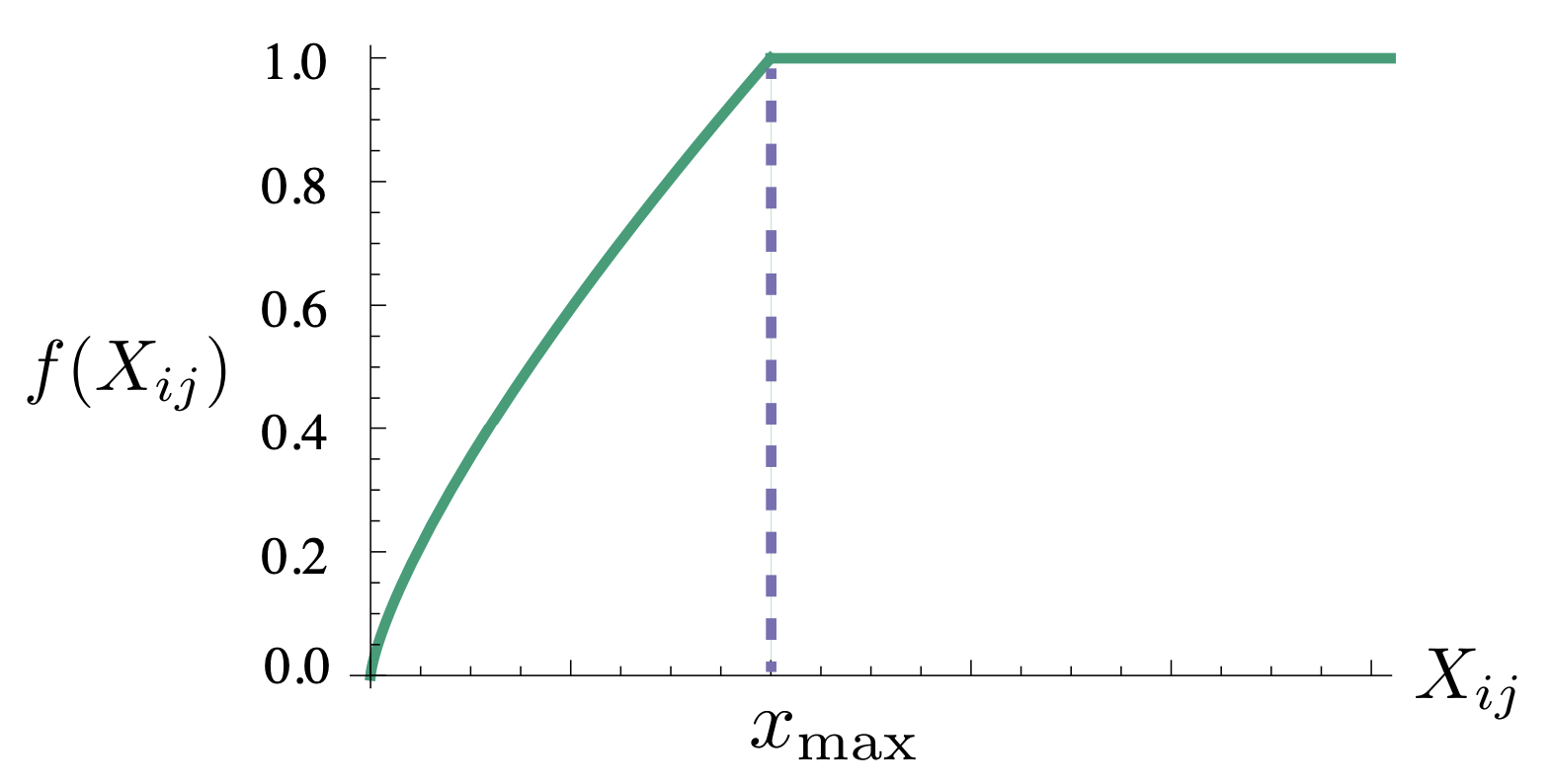
https://nlp.stanford.edu/pubs/glove.pdf
Trained Glove Embeddings
Trained Glove Embeddings
Wikipedia 2014 + Gigaword 5 (6B tokens, 400K vocab, uncased, 50d, 100d, 200d, & 300d vectors, 822 MB)
Common Crawl (42B tokens, 1.9M vocab, uncased, 300d vectors, 1.75 GB)
Common Crawl (840B tokens, 2.2M vocab, cased, 300d vectors, 2.03 GB)
Twitter (2B tweets, 27B tokens, 1.2M vocab, uncased, 25d, 50d, 100d, & 200d vectors, 1.42 GB)
Available at: https://nlp.stanford.edu/projects/glove/
1.3 Statistical Representation of Language and Knowledge 1.3.8 Embedding Properties
1.3 Statistical Representation of Language and Knowledge 1.3.8 Embedding Properties
Relations
Relations
Small windows (C= +/- 2) : nearest words are syntactically similar words in same taxonomy
Hogwarts nearest neighbors are other fictional schools:
Sunnydale, Evernight, Blandings
Large windows (C= +/- 5) : nearest words are related words in same semantic field
Hogwarts nearest neighbors are Harry Potter world:
Dumbledore, half-blood, Malfoy
Example of Similarities
Example of Similarities
The neighbor of “Frog”
1.frogs 2. toad 3. litoria 4. leptodactylidae 5.rana 6. lizard 7.eleutherodactylus
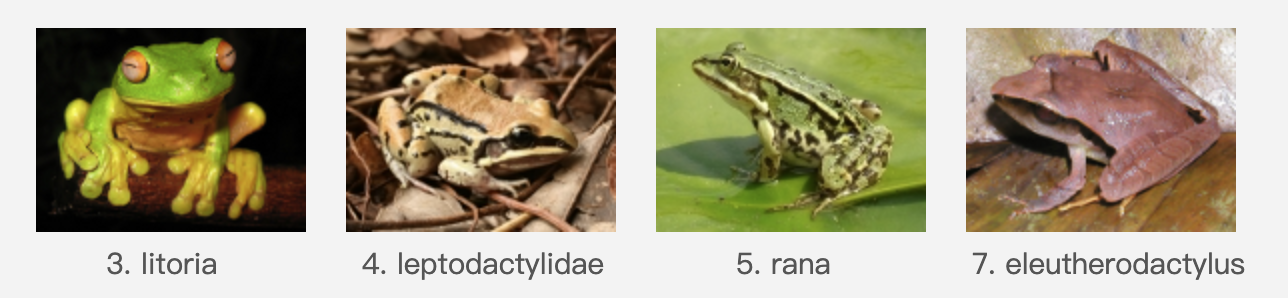
https://nlp.stanford.edu/projects/glove/
Analogical relations
Analogical relations
The classic parallelogram model of analogical reasoning (Rumelhart and Abrahamson 1973)
To solve: "apple is to tree as grape is to _____"
Add tree – apple to grape to get vine
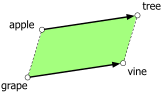
Analogical relations
Analogical relations
The parallelogram method can solve analogies with both sparse and dense embeddings (Turney and Littman 2005, Mikolov et al. 2013b)
is close to
is close to
For a problem , the parallelogram method is:

Structure in GloVE Embedding space
Structure in GloVE Embedding space
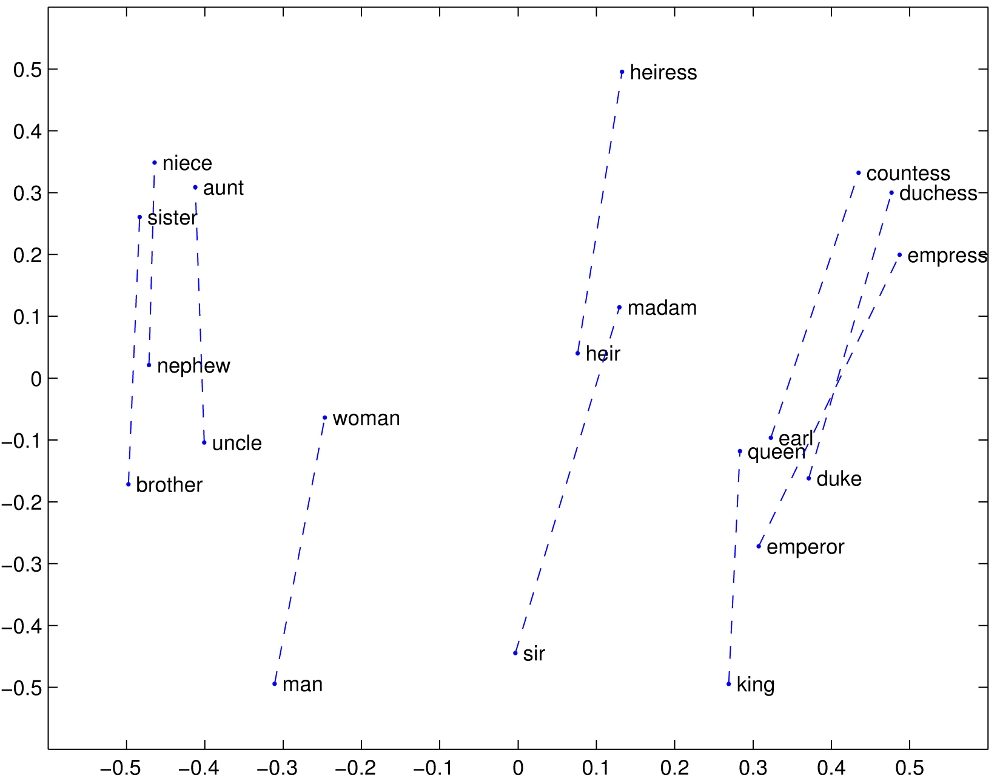
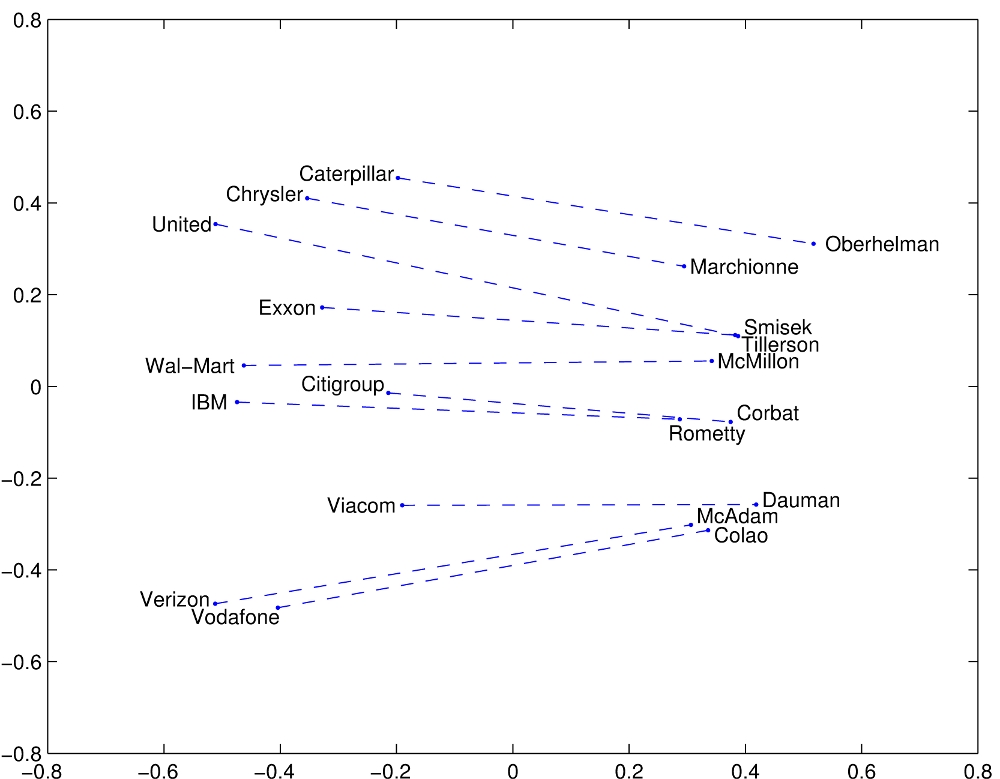
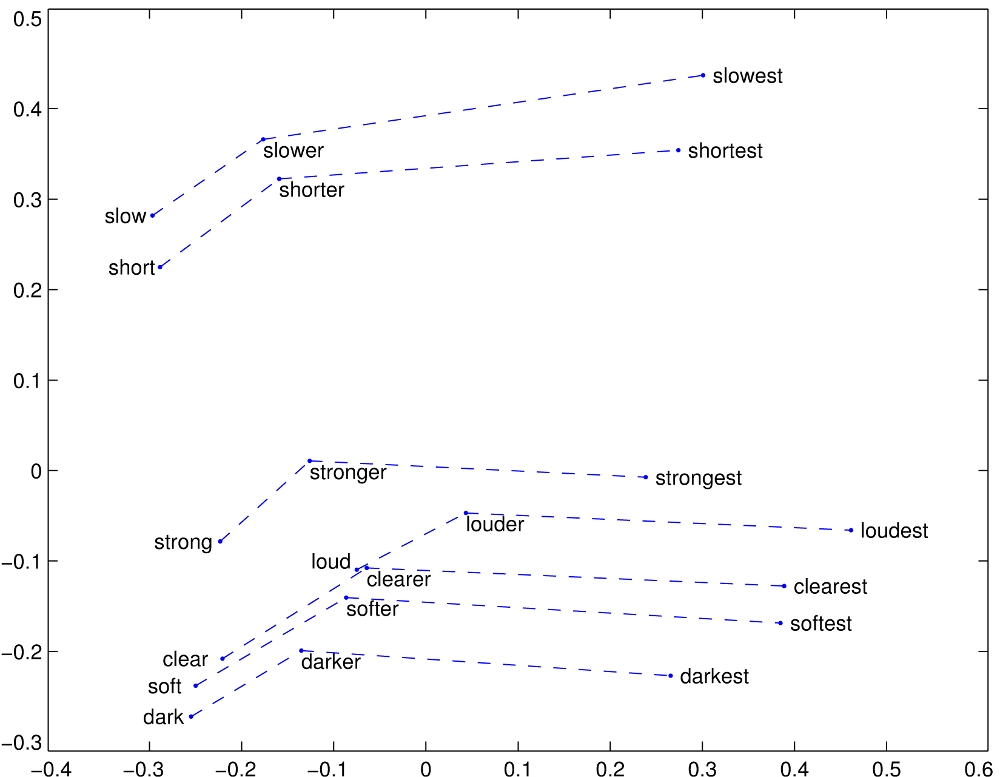
https://nlp.stanford.edu/projects/glove/
More about the Parallelogram Method
More about the Parallelogram Method
Parallelorgram method has been greatly developed and widely applied in the field of Knowledge Graph Embeddings (KGE).
It only seems to work for frequent words, small distances and certain relations (relating countries to capitals, or parts of speech), but not others. (Linzen 2016, Gladkova et al. 2016, Ethayarajh et al. 2019a)
Understanding analogy is an open area of research (Peterson et al. 2020)
Embeddings: a window onto Historical Semantics
Embeddings: a window onto Historical Semantics
Embeddings on different decades of historical text reveals meanings shift
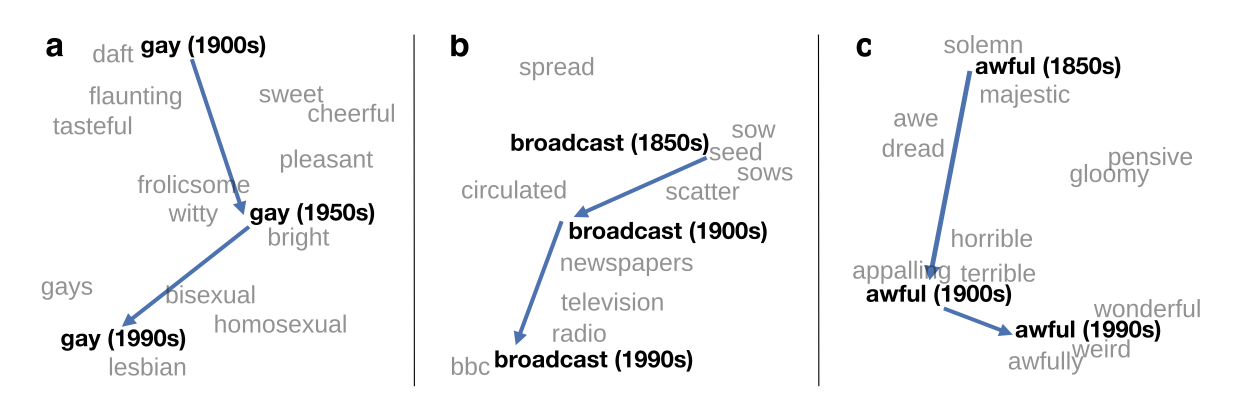
William L. Hamilton, Jure Leskovec, and Dan Jurafsky. 2016. Diachronic Word Embeddings Reveal Statistical Laws of Semantic Change. Proceedings of ACL.
Embeddings reflect cultural bias!
Embeddings reflect cultural bias!
Bolukbasi, Tolga, Kai-Wei Chang, James Y. Zou, Venkatesh Saligrama, and Adam T. Kalai. "Man is to computer programmer as woman is to homemaker? debiasing word embeddings." In NeurIPS, pp. 4349-4357. 2016.
Ask “Paris : France :: Tokyo : x”
x = Japan
Ask “father : doctor :: mother : x”
x = nurse
Ask “man : computer programmer :: woman : x”
x = homemaker
Algorithms that use embeddings as part of e.g., hiring searches for programmers, might lead to bias in hiring
Historical embedding as a tool to study cultural biases
Historical embedding as a tool to study cultural biases
Garg, N., Schiebinger, L., Jurafsky, D., and Zou, J. (2018). Word embeddings quantify 100 years of gender and ethnic stereotypes. Proceedings of the National Academy of Sciences 115(16), E3635–E3644.
Compute a gender or ethnic bias for each adjective: e.g., how much closer the adjective is to "woman" synonyms than "man" synonyms, or names of particular ethnicities
Embeddings for competence adjective (smart, wise, brilliant, resourceful, thoughtful, logical) are biased toward men, a bias slowly decreasing 1960-1990
Embeddings for dehumanizing adjectives (barbaric, monstrous, bizarre) were biased toward Asians in the 1930s, bias decreasing over the 20th century.
These match the results of old surveys done in the 1930s
1.3 Statistical Representation of Language and Knowledge 1.3.9 Knowledge Graph Embedding
1.3 Statistical Representation of Language and Knowledge 1.3.9 Knowledge Graph Embedding
Recall: Representation Learning
Recall: Representation Learning
Representation learning:
maps real-world objects into vectors (embeddings) in a vector space;
models their attributes, relationships, and interactions through the mathematical structure of these vectors;
thereby providing a computable and generalizable cognitive foundation for intelligent systems.
Can the elements (like relations) and operations (like reasoning) in KG be represented by embeddings?
Recall: Entity Linking
Recall: Entity Linking
We’ve learnt the entity embedding from its texture attributes.
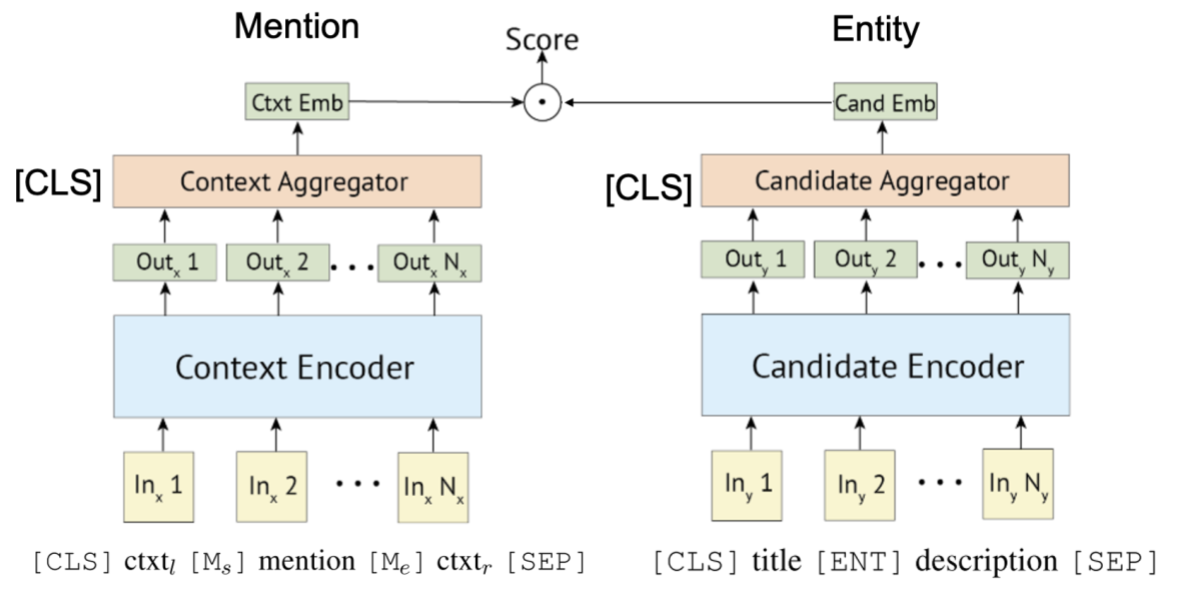
https://medium.com/nerd-for-tech/building-bi-encoder-based-entity-linking-system-with-transformer-6c111d86500
Node Embeddings
Node Embeddings
The meaning of nodes are defined by there environment.
To find embedding for nodes, just construct environment, and apply the Skip-Gram Algorithm.
DeepWalk
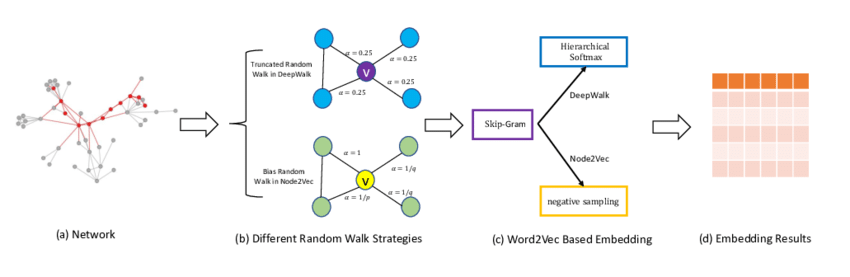
https://www.researchgate.net/figure/The-framework-of-DeepWalk-and-Node2Vec_fig2_343892685
Knowledge Graph Embeddings
Knowledge Graph Embeddings
Embeddings for KG elements:
Entity, Relation
How to obtain the embedding from the environment of KG?
What is the environments?
What is the objective of the embedding in this environment? That is, what is the expected relationship between the embedding of these elements?
Knowledge Graph Embeddings
Knowledge Graph Embeddings
Given a knowledge in KG , the entities and relations are logically connected;
Entity’s environments: associated relations and target entities;
Relation’s environments: associated head entities and tail entities.
We are expecting there exists certain relationship between their embeddings , that is .
Knowledge Graph Embedding
Knowledge Graph Embedding

https://arxiv.org/pdf/2410.14733
Recall: Analogical relations
Recall: Analogical relations
In word embedding:
is close to
is close to
For a problem , the parallelogram method is:
: a hidden relation representation?
Recall: Analogical relations
Recall: Analogical relations
https://nlp.stanford.edu/projects/glove/
Translation Based Embeddings
Translation Based Embeddings
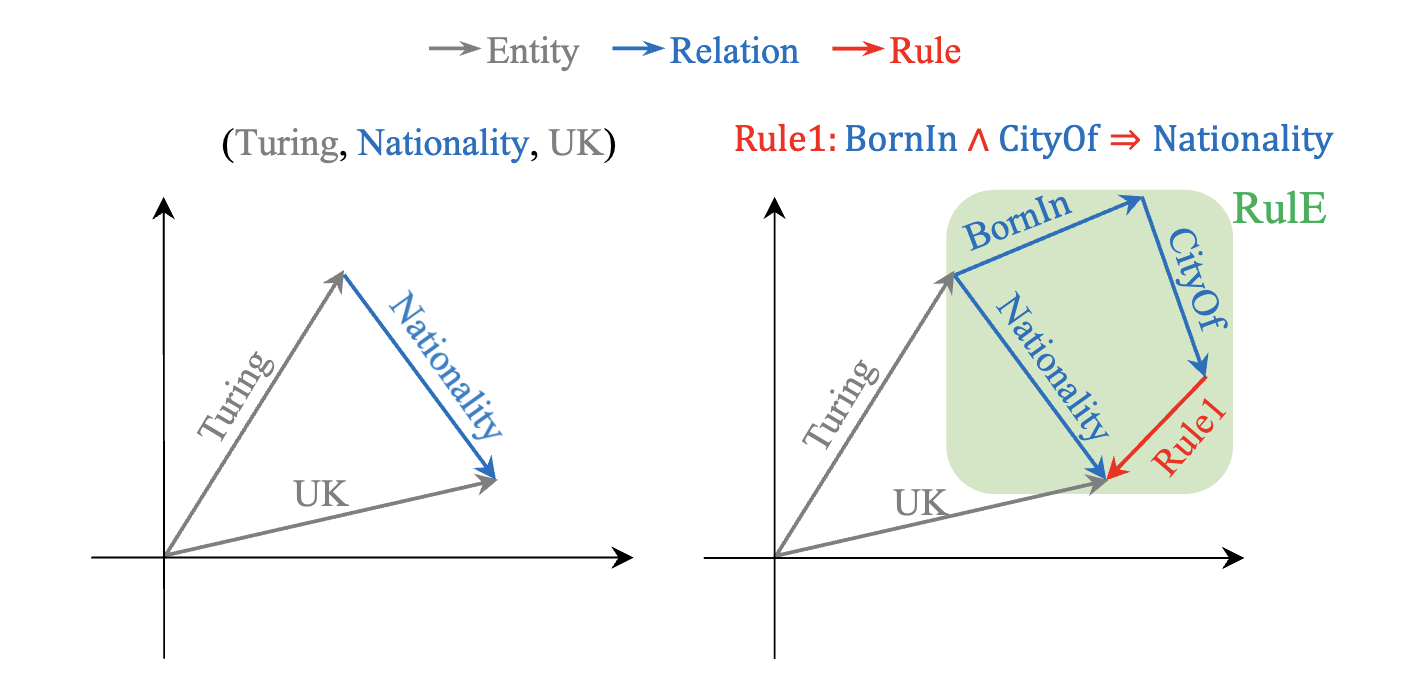
https://arxiv.org/pdf/2210.14905
TransE:
For positive facts, should be small;
For negative facts, should be large;
Training the Embedding Model
Training the Embedding Model
Use margin-based ranking loss:
For each positive triple (h, r, t), generate corrupted triple or by replace:
Head entity:
Tail entity:

Model Variants
Model Variants
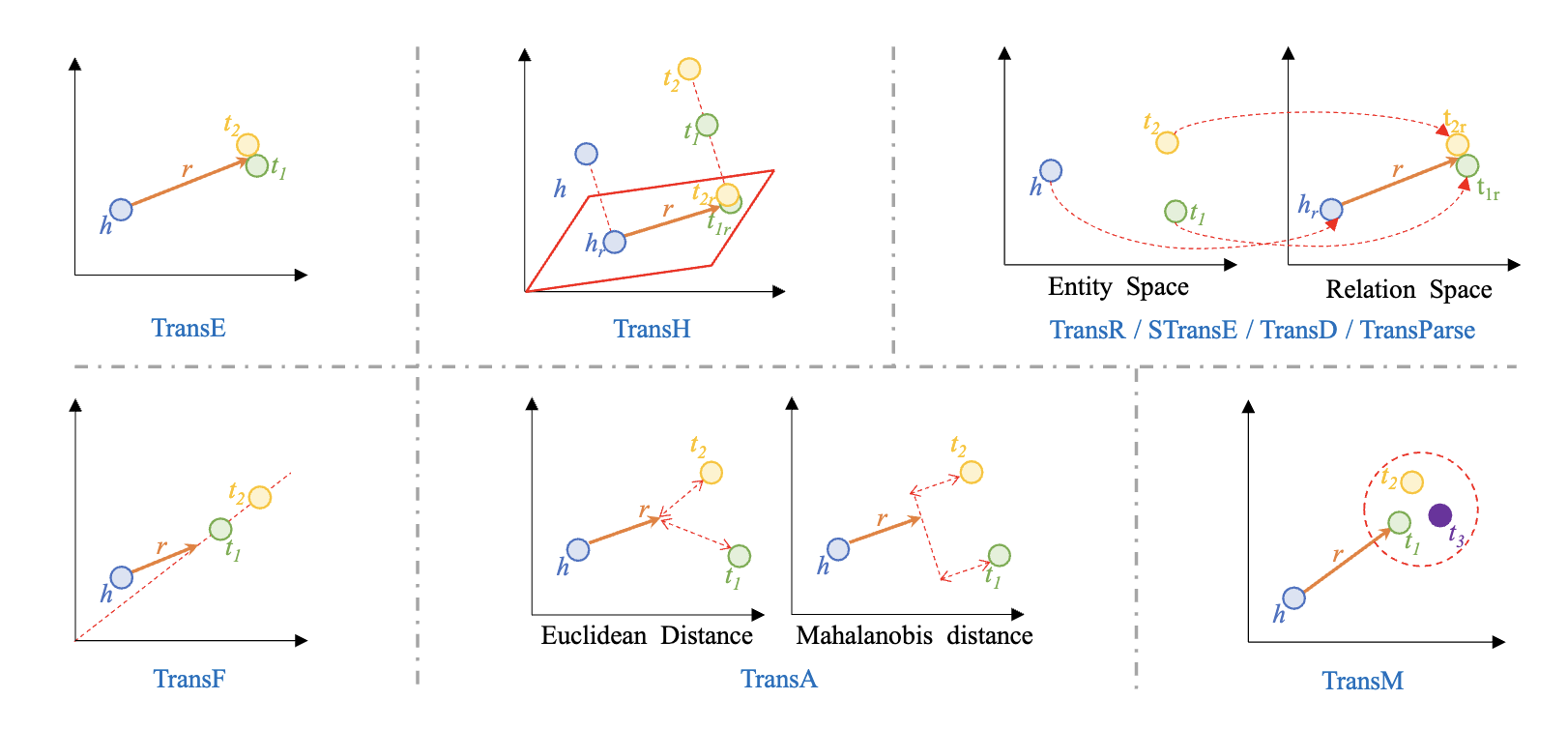
https://arxiv.org/pdf/2410.14733
Model Variants
Model Variants
https://arxiv.org/pdf/2410.14733
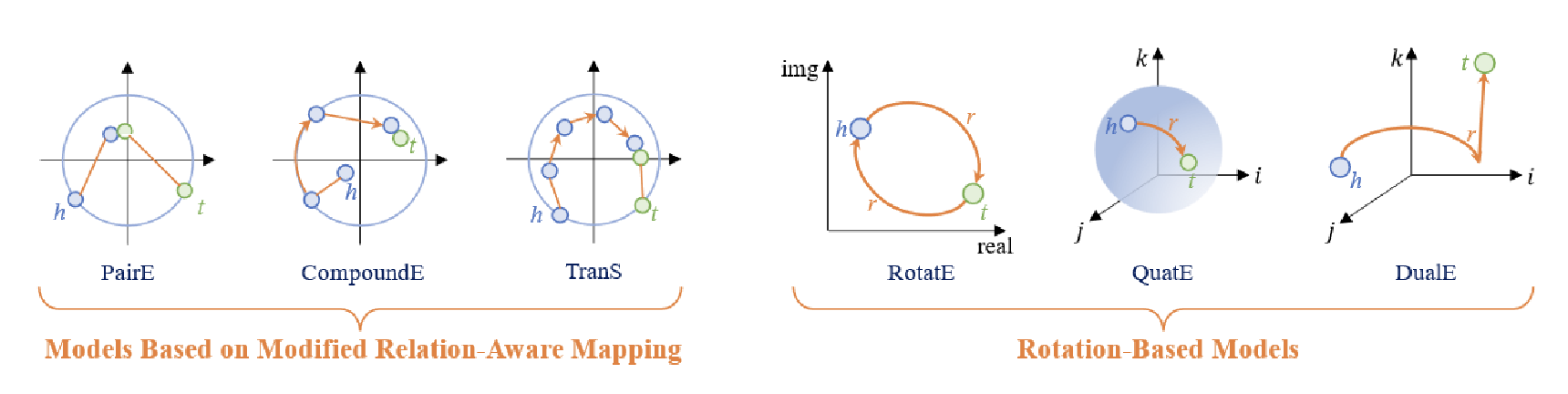
Why so many variants?
Why so many variants?
https://arxiv.org/pdf/2410.14733
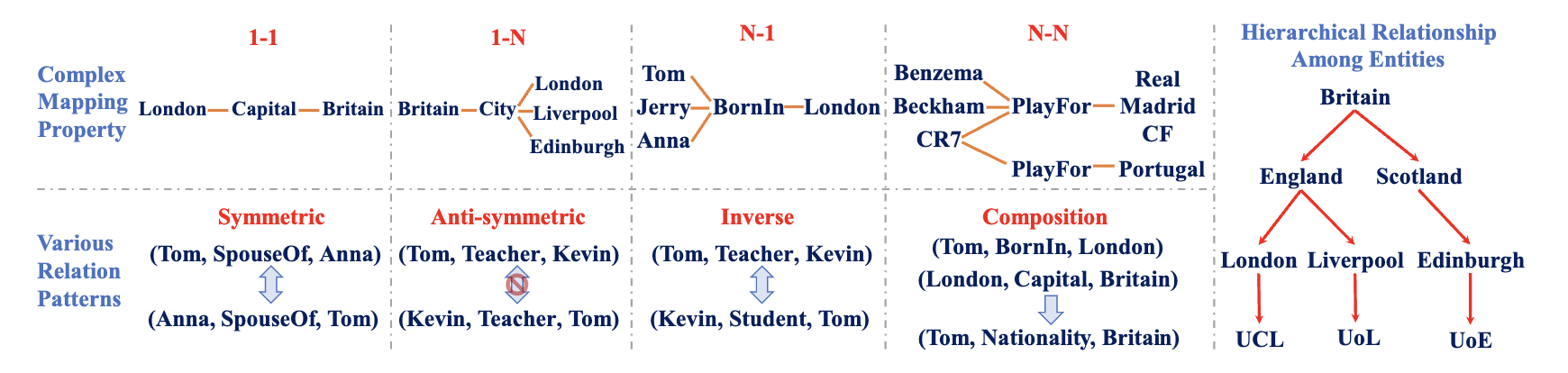
Why so many variants?
Why so many variants?
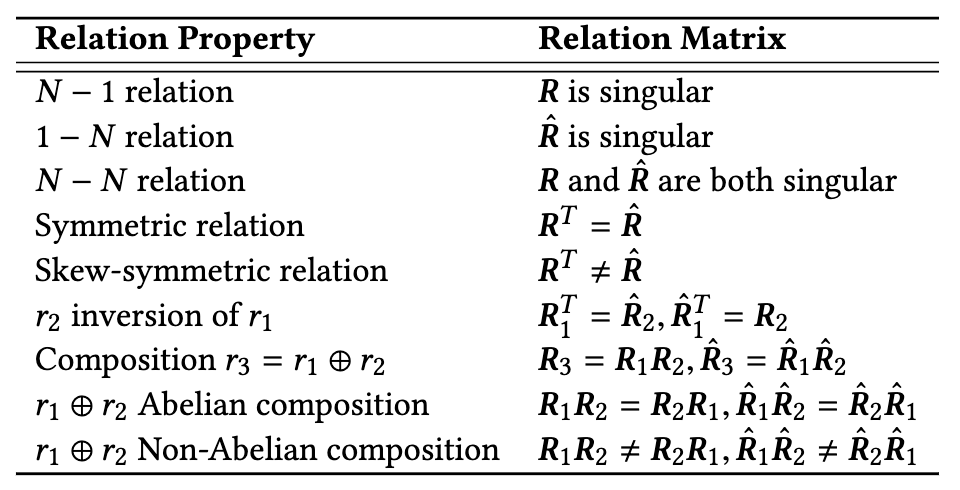
MQuadE
Why so many variants?
Why so many variants?
MQuinE
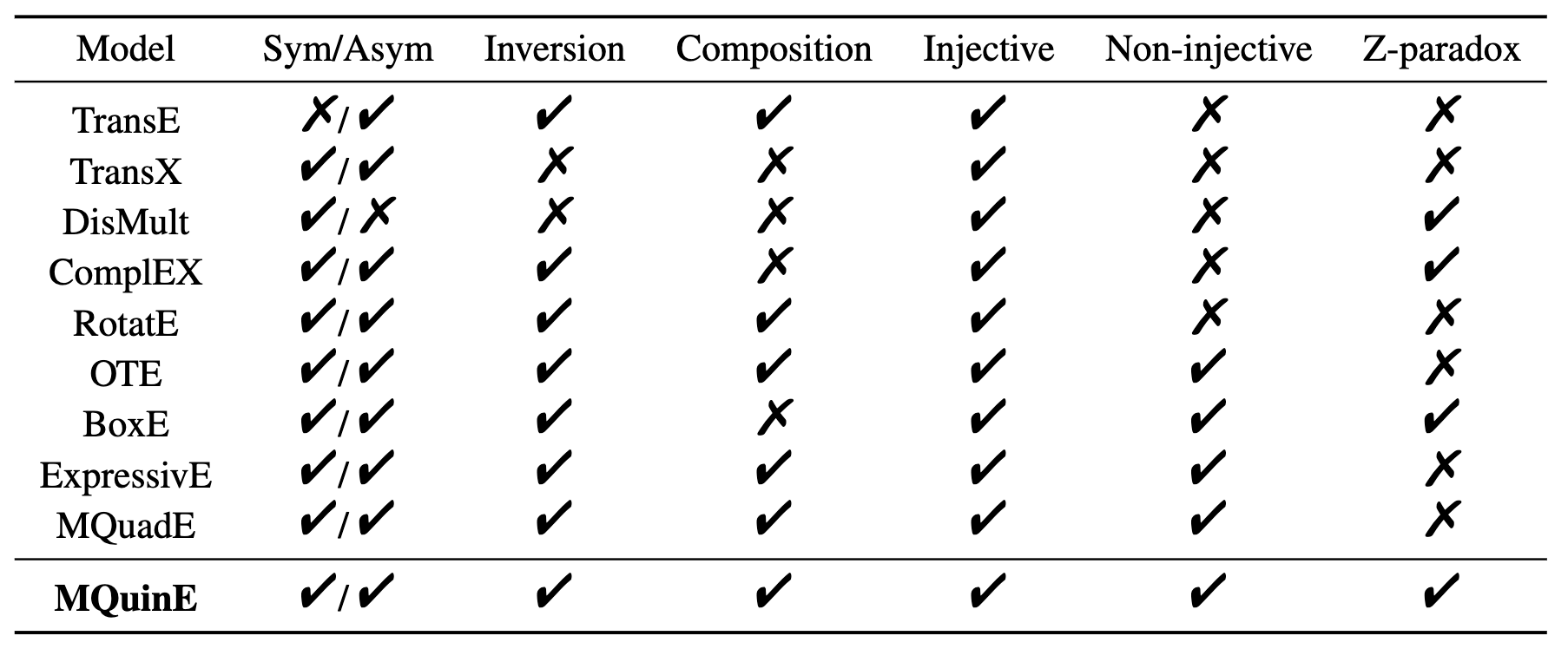
Applications of KGE
Applications of KGE
Link Prediction
or
Triplet Classification
is true or not
Entity Typing
Entity Matching
?
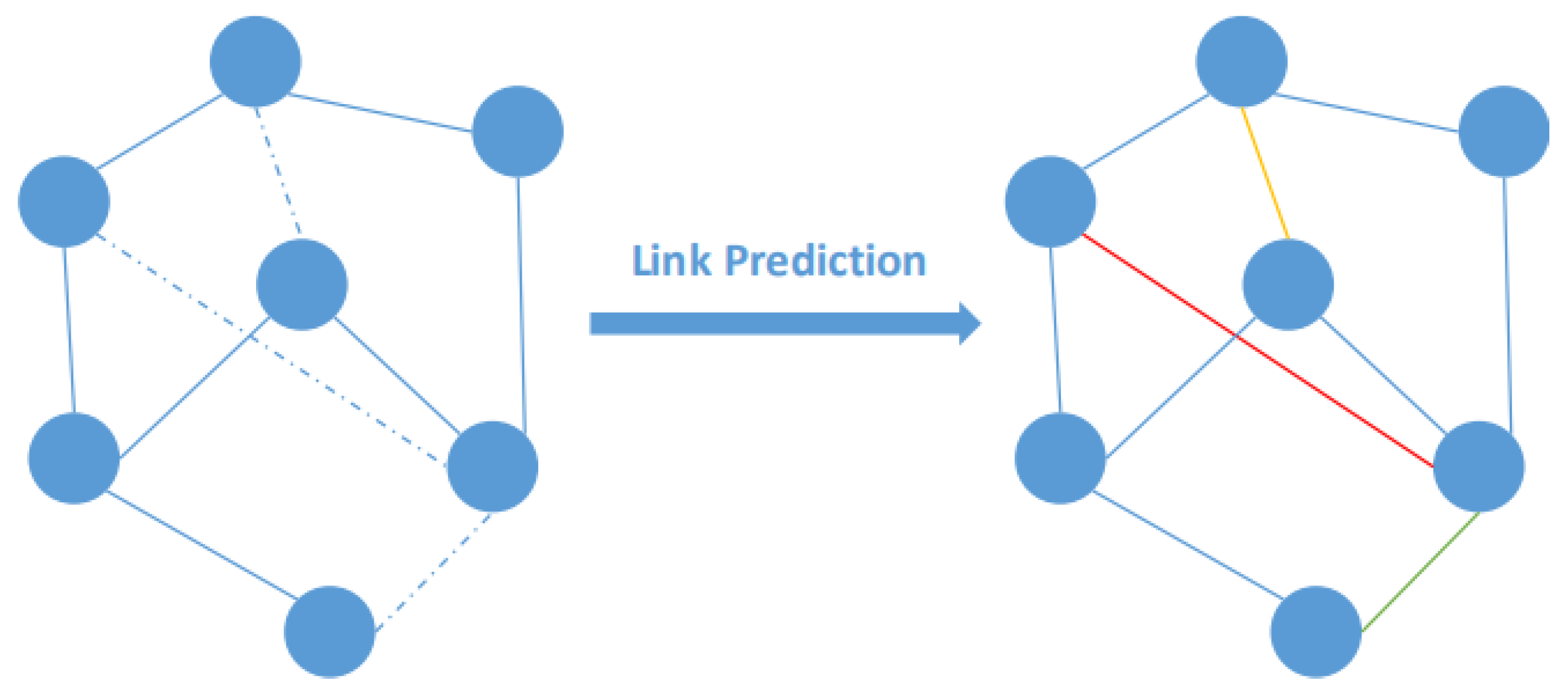
https://www.mdpi.com/2073-8994/13/3/485
1.3 Statistical Representation of Language and Knowledge 1.3.10 Suggested Readings
1.3 Statistical Representation of Language and Knowledge 1.3.10 Suggested Readings
Papers
Papers
1.3 Statistical Representation of Language and Knowledge 1.3.11 Assignment
1.3 Statistical Representation of Language and Knowledge 1.3.11 Assignment
Try and play with the ModelScope Platform
Try and play with the ModelScope Platform
Start the Jupyter Lab with CPU and GPU;
Make virtual environment;
Play with them, make sure the GPU is working as expected;
Remember to save data in the persistent path;
Remember to close the Jupyter Lab instance (Limited Time GPU)
The Report for Practical Project
The Report for Practical Project
Written in IPython notebook
A good experimental report: Introduction, Task description, Mathematical Model, Learning System Design, Experimental Setting, Model Selection, Performance Analysis and Case Study, Conclusion
Learning System Design: Write your math equation and implementation code and explanations
Experimental Setting: Describe your dataset, and hyper parameter candidates;
Model Selection: Perform cross-validation, choose the proper hyper-parameters and illustrate the underfit-overfit phenomenon;
Performance Analysis and Case Study: Evaluate the performance of the chosen model, and then analyze several good cases and bad cases.
Example: https://github.com/Sohaib1424/Support-Vector-Machine-from-scratch/blob/main/SVM.ipynb
Questions?
Questions?