Natural Language UnderstandingStatistical Language Modeling

Natural Language
Understanding
Statistical Language Modeling
Understanding
Statistical Language Modeling
Mingming Sun
BIMSA
Outline

Outline
Statistical Language Modeling
Building a N-Gram Language Model
Generalization to Unseen Words
Generation
Evaluation
2.1 Statistical Language Modeling 2.1.1 Statistical Language Modeling
2.1 Statistical Language Modeling 2.1.1 Statistical Language Modeling
Problem: Is this Document Natural?
Problem: Is this Document Natural?
Symbolic Approach:
Decompose the document into sentences and paragraphs;
Check whether each sentence is generated by valid generative gramma;
Check whether the former and latter sentences/paragraphs satisfy coherent relations;
Check whether the knowledge stated in the document be consistent with the real world.
…
Statistical Approach
Check whether
Language Modeling
Language Modeling
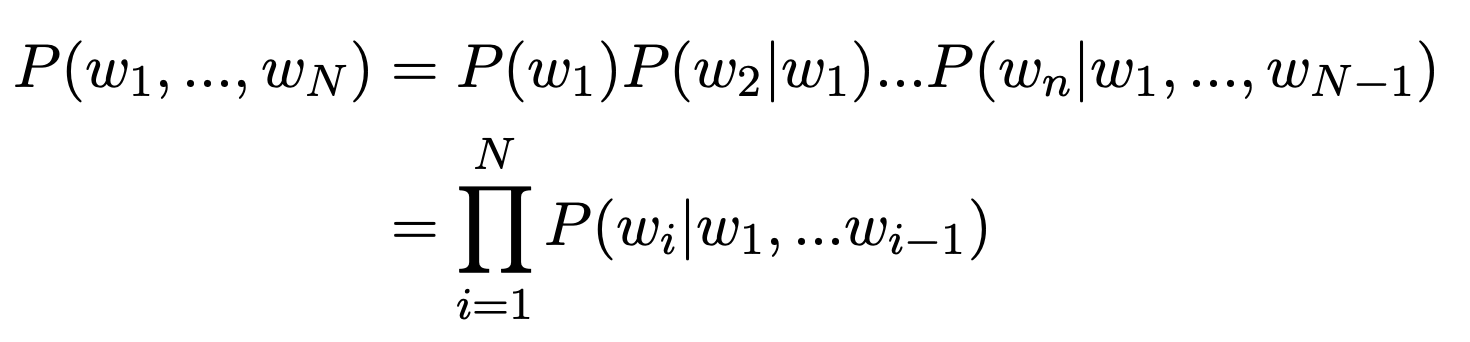
Probabilistic Sequence Model:
The sentence/document is generated by Next-Word-Generation: generate given .
Predicting Next Words
Predicting Next Words
The water of Walden Pond is beautifully ...
blue
green
clear
refrigerator
that
tomorrow
Examples
Examples
How to estimate these probabilities
How to estimate these probabilities
Could we just count and divide?
No! Too many possible sentences!
We’ll never see enough data for estimating these


=
Markov Assumption
Markov Assumption


≈
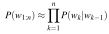
Simplify the problem by applying Markov Assumption:
Bigram Model
Bigram Model

N-gram Model
N-gram Model

Generalize the Markov Assumption to Higher Order Markov Assumption:
Given the previous words, probability of -th word is independent of words prior to words.
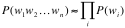
Simplest Case: Unigram Model
Simplest Case: Unigram Model
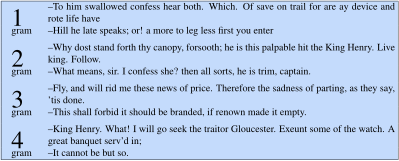
To him swallowed confess hear both . Which . Of save on trail for are ay device and rote life have
Hill he late speaks ; or ! a more to leg less first you enter
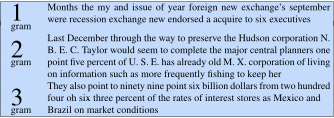
Months the my and issue of year foreign new exchange’s September
were recession exchange new endorsed a acquire to six executives
Example of Bigram Model
Example of Bigram Model
Why dost stand forth thy canopy, forsooth; he is this palpable hit the King Henry. Live king. Follow.
What means, sir. I confess she? then all sorts, he is trim, captain.
Last December through the way to preserve the Hudson corporation N. B. E. C. Taylor would seem to complete the major central planners one gram point five percent of U. S. E. has already old M. X. corporation of living
on information such as more frequently fishing to keep her
Pros and Cons of N-gram Model
Pros and Cons of N-gram Model
Pros:
Make Statistical Language Model feasible, greatly promote the research;
Cons:
N-grams do not modeling semantic relationships.
N-grams can't handle long-distance dependencies.
“The soups that I made from that new cookbook I bought yesterday were amazingly delicious."
Application of N-Gram Model
Application of N-Gram Model
Build a N-Gram Model from a Corpus, and use it to:
Calculate the probability of a sequence:
Select most possible (in ASR) /natural (in MT) result;
Generate a sequence:
Input completion in Input Method/Code Editing/Search Query;
2.1 Statistical Language Modeling 2.1.2 Building an N-gram Language Model
2.1 Statistical Language Modeling 2.1.2 Building an N-gram Language Model
Build a N-Gram Model from Corpus
Build a N-Gram Model from Corpus
Language distributions are different among problem domains:
If task-specific (legal or medical), use a training corpus that has a similar genre to your task.
Variety is important:
Make sure to cover different kinds of language patterns in the task domain.
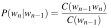
Estimating Bigram Probabilities
Estimating Bigram Probabilities
<s> I am Sam </s>
<s> Sam I am </s>
<s> I do not like green eggs and ham </s>
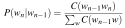

More examples: Berkeley Restaurant Project
More examples:
Berkeley Restaurant Project
Berkeley Restaurant Project
can you tell me about any good cantonese restaurants close by
tell me about chez panisse
i’m looking for a good place to eat breakfast
when is caffe venezia open during the day
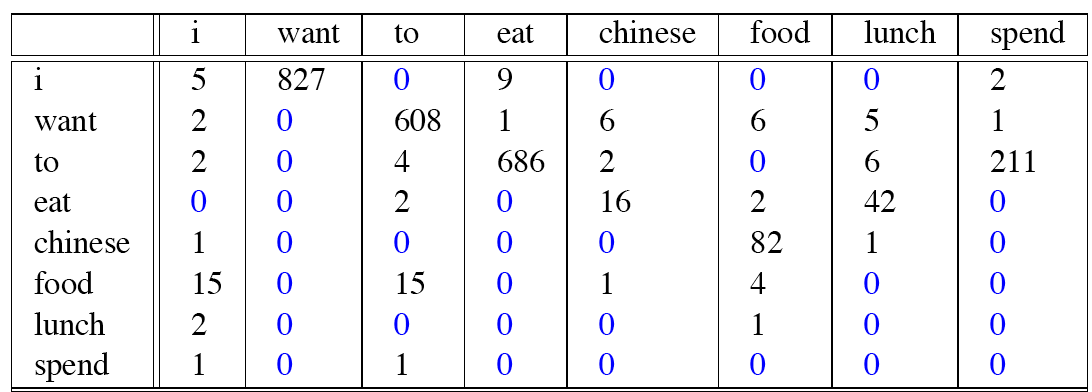
Raw Bigram Counts: 9222 Sentences
Raw Bigram Counts: 9222 Sentences
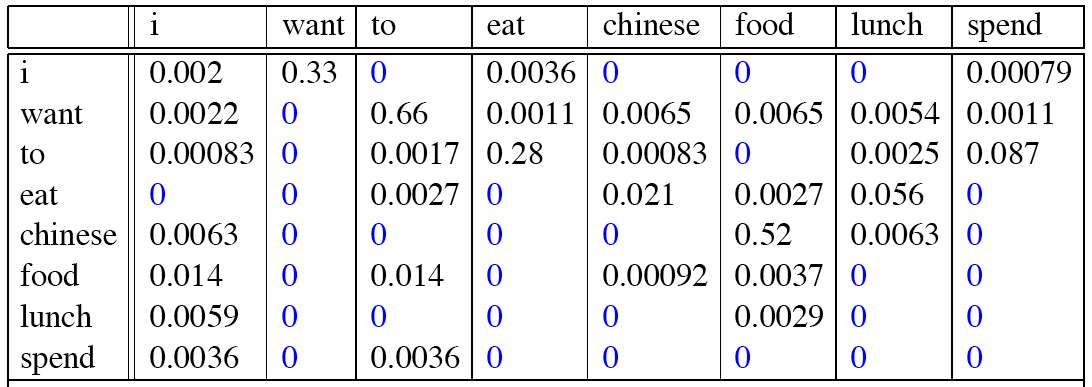
Raw Bigram Probabilities
Raw Bigram Probabilities

Bigram estimates of sentence probabilities
Bigram estimates of sentence probabilities
Dealing with scale in large n-grams
Dealing with scale in large n-grams
Log Probabilities: avoids underflow from multiplying many small numbers

Larger ngrams: 4-grams, 5-grams
Larger ngrams: 4-grams, 5-grams
N-grams from Corpus of Contemporary American English (COCA) 1 billion words (Davies 2020)
Google Web 5-grams (Franz and Brants 2006) 1 trillion words)
Infini-grams (∞-grams)
Infini-grams (∞-grams)
The biggest n-gram LM ever built to date.
Trained on 5 trillion tokens;
Contains about 5 quadrillion (or 5 thousand trillion, or 5x10^15) unique n-grams.
Larger-N is Better
Larger-N is Better
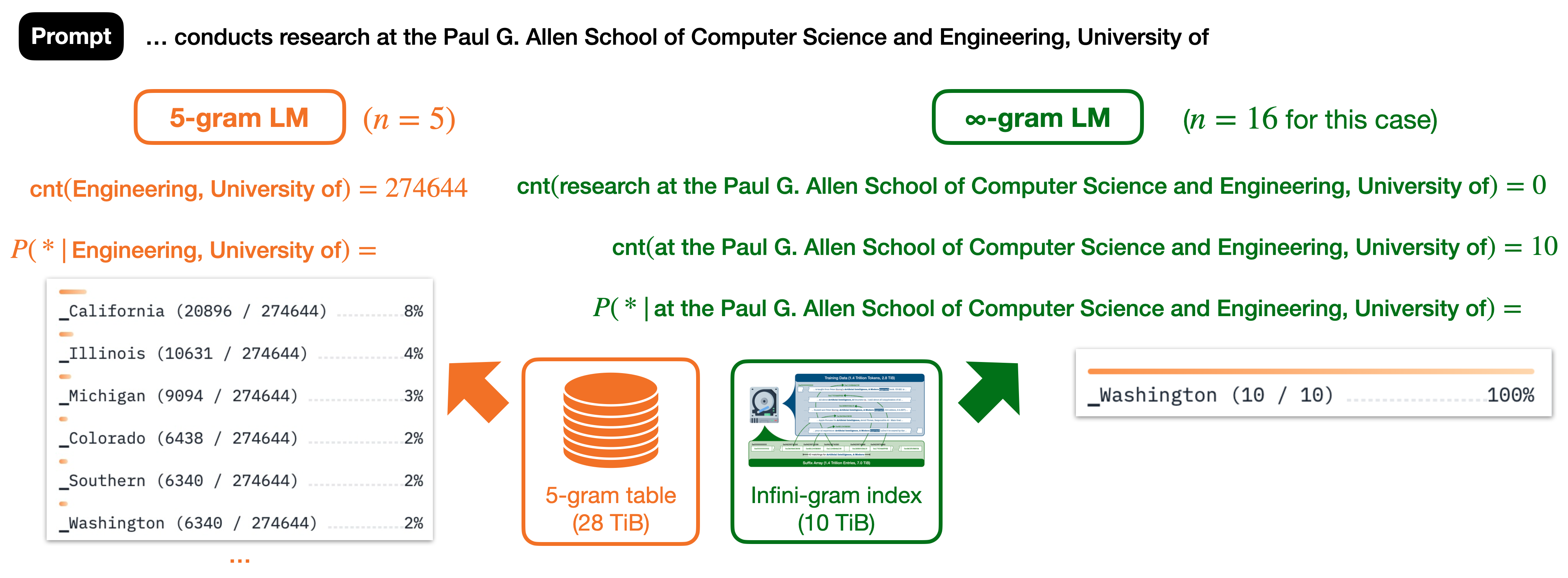
https://infini-gram.io/
But the world always surprise you
But the world always surprise you
Shakespeare Corpus: 884,647 words , voc size =29,066;
Shakespeare produced 300,000 bigram types out of 844 million possible bigrams;
So 99.96% of the possible bigrams were never seen in the corpus ;
That sparsity is even worse for 4-grams;
But you may see them in applications.
2.1 Statistical Language Modeling 2.1.3 Generalization to Unseen Words
2.1 Statistical Language Modeling 2.1.3 Generalization to Unseen Words
Zero Probability Problem
Zero Probability Problem
Training:
… ate lunch
… ate dinner
… ate a
… ate the
Application: Probability
Application: Generation
Cannot generate breakfast
Smoothing
Smoothing
We have sparse statistics
allegations
reports
claims
attack
request
man
outcome
…
allegations
attack
man
outcome
…
allegations
reports
claims
request
Steal probability mass to generalize better
Add-one Estimation (Laplace smoothing)
Add-one Estimation (Laplace smoothing)
Pretend we saw each word one more time than we did
Just add one to all the counts!
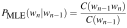
MLE estimate:
Add-1 estimate:

Backoff and Interpolation
Backoff and Interpolation
More context length results in more Sparsity;
Less context reduces the Zero probability problem;
Condition on less context for contexts you know less about
Backoff:
use trigram if you have good evidence,
otherwise bigram, otherwise unigram
Interpolation:
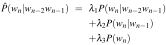
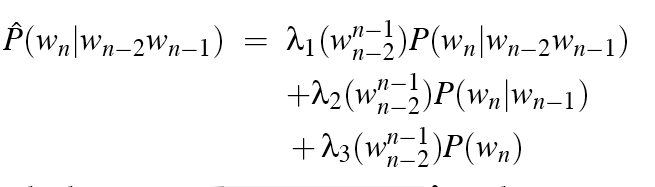
mix unigram, bigram, trigram
Interpolation works better
Linear Interpolation
Linear Interpolation
Simple interpolation
Lambdas conditional on context:

Backoff
Backoff
Suppose you want:
If the trigram probability is 0, use the bigram
If the bigram probability is 0, use the unigram
Complication: need to discount the higher-order ngram so probabilities don't sum higher than 1 (e.g., Katz backoff)
Stupid Backoff
Stupid Backoff
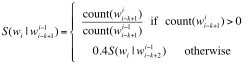
Backoff without discounting (not a true probability)

2.1 Statistical Language Modeling 2.1.4 Generation
2.1 Statistical Language Modeling 2.1.4 Generation
Generating Language using N-Gram Model
Generating Language using N-Gram Model
The Shannon (1948) Visualization Method
Unigram
Bigram
REPRESENTING AND SPEEDILY IS AN GOOD APT OR COME CAN DIFFERENT NATURAL HERE HE THE A IN CAME THE TO OF TO EXPERT GRAY COME TO FURNISHES THE LINE MESSAGE HAD BE THESE.
THE HEAD AND IN FRONTAL ATTACK ON AN ENGLISH WRITER THAT THE CHARACTER OF THIS POINT IS THEREFORE ANOTHER METHOD FOR THE LETTERS THAT THE TIME OF WHO EVER TOLD THE PROBLEM FOR AN UNEXPECTED.

How Shannon sampled those words in 1948
How Shannon sampled those words in 1948
"Open a book at random and select a letter at random on the page. This letter is recorded. The book is then opened to another page and one reads until this letter is encountered. The succeeding letter is then recorded. Turning to another page this second letter is searched for and the succeeding letter recorded, etc."

Sampling a word from a distribution
Sampling a word from a distribution
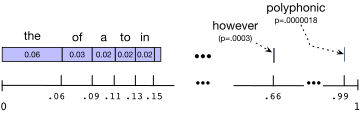
Visualizing Bigrams the Shannon Way
Visualizing Bigrams the Shannon Way
Choose a random bigram according to its probability ;
Now choose a random bigram according to its probability ;
And so on until we choose ;
Then string the words together
<s> I
I want
want to
to eat
eat Chinese
Chinese food
food </s>
I want to eat Chinese food
Approximating Shakespeare
Approximating Shakespeare
The Wall Street Journal
The Wall Street Journal
2.1 Statistical Language Modeling 2.1.5 Evaluation
2.1 Statistical Language Modeling 2.1.5 Evaluation
Evaluation of N-Gram Model
Evaluation of N-Gram Model
Extrinsic Evaluation:
Evaluate the model on external Task
Intrinsic Evaluation:
Directly measures language model performance at predicting words.
Doesn't necessarily correspond with real application performance
But gives us a single general metric for language models
Recall: Evaluating the Machine Learning Algorithms
Recall: Evaluating the Machine Learning Algorithms
Training Data: Used to train a machine given a hyper-parameter setting;
Development Data: Evaluate the trained machines to select the best hyper-parameter setting;
Testing Data: Evaluate the real performance of the selected machine;
Datasets should be with the same distribution with the final task;
Datasets should be no overlap. Do not test on training data!
Train Data
Dev Data
Test Data
What is a Good Language Model
What is a Good Language Model
A good LM prefers the next word that actually occurs;
Assign higher probability to “time” given “Once upon a _”;
Assign near zero probability to “and” given “Once upon a _”;
A good LM prefers “real” sentences:
Assign higher probability to “real” or “frequently observed” sentences
Assigns lower probability to “word salad” or “rarely observed” sentences
How to Evaluate N-Gram Model on a Dataset
How to Evaluate N-Gram Model on a Dataset
The test set represents the real sentences;
The best LM assigns high probability to the entire test set.
A good performance metric for LM:
When comparing two LMs, A and B
We compute and
The one with larger probability is better.
The Problem of Probability as a Metric
The Problem of Probability as a Metric
Probability of test set depends on the number of tokens in it:
Sentence probability gets smaller for longer sentences
Dataset probability gets smaller for larger dataset;
We’d prefer a metric that is per-word, normalized by length, so we could compare across texts of different lengths.
Perplexity
Perplexity
Perplexity is the inverse probability of the test set, normalized by the number of words;
Minimizing perplexity is the same as maximizing probability
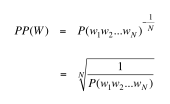
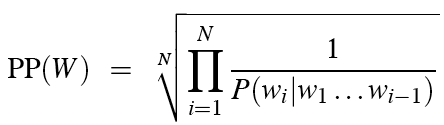
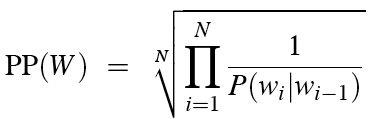
Bigrams:
Chain rule:
Perplexity for Sentence and Corpus
Perplexity for Sentence and Corpus
Compute the log likelihood for each sentence
Given a sentence , the log perplexity per word is:
Compute the perplexity for each sentence
Aggregate over all sentences in the corpus
Compute the total log-likelihood across all tokens then normalize by the total number of tokens:
whereis the total number of tokens in the dataset.
Empirical Studies
Empirical Studies
WSJ Dataset:
the Wall Street Journal newspaper
Training 38 million words, test 1.5 million words
Unigram | Bigram | Trigram | |
Perplexity | 962 | 170 | 109 |