Intelligent System

Natural Language
Understanding
Intelligent System
Mingming Sun
BIMSA
Intelligent System: Capabilities

Intelligent System: Capabilities
4.1 System Architecture
4.2 Perception and Generation
4.3 Memory and Knowledge
4.4 Action and Execution
4.5 Planning and Control
4.6 Coordination and Collaboration
4.7 Learning and Evaluation
4.1 System Architecture 4.1.1 General-Purpose AI
4.1 System Architecture 4.1.1 General-Purpose AI
Artificial General Intelligence
Artificial General Intelligence
Traditional AI: Solving specific problems in specific domain
General-purpose AI: transfer across tasks and domains
Capability dimensions, not an AGI test:
All-Tasks of one Modal such as Language in one Model
All-Modal in one Model
AGI: All-Tasks in One Modal
AGI: All-Tasks in One Modal
Task Specific Model:
Input Data → Model → Prediction
Just need to understand the mapping between data;
The model does not need to understand the task.
AGI Model:
Input Data + Task Description → Model → Prediction
Also need to understand the task.
AGI: All-Modal in One Model
AGI: All-Modal in One Model
Modal Specific Model:
Language: RNN/Transformer
Vision: CNN/Diffusion
Speech: HMM
Smell: ?
AGI Model:
Data in all modal → Model → Prediction
Mixed input of multi-modal data;
Unified model architecture.
4.1 System Architecture 4.1.2 Language Models as Components
4.1 System Architecture 4.1.2 Language Models as Components
Language Model Capabilities
Language Model Capabilities
Understand the Domain Input -- Language
Understand the Task -- Instructions
Output High Quality Response -- Human Preference
Learning Language Model Capabilities
Learning Language Model Capabilities
Pretraining: Understand the Language
Instruction Fine-tuning: Understand the Task
Reinforcement Learning with Human Feedback: Align with Human Preference
4.1 System Architecture 4.1.3 Agents and System Architecture
4.1 System Architecture 4.1.3 Agents and System Architecture
Intelligent System
Intelligent System
Till now, we talked about neural models.
An intelligent system also needs explicit task state:
Retain goals, observations, actions and outcomes;
Intelligent need to interact with outer-world:
Human can explore external knowledge;
Human can use existing tools;
Human can write code to control the objects in the world.
Real system/organizations involves interaction of multiple intelligent individuals.
Agent!
Agent!
Long-term goal of AI
Agent models connect observations, goals and actions.
“An agent is anything that can be viewed as perceiving its environment through sensors and acting upon that environment through actuators.” -- Russell & Norvig
An agent selects actions using observations and state;
An intelligent system may use one or multiple agents.
Agent
Agent
https://langchain-ai.github.io/langgraph/tutorials/workflows/#agent
Why Agents today?
Why Agents today?
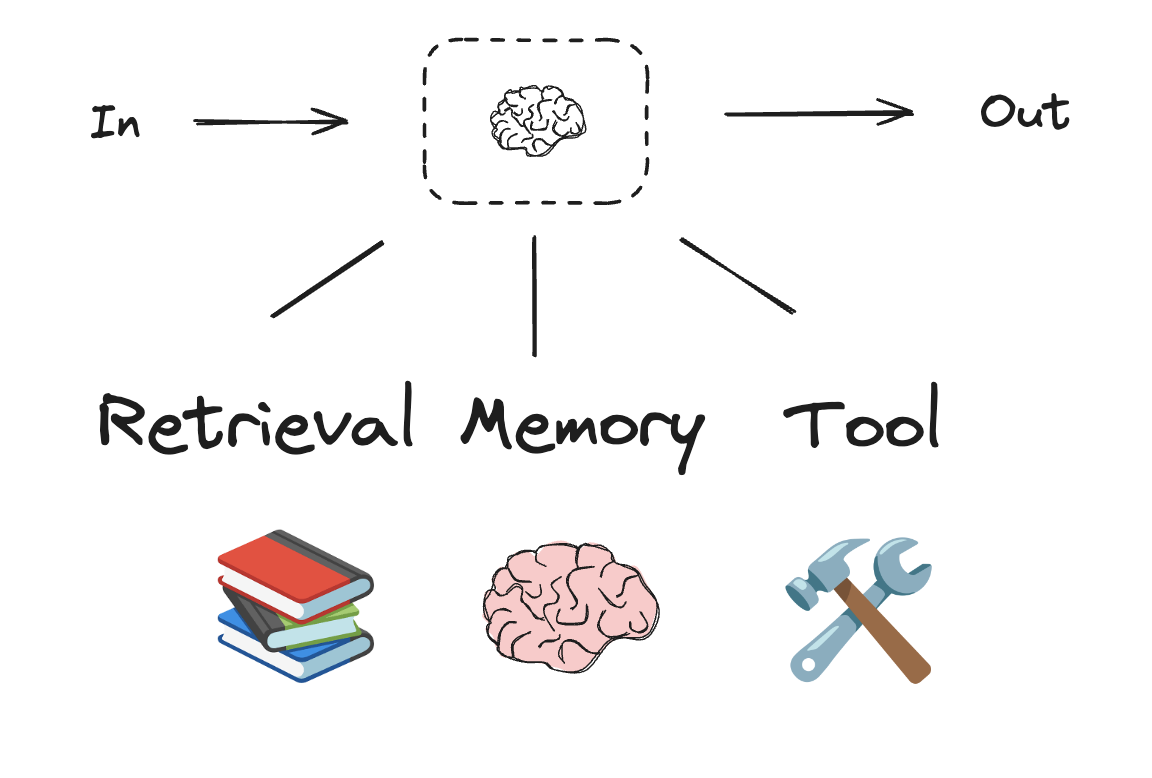
The unprecedented reasoning capabilities of large language models;
Progress in tool manipulation and environmental interaction;
Sophisticated memory architectures that support long-term experience accumulation.
Through collaboration, competition, and evolutionary dynamics, multi-agent systems can tackle highly complex tasks.