4.5 Planning and Control 4.5.1 Agent Control and Planning
The Agent Chooses the Next Operation
More thinking changes a candidate. An action may reveal new evidence or change the environment.
Updating context, beliefs or memory is not necessarily a parameter update.
Stop on a checked result, a justified handoff, a budget limit, or lack of a useful next action.
Ana: Think More, or Obtain New Evidence?
| Current gap | Useful next operation | What it can resolve |
|---|---|---|
| Policy translated incorrectly | Re-read policy; repair formalization | Semantic fidelity |
| Proof search unfinished | Allocate solver time | Formal consequence |
| Filing record unreliable | Query authoritative filing system | Evidence about F |
| Source conflict unresolved | Inspect provenance / request review | Dependence and factual dispute |
P(R ∣ O) = 11/21 concerns review priority. It does not authorize approval.
Choose an operation that addresses the actual uncertainty.
Case Study: Plan and Execute

Case Study: Plan and Execute
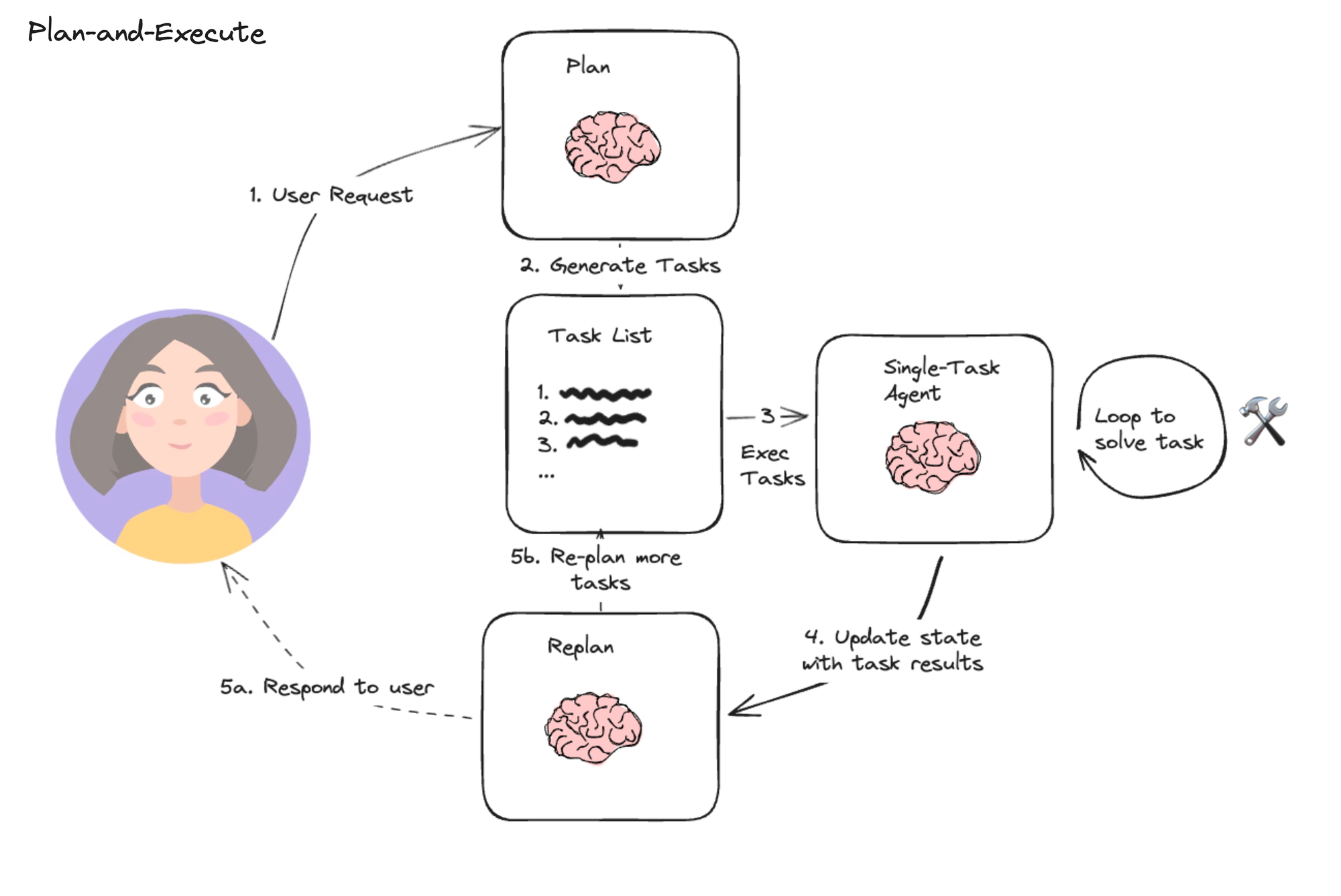
https://langchain-ai.github.io/langgraph/tutorials/plan-and-execute/plan-and-execute/
4.5 Planning and Control 4.5.2 System I / II in Agents

4.5 Planning and Control 4.5.2 System I / II in Agents
System I / II: An Operational Analogy
| Dimension | Direct response | Additional deliberation |
|---|---|---|
| Computation | Generate the answer directly | Reason, branch, revise or check |
| Useful when | Current policy and evidence suffice | Extra work can resolve uncertainty |
| Failure | Confident shortcut | Repeated error; unnecessary work |
| Measure | Success, actual compute, latency, evidence gained | |
Fast is not automatically shallow. Slow is not automatically correct.
These labels do not establish human-like mental systems inside an LLM.
No fixed “95% / 5%” allocation is assumed. A direct answer still requires neural computation.
Training, Decoding and Agent Control
| Layer | What changes? | Example |
|---|---|---|
| Training | Model parameters | SFT, RLVR, distillation |
| Decoding / inference | Candidate trajectory and budget | Sampling, search, reasoning tokens |
| Agent control | Next operation and environment state | Call a tool, observe, retry, stop |
A single model can support several modes. A search can repeatedly call a direct policy.
Nucleus sampling is a decoding choice, not a definition of System I.
Public o1 evidence does not establish a specific MCTS + CriticGPT architecture.
4.5 Planning and Control 4.5.3 Adaptive Reasoning
Recent Work: Different Control Problems
| Question | Representative work | What is controlled? |
|---|---|---|
| Expose two modes | Qwen3 (May 2025) | Prompt / template + budget |
| Learn when to use each | Thinkless; AdaptThink (2025) | Mode-selection policy |
| Predict required budget | Sonata (ICLR 2026) | Compute allocation before reasoning |
| Make future direct answers better | System 2 distillation (2024) | Parameters, using selected outputs |
| Check simple-task behavior | S1-Bench (IJCAI 2026) | Evaluation, not a controller |
Research selection checked on 2026-11-15. Versions and primary sources are recorded in the reading page.
Qwen3 Technical Report · Thinkless: LLM Learns When to Think · AdaptThink: Reasoning Models Can Learn When to Think · Adaptive Thinking: Large Language Models Know When to Think in Latent Space · Distilling System 2 into System 1 · Exploring the System 1 Thinking Capability of Large Reasoning Models
Qwen3: Make Both Modes Available
The May 2025 report provides a controllable interface.
Mode availability alone does not demonstrate an optimal learned router.
§4.3: thinking-mode fusion. §4.7: budget analysis. These claims refer to the original unified-mode version.
Thinkless: Learn the Mode Token
| Table 1 · 1.5B | Baseline → Thinkless accuracy | Mean response tokens |
|---|---|---|
| GSM8K | 83.47% → 84.18% | 1919 → 624 |
| MATH-500 | 86.08% → 81.84% | 5675 → 2555 |
Token savings can accompany an accuracy loss. Thinking frequency, token count and wall time are different metrics.
AdaptThink: Prefer Direct Answers Under a Constraint
Cold start: a long-thinking model may never sample direct answers without explicit exploration.
Importance sampling: correct for the sampling distribution while learning from both modes.
The performance constraint is an optimization target—not a proof that every future answer is correct.
AdaptThink: Quality and Cost Together
DeepSeek-R1-Distill-Qwen-1.5B · original Thinking → AdaptThink · Table 1
| Dataset | Accuracy (%) | Response tokens | NoThinking share |
|---|---|---|---|
| GSM8K | 79.0 → 83.1 | 978 → 480 | 86.9% |
| MATH500 | 80.6 → 82.0 | 4887 → 1782 | 76.8% |
| AIME 2024 | 29.4 → 31.0 | 12073 → 6679 | 40.4% |
Three-dataset macro average: +2.4 pp accuracy; −53.0% response length.
16K evaluation context; temperature 0.6. AIME: 16 samples per problem, averaged—not best-of-16. Token reduction is not measured wall-clock speedup.
Sonata: Predict a Budget Before Thinking
Self-consistency is a proxy for thinking need, not a truth certificate.
“Latent space” here supplies features to a budget predictor. It does not mean all reasoning becomes a Coconut-style latent chain.
Sonata: What the 2026 Evidence Supports
Reported in ICLR 2026 proceedings
20–60% fewer thinking tokens at the same accuracy across reported model / task settings.
Models include Qwen3-8B / 32B, GPT-OSS-120B, Qwen3-235B-A22B.
Read the boundary
Tasks include AIME25, GSM8K, MATH500, GPQA and LiveCodeBench.
Not a universal per-query guarantee.
Not a tool-use success benchmark.
Not the same as measured latency.
Evaluate calibration cost, routing overhead, difficult-tail failures and actual task quality.
Version frozen to the conference proceedings; later author summaries report different experiment ranges.